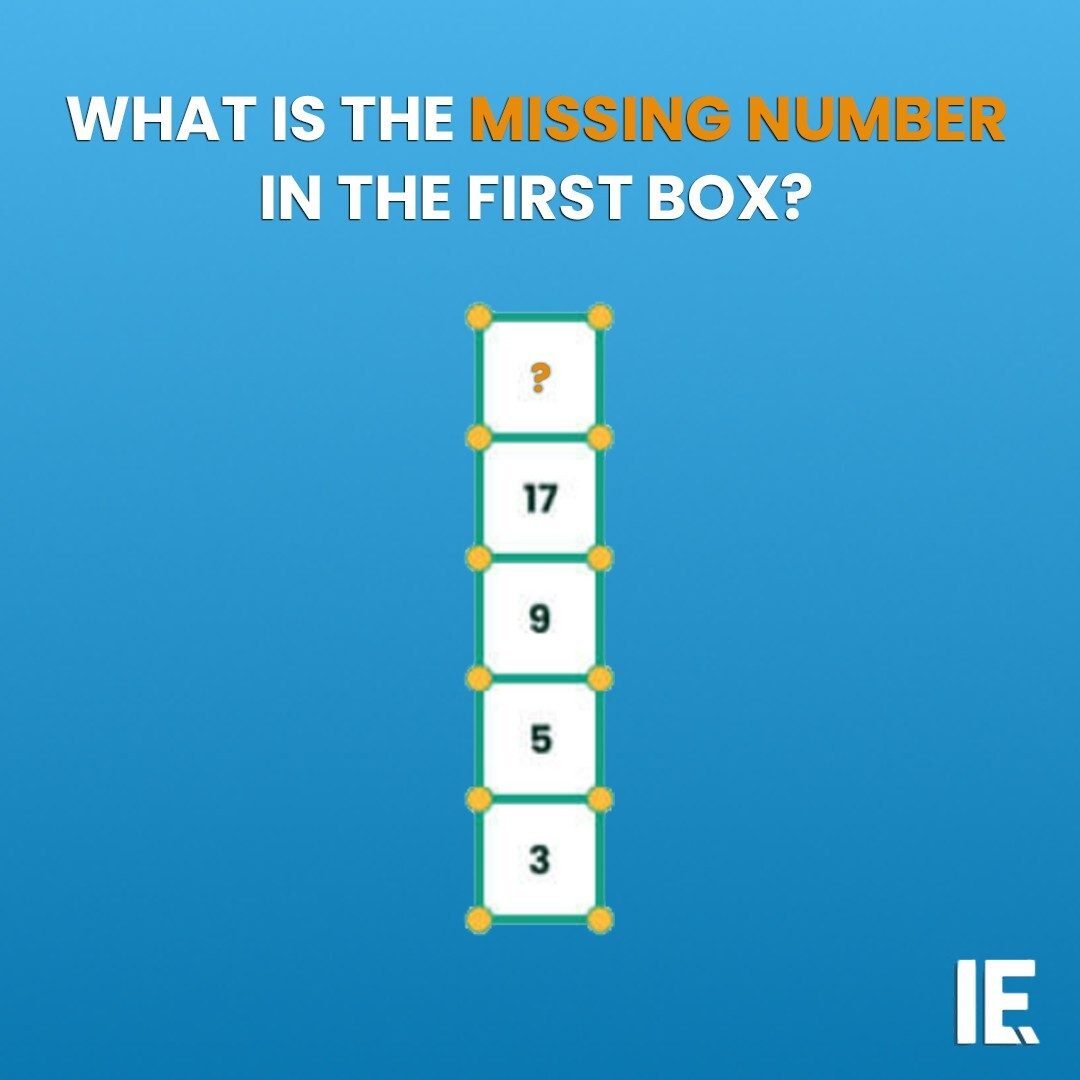
Solving the Missing Number Puzzle
There's a sequence hidden within a set of boxes, and the challenge is to find the missing number in the top box. Puzzles like this one are a great way to exercise your logical thinking and problem-solving skills. Let's dive into the puzzle and explore how to tackle it.
Why This Matters
Engaging with puzzles like this one can sharpen your mind and improve your ability to recognize patterns. Whether you're a student, a professional, or just someone who enjoys a good mental challenge, these brain teasers offer a fun way to stay sharp.
The Puzzle Breakdown
The puzzle consists of a sequence of boxes with numbers. The numbers provided are 17, 9, 5, and 3. The task is to identify the missing number in the first box. Let's break down the steps to solve this type of puzzle.
First, observe the sequence of numbers: 17, 9, 5, and 3. Notice that each number appears to decrease. This suggests that the sequence might be a decreasing arithmetic sequence, where each term is obtained by subtracting a constant difference from the previous term.
Let's denote the missing number in the first box as ( x ). The sequence would then look like this: ( x, 17, 9, 5, 3 ).
Identifying the Pattern
To find the common difference, we can subtract consecutive terms:
- ( 17 - 9 = 8 )
- ( 9 - 5 = 4 )
- ( 5 - 3 = 2 )
However, the differences are not consistent, which suggests that the sequence might not be a simple arithmetic sequence. Let's consider another approach.
Exploring Alternative Patterns
Sometimes, puzzles involve more complex patterns. Let's try a different method. We can look for a relationship between the terms. One common strategy is to check if the numbers are related through division or multiplication.
- ( 17 \div 9 \approx 1.89 )
- ( 9 \div 5 = 1.8 )
- ( 5 \div 3 \approx 1.67 )
The division results are not consistent, so this approach doesn't seem to work either.
A Different Approach
Given that the sequence isn't immediately obvious, it might involve a more complex pattern. Let's consider the possibility of a geometric sequence or a sequence involving subtraction with a varying difference.
Geometric Sequence
A geometric sequence involves multiplying each term by a constant ratio. Let's check if this applies:
- ( 17 \div 9 = 1.89 )
- ( 9 \div 5 = 1.8 )
- ( 5 \div 3 = 1.67 )
The ratios are not consistent, so it's not a geometric sequence.
Varying Difference
Let's try to find a pattern in the differences:
- ( 17 - 9 = 8 )
- ( 9 - 5 = 4 )
- ( 5 - 3 = 2 )
The differences are decreasing by 4 each time. If this pattern holds, we can extend it to find the missing number. The difference before 8 should be 12 (since 8 - 4 = 4, and 4 - 2 = 2).
Now, we can find the missing number by adding 12 to the second number in the sequence:
- ( 17 + 12 = 29 )
So, the missing number in the first box is 29.
Practical Tips
When solving puzzles like this, it's important to:
- Observe the Sequence: Carefully note down the given numbers and look for any obvious patterns.
- Try Different Approaches: If a simple arithmetic or geometric sequence doesn't work, consider more complex patterns or relationships.
- Check for Consistency: Ensure that the differences or ratios are consistent throughout the sequence.
- Experiment with Calculations: Use addition, subtraction, multiplication, and division to see if any pattern emerges.
Important Takeaways
- Patterns Matter: Recognizing patterns is key to solving these types of puzzles. Look for both simple and complex relationships between the numbers.
- Be Systematic: Approach the puzzle methodically, trying different strategies until you find the one that works.
- Practice Makes Perfect: The more you engage with these types of puzzles, the better you'll get at spotting patterns and solving them.
Conclusion
Finding the missing number in a sequence of boxes is a fun and challenging way to exercise your logical thinking. By breaking down the problem, exploring different patterns, and systematically working through the possibilities, you can solve even the most complex puzzles. Whether you're a student, a professional, or just someone who loves a good brain teaser, these types of challenges can help keep your mind sharp and your problem-solving skills honed.
Watch the Reel
Questions readers ask
How do I start solving a pattern recognition puzzle like this one?
Begin by examining the given numbers in the sequence: 17, 9, 5, and 3. Look for a relationship between consecutive numbers, such as addition, subtraction, multiplication, or division. Consider if the sequence might involve squares, cubes, or other mathematical operations.
What if I can't find an obvious pattern in the sequence?
If the pattern isn't immediately clear, try listing the differences between consecutive numbers or look for a more complex relationship, such as a quadratic or geometric progression. Sometimes, puzzles involve a combination of operations or a non-linear pattern.
Are there any tips for improving my pattern recognition skills?
Practice with various types of sequences and puzzles to train your brain to recognize different patterns. Start with simple arithmetic progressions and gradually move to more complex challenges. Engage with visual puzzles and brain teasers regularly to enhance your problem-solving abilities.
How can solving these puzzles benefit me in real life?
Solve these puzzles to sharpen your analytical and logical thinking, which can be beneficial in various fields. Engineers, for instance, may encounter similar challenges in their work, making these puzzles a valuable exercise for problem-solving and critical thinking.
What should I do if I'm still stuck on finding the missing number?
If you're stuck, take a break and come back to the puzzle with fresh eyes. Sometimes, stepping away can provide a new perspective. You can also try solving similar puzzles to build your skills and return to the original challenge later.
Can these puzzles be solved using a formula, or is it always about pattern recognition?
While some sequences may follow a specific formula, many rely on pattern recognition. It's essential to develop both skills—identifying formulas and recognizing patterns—to tackle a wide range of logic puzzles effectively. Start by looking for a formula or rule that applies to the given numbers.
How can I create my own sequence puzzles to challenge others?
To create your own sequence puzzle, start with a clear pattern or rule in mind. Generate a set of numbers based on that rule and leave one number out. Make sure the pattern is solvable but not too obvious. Test your puzzle with friends or family to ensure it's challenging and fun.
Related deep dives
Similar reads based on topic and creator.


Recent articles
Fresh deep dives from the latest Reels we unpacked.




Comments
Be the first to comment.