Probability Puzzle: Breaking Down the Math
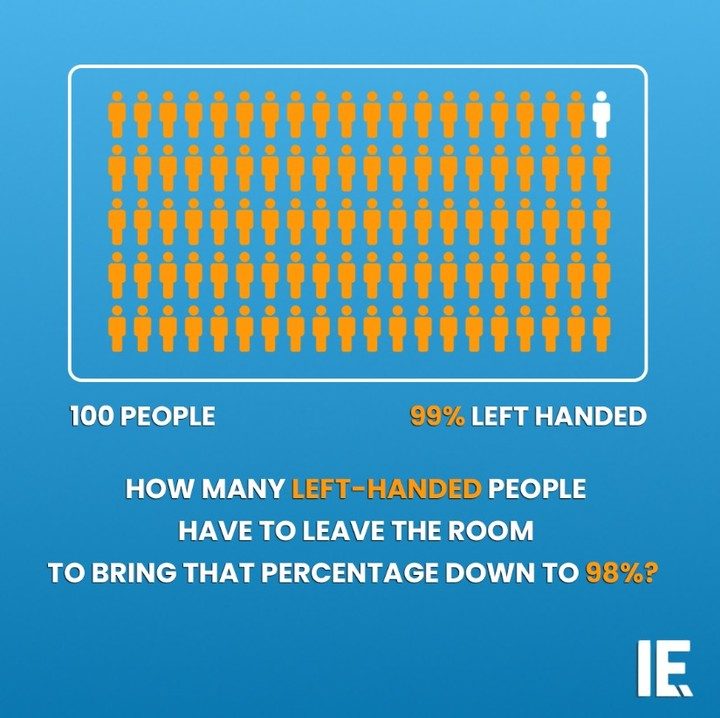
The puzzle: If 99 out of 100 people are left-handed, how many need to leave to make the percentage 98%? This seemingly simple question is a classic example of how our intuitive sense of probability can mislead us.
Context / Why This Matters
This puzzle isn't just a brain teaser. It illustrates a common pitfall in probability and statistics. Understanding this concept can help anyone make better sense of data, from election results to scientific studies. It's a practical tool that can help you think more critically about the world.
Main Discussion
The Initial Setup
Let's break down the initial conditions. You have a group of 100 people, and 99 of them are left-handed. This means that 99% of the group is left-handed, and 1% is right-handed. The goal is to determine how many left-handed people need to leave to reduce the left-handed percentage to 98%.
The Intuitive (but Incorrect) Solution
Many people initially think that one left-handed person needs to leave to achieve the 98% threshold. However, this is not the case. Let's see why.
The Correct Approach
To solve this, we need to change the percentage of left-handed people in the room. Initially, there is 1 right-handed person out of 100, making 1% of the group. If we want the percentage of left-handed people to be 98%, then there should be 2% right-handed people.
So, if the number of right-handed people should be 2% of the group, we need to determine the new total number of people in the room. If 1 person is right-handed and that represents 2% of the group, then the group must have 50 people in total.
Calculating the Number of People to Leave
Out of 100 people, we need to reduce the total count to 50. This means 50 people need to leave. This includes 49 left-handed people and 1 right-handed person. When this happens, the 1 right-handed person will constitute 2% of the group, and the 49 left-handed people will constitute 98%.
Therefore, 49 left-handed people need to leave the room to achieve the desired 98% left-handed ratio.
Visualizing the Process
Let's visualize it:
-
Initial State:
- Total People: 100
- Left-Handed People: 99
- Right-Handed People: 1
-
Final State:
- Total People: 50
- Left-Handed People: 49
- Right-Handed People: 1
By reducing the total number of people to 50, the left-handed percentage drops to 98%.
Understanding the Counterintuitive Result
The counterintuitive part of this puzzle lies in the fact that the percentage of left-handed people decreases by reducing the number of left-handed individuals. This demonstrates how percentages can change dramatically with changes in the total population, even when the absolute number of individuals in a subset changes modestly.
Practical Tips
Use Absolute Numbers
Whenever you encounter percentage-based problems, try converting the percentages into absolute numbers. This can make the problem easier to visualize and solve.
Consider the Total Population
Changes in percentages are highly dependent on the total population. Be mindful of how changes in the total number of people affect the percentages.
Double-Check Your Assumptions
Percentage problems can often trick you into making incorrect assumptions. Always double-check your math and assumptions to ensure accuracy.
Important Takeaways
In probability and statistics, the intuitive answer is often wrong. The human brain is not naturally wired to handle percentages and probabilities well. By visualizing the problem and breaking it down into absolute numbers, you can avoid common pitfalls.
Conclusion
The probability puzzle of reducing the percentage of left-handed people from 99% to 98% in a group of 100 is a classic example of how our intuition can mislead us. By carefully examining the numbers and understanding the relationship between absolute numbers and percentages, you can solve this and similar puzzles. This practical knowledge can be applied to a wide range of real-world scenarios, helping to make better decisions and avoid common errors.
Watch the Reel
Questions readers ask
How many left-handed individuals need to leave to reduce the left-handed percentage to 98%?
To reduce the left-handed percentage from 99% to 98%, you need to change the total number of people in the room so that the remaining left-handed individuals constitute 98% of the total. This means 98 left-handed people should remain, so 1 left-handed person needs to leave, but this alone isn't enough. You also need to reduce the total number of people in the room to 99, so the right-handed person needs to leave as well.
What is the logic behind the left-handed room puzzle?
The left-handed room puzzle challenges our intuitive understanding of percentages. It shows that simply removing a left-handed person doesn't achieve the desired percentage change because it also changes the total number of people. The key is to adjust both the number of left-handed individuals and the total number of people in the room.
Can swapping a left-handed person with a right-handed person solve the puzzle?
Swapping one left handed person for a right-handed person changes the total number of people in the room. This changes the percentage of left-handed people. In this case, you would have 99 left-handed people and 1 right-handed person. But you only need to reduce the number of left-handed people to one less than 99, so there is no need for a swap.
Why doesn't removing one left-handed person work in this puzzle?
Removing one left-handed person from the room would leave 98 left-handed people and 1 right-handed person, making the total 99. This would indeed make 98% of the people left-handed, but it also reduces the total number of people to 99, and the percentage in the room would be 98%.
How can understanding this puzzle help in real-life situations?
This puzzle highlights the importance of considering both parts and the whole when dealing with percentages. This concept is applicable in various real-life scenarios, such as analyzing survey results, interpreting scientific data, or making informed decisions based on statistical information.
What happens if more than one person leaves the room?
If more than one person leaves the room, the percentage of left-handed people will change. For example, if two left-handed people leave, you would have 97 left-handed people and 1 right-handed person, making the total 98. This would make 99% of the people left-handed, not 98%. The puzzle specifically asks for a reduction to 98%, so removing more than one person is not the correct approach.
Is there a formula to solve this type of puzzle?
While there isn't a one-size-fits-all formula, you can use a simple approach to solve this. Determine the desired percentage and the total number of people after the change. In this case, you want 98% of the people to be left-handed, so you need to have 98 left-handed people out of 100. This means 1 left-handed person needs to leave. You also need to reduce the total number of people to 99, so the right-handed person needs to leave as well.
Related deep dives
Similar reads based on topic and creator.

Recent articles
Fresh deep dives from the latest Reels we unpacked.




Comments
Be the first to comment.