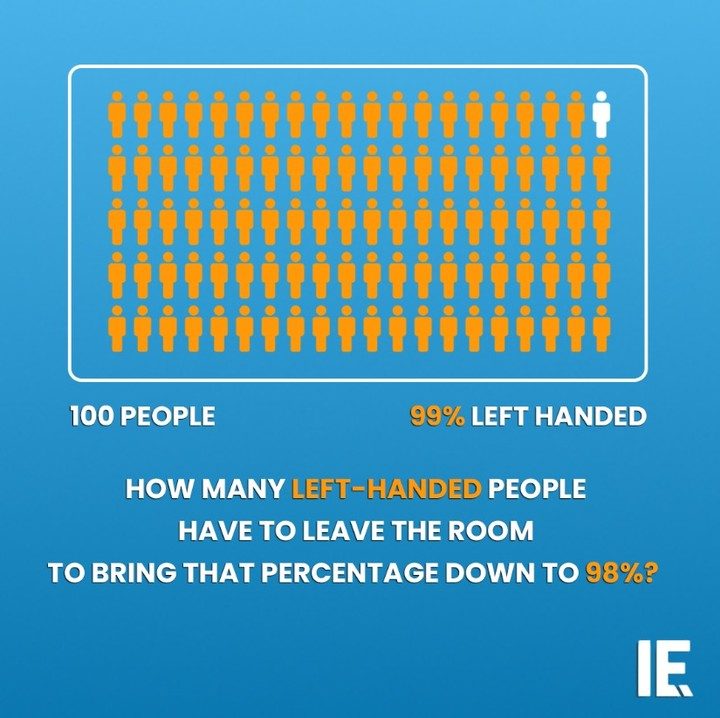
The Intriguing Left-Handed People Puzzle
Let's dive into a fascinating probability puzzle. In a room of 100 people, 99 are left-handed. How many left-handed people need to leave to reduce the percentage of left-handed people to 98%? This might sound deceptively simple, but it certainly poses an intriguing challenge to the brain.
Context
Understanding percentages and probabilities is crucial in various fields, from engineering and statistics to everyday decision-making. This puzzle helps sharpen analytical skills and demonstrates how small changes can significantly affect percentages. It's a great exercise to illustrate how probabilities work in practical scenarios.
Calculating the Change
To solve this puzzle, we need to understand the impact of removing left-handed individuals from the total count.
First, let's break down the initial conditions:
- The room has 100 people.
- 99 of these people are left-handed.
- This makes the percentage of left-handed people 99%.
When trying to reduce the percentage of left-handed people to 98%, we need to re-calculate the percentages after a number of left-handed people leave. Start by setting up the equation for the new percentage.
Initial Setup
Let ( L ) be the number of left-handed people who leave. The new total number of people in the room will be ( 100 - L ). The number of left-handed people remaining in the room will be ( 99 - L ).
The new percentage of left-handed people will be: [ \frac{99 - L}{100 - L} = 0.98 ]
Solving the Equation
We solve for ( L ): [ 99 - L = 0.98 \times (100 - L) ] [ 99 - L = 98 - 0.98L ] [ 99 - 98 = 0.98L - L ] [ 1 = 0.02L ] [ L = \frac{1}{0.02} ] [ L = 50 ]
So, 50 left-handed people need to leave the room to reduce the percentage of left-handed people to 98%. While this might seem counterintuitive, it underscores the importance of understanding how percentages and probabilities work in different contexts.
Practical Tips for Solving Percentage Problems
Step-by-Step Approach
- Identify the Total and the Subset: Clearly identify the total number of items and the subset you are interested in. In this case, the total is 100 people, and the subset is 99 left-handed people.
- Set Up the Equation: Formulate an equation based on the desired percentage change. This involves understanding how removing a subset affects the overall percentage.
- Solve for the Unknown: Use algebraic methods to solve for the number of items that need to be removed. This often involves setting up a proportion and solving for the variable.
Double-Check Your Work
Always double-check your calculations to ensure the logic holds. Sometimes, the correct answer might not be immediately intuitive, so verifying your steps can prevent errors.
Important Takeaways
Understanding Percentages and Probabilities
This puzzle highlights the importance of understanding how percentages and probabilities work. Small changes in the number of items can have significant impacts on the overall percentage.
Real-World Applications
The concepts demonstrated in this puzzle are applicable in many real-world scenarios, from statistical analyses to decision-making in various fields. Understanding these principles can enhance analytical skills and problem-solving abilities.
Critical Thinking
Engaging with puzzles like this one encourages critical thinking and analytical reasoning. It's a great exercise for anyone looking to sharpen their mental acuity and logical thinking skills.
Conclusion
This left-handed people puzzle is a compelling example of how probabilities and percentages work in practice. By breaking down the problem and solving it step-by-step, we gain a deeper understanding of the underlying principles. This kind of puzzle not only challenges the mind but also provides valuable insights into the workings of probabilities and percentages in various contexts.
Watch the Reel
Questions readers ask
How does the left-handed percentage change when left-handed individuals leave the room?
When left-handed individuals leave a room, the total number of people in the room decreases. This change can significantly impact the percentage of left-handed people, especially when the initial percentage is high, as in this puzzle.
What is the formula to calculate the new percentage of left-handed people after some leave?
To find the new percentage, divide the number of remaining left-handed people by the new total number of people in the room, then multiply by 100. For example, if there are 95 left-handed people remaining out of 100 total, the new percentage is (95/100)*100 = 95%.
Why is it important to understand the left-handed percentage puzzle?
Understanding this puzzle helps in grasping the underlying principles of percentages and probabilities. It shows how a small change in the number of left-handed individuals can lead to a significant shift in the overall percentage.
How many left-handed people need to leave to achieve a 98% left-handed percentage?
To reduce the left-handed percentage to 98%, only one left-handed person needs to leave. This is because 98% of 100 people is 98 people, so having 98 left-handed people out of 100 total gives the desired percentage.
What happens to the percentage if a right-handed person leaves instead of a left-handed person?
If a right-handed person leaves, the total number of people decreases, but the number of left-handed people remains the same. This change increases the percentage of left-handed people. For instance, if one right-handed person leaves, the percentage of left-handed people becomes 99/99 * 100 = 100%.
Can this left-handed percentage puzzle be applied to real-life scenarios?
Yes, this puzzle can be applied to various real-life scenarios. For example, understanding how changes in population demographics can affect percentages is useful in fields like statistics, engineering, and even everyday decision-making. It illustrates how small changes can significantly impact overall percentages.
What is the logic behind the left-handed percentage puzzle?
The logic behind this puzzle involves understanding how percentages are calculated and how they change with changes in the population. It demonstrates that even small changes in the number of individuals can lead to significant shifts in percentages, especially when the initial percentage is high.
Related deep dives
Similar reads based on topic and creator.

Recent articles
Fresh deep dives from the latest Reels we unpacked.




Comments
Be the first to comment.