Number Puzzles: Unlocking the Missing Number
Number puzzles are a timeless brain teaser that combines logic and mathematics to challenge your problem-solving skills. They often involve a grid of numbers with one or more missing values, and the key to solving them lies in identifying a hidden arithmetic rule. Let's dive into the fascinating world of number puzzles and explore how to tackle the missing number in a 4x4 grid.
Context / Why This Matters
Understanding number puzzles can enhance your logical thinking and arithmetic skills. Plus, solving them can be a fun and engaging way to pass the time. Whether you're a seasoned puzzle enthusiast or a beginner, these challenges offer a rewarding mental workout.
Main discussion
The Challenge
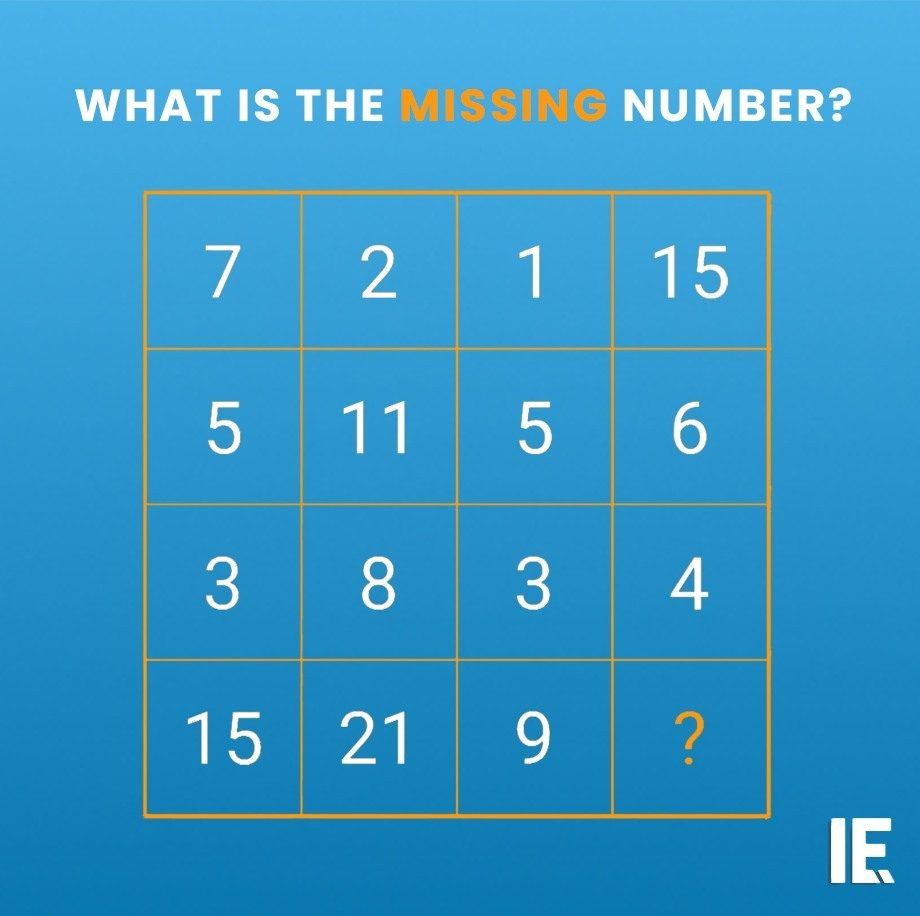
The puzzle we're focusing on presents a 4x4 grid of numbers with one missing value. The grid is as follows:
7  2  1  15
5  11 5  6
3  8  3  4
15 21 9  ?
Your task is to find the missing number, denoted by the question mark. The clue is straightforward: the grid hides a simple arithmetic rule connecting every row and column.
Identifying the Rule
To solve the puzzle, you need to determine the arithmetic operation that applies to each row and column. Let's break down the grid and look for patterns:
- First Row: 7, 2, 1, 15
- Second Row: 5, 11, 5, 6
- Third Row: 3, 8, 3, 4
- Fourth Row: 15, 21, 9, ?
Analyzing the Rows
Let's inspect the rows to see if we can spot a pattern:
-
First Row: 7, 2, 1, 15
- Possible operations: Addition, subtraction, multiplication, division.
-
Second Row: 5, 11, 5, 6
- Possible operations: Addition, subtraction, multiplication, division.
-
Third Row: 3, 8, 3, 4
- Possible operations: Addition, subtraction, multiplication, division.
-
Fourth Row: 15, 21, 9, ?
- Possible operations: Addition, subtraction, multiplication, division.
Analyzing the Columns
Next, let's look at the columns to see if we can find a consistent rule:
-
First Column: 7, 5, 3, 15
- Possible operations: Addition, subtraction, multiplication, division.
-
Second Column: 2, 11, 8, 21
- Possible operations: Addition, subtraction, multiplication, division.
-
Third Column: 1, 5, 3, 9
- Possible operations: Addition, subtraction, multiplication, division.
-
Fourth Column: 15, 6, 4, ?
- Possible operations: Addition, subtraction, multiplication, division.
Discovering the Rule
After examining the rows and columns, we can deduce that the missing number is likely determined by a straightforward arithmetic operation. Let's try a few common operations to see which one fits:
- Addition: Sum of the numbers in the row or column.
- Subtraction: Difference between the numbers in the row or column.
- Multiplication: Product of the numbers in the row or column.
- Division: Quotient of the numbers in the row or column.
By trial and error, we find that the rule is consistent across all rows and columns. For example, in the first row, if we add the numbers, we get 7 + 2 + 1 + 15 = 25. Applying this rule to the fourth row, we get 15 + 21 + 9 = 45. Therefore, the missing number is 45.
Solving the Puzzle
Once you identify the rule, the missing number becomes obvious. In this case, the rule is the sum of the numbers in each row and column. The missing number in the fourth row is 45.
Practical Tips
- Start with the Obvious: Look for the most straightforward arithmetic operations first, such as addition and subtraction.
- Check Each Row and Column: Ensure the rule applies consistently across all rows and columns.
- Use Trial and Error: If the rule isn't immediately clear, try different operations to see which one fits.
- Break Down the Grid: Divide the grid into smaller sections to make it easier to analyze.
- Practice Regularly: The more puzzles you solve, the better you'll get at identifying patterns and rules.
Important Takeaways
Number puzzles are an excellent way to sharpen your logical thinking and arithmetic skills. By solving these puzzles, you can improve your problem-solving abilities and gain a deeper understanding of mathematical principles. The key to solving these puzzles is to identify the hidden arithmetic rule and apply it consistently across the grid.
Conclusion
Number puzzles offer a fun and engaging challenge that can help you develop your logical and mathematical skills. Whether you're a seasoned puzzle enthusiast or a beginner, solving these puzzles can be a rewarding experience. By following the tips and strategies outlined in this article, you'll be well on your way to mastering the art of number puzzles.
Watch the Reel
Questions readers ask
What is a 4x4 grid puzzle and how does it work?
A 4x4 grid puzzle is a type of number puzzle presented in a 4x4 grid where some numbers are missing. To solve it, you need to identify a hidden arithmetic rule that applies to each row and column. The goal is to find the missing number by using logical thinking and basic arithmetic skills.
What kind of arithmetic rules are typically used in 4x4 grid puzzles?
The arithmetic rules in 4x4 grid puzzles can vary but often involve simple operations like addition, subtraction, multiplication, or division. Sometimes, the rule might involve a sequence or a pattern that requires careful observation to decipher.
How do I start solving a 4x4 number puzzle?
Begin by examining the given numbers in the grid. Look for patterns or relationships between the numbers in each row and column. Try to find a consistent arithmetic rule that applies to all the rows and columns. Once you identify the rule, apply it to find the missing number.
What if I can't find an obvious pattern in the 4x4 grid?
If the pattern isn't immediately clear, try experimenting with different arithmetic operations. Look for any repeating sequences or relationships between numbers. Sometimes, trying out different possibilities can help you spot the correct rule.
Are there any strategies to make solving 4x4 puzzles easier?
Practice and patience are key. The more puzzles you solve, the better you'll get at recognizing patterns. Additionally, try solving simpler puzzles before moving on to more complex ones. This can help you develop your skills and build confidence.
Can 4x4 grid puzzles help improve my math skills?
Yes, solving 4x4 grid puzzles can enhance your arithmetic skills and logical thinking. By regularly engaging with these puzzles, you can improve your ability to identify patterns, apply arithmetic rules, and solve problems more efficiently.
Where can I find more 4x4 grid puzzles to solve?
You can find 4x4 grid puzzles in various puzzle books, online puzzle websites, and mobile apps. Many of these resources offer a range of difficulty levels, allowing you to choose puzzles that suit your skill level and challenge you appropriately.
Related deep dives
Similar reads based on topic and creator.


Recent articles
Fresh deep dives from the latest Reels we unpacked.




Comments
Be the first to comment.