Market Share of Soft Drinks
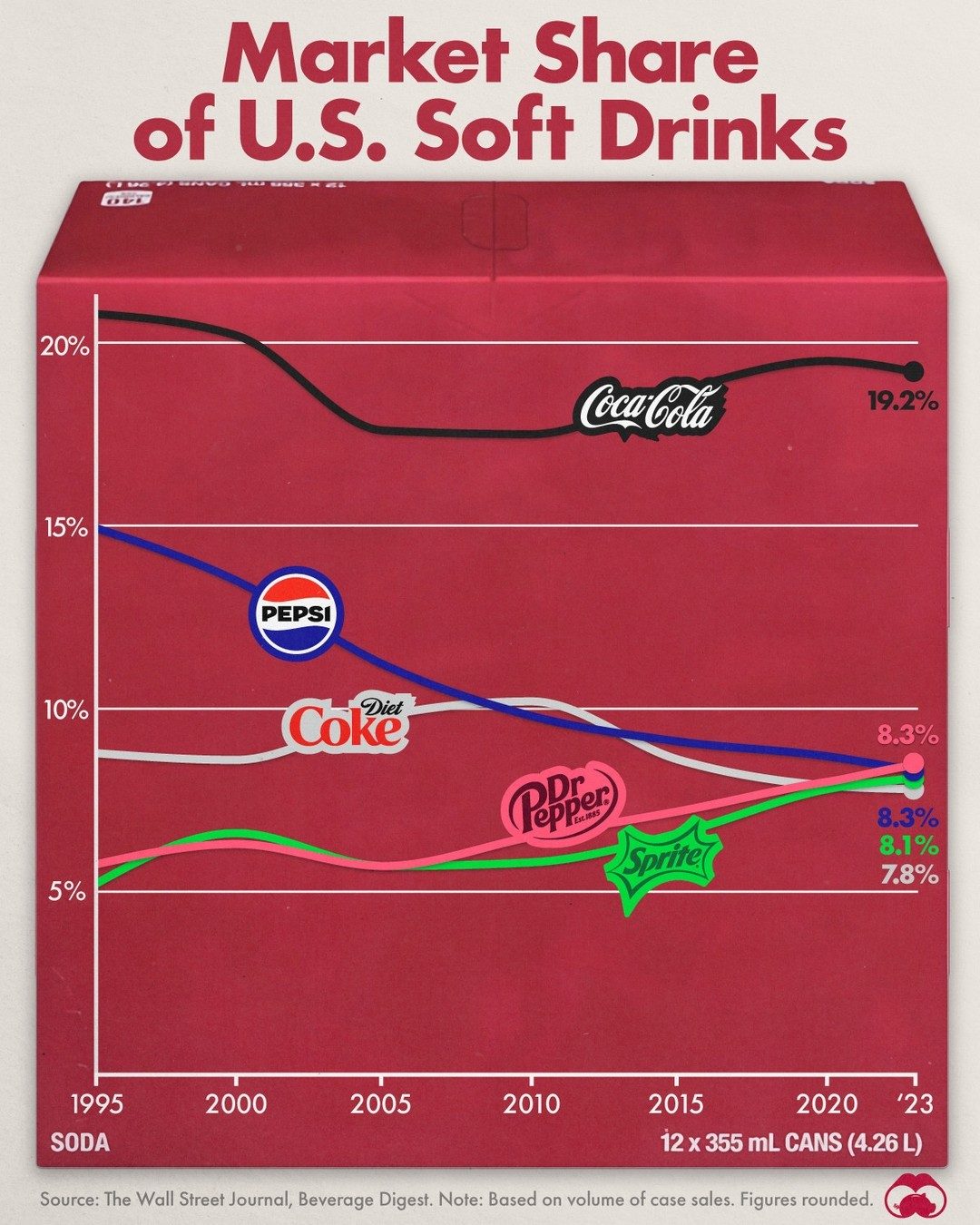
The market share of soft drinks in the United States has seen significant shifts over the past few decades. The infographic presents a visual overview of how the market share has evolved from 1995 to 2023, focusing on key brands such as Coca-Cola, Pepsi, Dr Pepper, and Sprite.
Why This Matters
Understanding the market dynamics of soft drinks is crucial for industry stakeholders, investors, and consumers alike. Trends in market share reflect changes in consumer preferences, marketing strategies, and competitive landscapes. The data compiled by Beverage Digest, as presented by The Wall Street Journal, provides valuable insights into these trends.
The Dominance of Coca-Cola
Consistent Market Leadership
Coca-Cola has maintained a dominant position in the U.S. soft drink market, holding between 17% and 20% of the market share since 1995. This consistency is a testament to Coca-Cola's strong brand loyalty, effective marketing, and extensive distribution network. The steady market share indicates that Coca-Cola has been able to adapt to changing consumer tastes and preferences over the years.
The Evolution of Market Share
The market share of Coca-Cola has shown remarkable stability, even as other brands have experienced fluctuations. This stability can be attributed to several factors, including Coca-Cola's ability to innovate and introduce new products, as well as its strong presence in various distribution channels. The brand's marketing efforts have also played a crucial role in maintaining its market leadership.
The Rise and Fall of Pepsi
Initial Dominance
Pepsi was a strong competitor in the 1990s, holding a significant 15% market share. Pepsi's aggressive marketing campaigns and product innovations helped it gain a substantial following, challenging Coca-Cola's dominance. However, over the years, Pepsi's market share has declined, reaching 8.3% in 2023.
Factors Contributing to the Decline
Several factors have contributed to Pepsi's decline in market share. The increasing health consciousness among consumers has led to a rise in demand for healthier beverages, including diet sodas and non-carbonated drinks. This shift has impacted Pepsi's traditional soda market. Additionally, fierce competition from other brands and changing consumer preferences have also played a role in Pepsi's declining market share.
Dr Pepper and Sprite: Smaller but Steady
Market Position
Dr Pepper and Sprite have consistently maintained a smaller but stable market share. As of 2023, Dr Pepper holds 8.1% of the market, while Sprite has 7.8%. Both brands have been able to carve out a niche for themselves, appealing to specific consumer segments. Dr Pepper's unique flavor and Sprite's association with lemon-lime sodas have helped them maintain their market positions.
Strategies for Success
Dr Pepper and Sprite have employed various strategies to maintain their market share. These include targeted marketing campaigns, product innovations, and partnerships with popular cultural events. For example, Dr Pepper has leveraged its association with events like NASCAR and college sports to appeal to younger consumers.
The Role of Data Visualization
The infographic effectively illustrates the market share dynamics of the U.S. soft drink industry. By presenting the data in a visual format, it provides a clear and concise overview of the changes in market share over time. This visualization helps stakeholders understand the competitive landscape and make informed decisions.
Key Insights from the Infographic
The infographic highlights several key insights:
- Coca-Cola's consistent dominance in the market.
- Pepsi's decline from 15% to 8.3% market share over the years.
- Dr Pepper and Sprite's relatively stable market shares.
- The infographic also underscores the importance of data in understanding market trends.
Practical Tips for Industry Players
Leveraging Data
For industry players, leveraging data is crucial for understanding market trends and making informed decisions. Regularly analyzing market share data can help identify opportunities and threats, allowing companies to adjust their strategies accordingly.
Strong Branding and Marketing
Branding and marketing play a vital role in maintaining market share. Companies should focus on building strong brand loyalty and implementing effective marketing campaigns to appeal to different consumer segments. Innovating and introducing new products can also help attract new customers.
Adaptation to Consumer Preferences
Adapting to changing consumer preferences is essential for long-term success. The increasing demand for healthier beverages highlights the need for companies to innovate and offer healthier alternatives. Companies should also consider the preferences of younger consumers, who are increasingly health-conscious.
Important Takeaways
Coca-Cola's Dominance
Coca-Cola's consistent market leadership underscores the importance of brand loyalty, effective marketing, and a strong distribution network. The company has been able to adapt to changing consumer preferences and maintain its dominant position.
Pepsi's Challenges
Pepsi's decline in market share highlights the challenges posed by increasing health consciousness and fierce competition. Companies need to innovate and adapt to changing consumer preferences to maintain their market positions.
Consistent Performers
Dr Pepper and Sprite's stable market shares demonstrate the value of targeted marketing and product innovation. These brands have been able to carve out a niche for themselves, appealing to specific consumer segments.
The Power of Data
Data visualization, as seen in the infographic, provides valuable insights into market trends. By leveraging data, companies can make informed decisions and stay ahead of the competition.
Conclusion
The market share of soft drinks in the United States has undergone significant changes over the past few decades. Coca-Cola's consistent dominance, Pepsi's decline, and the stable performance of Dr Pepper and Sprite highlight the dynamics of the soft drink industry. Understanding these trends is crucial for industry players to make informed decisions and adapt to changing consumer preferences. By leveraging data, focusing on branding, and adapting to consumer preferences, companies can navigate the competitive landscape and achieve long-term success.
Watch the Reel
Questions readers ask
What was the most significant change in the soda market share from 1995 to 2023?
The most notable change is Coca-Cola's consistent dominance and Pepsi's decline. Coca-Cola has maintained a strong lead, while Pepsi has experienced a decrease in market share over the years.
Which brands are highlighted in the soda market share infographic?
The infographic focuses on key brands including Coca-Cola, Pepsi, Dr Pepper, and Sprite. These brands are highlighted to provide a clear picture of the market share evolution.
Why is understanding soda market share trends important for investors?
Understanding soda market share trends helps investors make informed decisions. By tracking the performance of brands like Coca-Cola and Pepsi, investors can gauge the effectiveness of marketing strategies and anticipate future market movements.
How has Coca-Cola's market performance compared to Pepsi over the past few decades?
Coca-Cola has consistently maintained a dominant position, while Pepsi has seen a decline in its market share. This trend highlights the shifting preferences of consumers in the soda industry.
What insights can consumers gain from the historical soda market trends?
Consumers can gain insights into the changing landscape of the soda industry. By understanding the market performance of brands like Coca-Cola and Pepsi, consumers can better grasp the reasons behind the current offerings and trends in the beverage market.
What does the data from Beverage Digest and The Wall Street Journal reveal about the soda industry?
The data reveals significant trends in the soda industry, showing how consumer preferences and competitive strategies have evolved. This information is valuable for stakeholders looking to understand the dynamics of the soda market.
What brands have seen the most significant changes in market share since 1995?
The most significant changes have been seen with Coca-Cola, which has maintained its dominance, and Pepsi, which has experienced a notable decline. These shifts indicate evolving consumer preferences and market strategies.
Related deep dives
Similar reads based on topic and creator.

Recent articles
Fresh deep dives from the latest Reels we unpacked.




Comments
Be the first to comment.