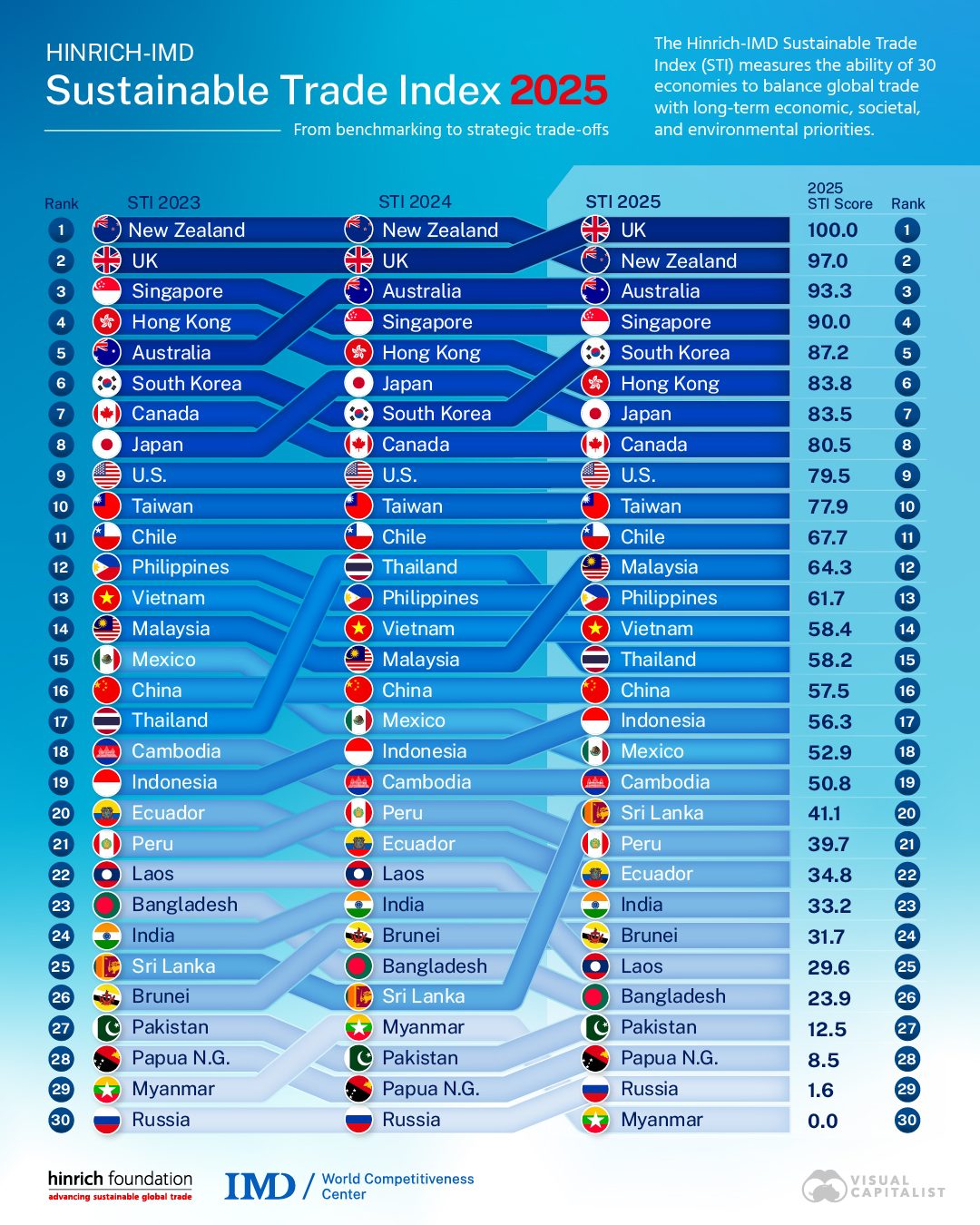
Sustainable Trade Index: Ranking Global Economies in Trade and Sustainability
The Sustainable Trade Index (STI) offers a comprehensive assessment of how 30 economies balance global trade with long-term economic, societal, and environmental goals. Developed by the Hinrich Foundation in partnership with IMD, a leading global business school, the 2025 STI report provides valuable insights into the evolving landscape of sustainable trade.
Context: Why This Matters
Global trade is a powerful driver of economic growth, but it also presents significant challenges in terms of environmental sustainability and societal well-being. The STI helps policymakers, businesses, and stakeholders understand where economies stand in terms of a balanced approach to trade. By evaluating three key pillars—Economic, Societal, and Environmental—the index provides a holistic view of sustainable trade practices.
Main Discussion
The Evolution of the Sustainable Trade Index
The Hinrich-IMD Sustainable Trade Index has evolved over the years, expanding its scope and refining its methodology. The 2025 report marks the third iteration, highlighting the progress and setbacks of various economies in balancing trade with sustainability. By comparing the data from 2023, 2024, and 2025, the report shows how economies have adapted and improved their practices.
The Three Pillars of Sustainable Trade
The STI evaluates economies based on three critical pillars: Economic, Societal, and Environmental. Each pillar plays a crucial role in determining an economy's overall sustainability performance.
The Economic Pillar
The Economic Pillar assesses an economy’s ability to ensure and promote economic growth through international trade. This includes factors like openness to trade, government debt-to-GDP, and trade facilitation. Economies with high rankings in this pillar are those that have successfully leveraged global trade to drive economic prosperity while maintaining fiscal responsibility.
The Societal Pillar
The Societal Pillar measures the development of human capital within an economy. This includes factors like human rights, life expectancy, and education. Countries that rank high in this pillar have robust social policies that support the well-being and development of their citizens. A strong societal pillar indicates a balanced approach to economic growth that prioritizes human capital.
The Environmental Pillar
The Environmental Pillar evaluates an economy’s commitment to mitigating its environmental impact and managing its natural resources. This includes factors like ecological footprint, CO₂ emissions per capita, and environmental policy effectiveness. Countries that rank high in this pillar are those that have implemented robust environmental policies and practices, ensuring that their trade activities do not come at the expense of the planet.
New Zealand: A Leader in Sustainable Trade
New Zealand consistently ranks high across all three pillars, making it a standout performer in the 2025 STI report. The country's strong performance can be attributed to its robust policies in environmental sustainability, human capital development, and economic growth. New Zealand's commitment to sustainable practices serves as a benchmark for other economies aiming to strike a balance between trade and sustainability.
Notable Performances
High-ranking Economies
Several economies have made significant strides in sustainable trade. Countries like Singapore, Hong Kong, and South Korea have shown impressive results in the Economic and Environmental Pillars. Their dedication to trade facilitation and environmental policy effectiveness has positioned them as leaders in sustainable trade.
Emerging Economies
Countries like Vietnam, Thailand, and Malaysia have also made notable progress, particularly in the Societal Pillar. These economies have focused on improving human capital and social development, which has contributed to their overall sustainability performance.
Practical Tips for Policymakers
For policymakers looking to improve their economies' sustainability performance, the 2025 STI report offers several practical tips:
- Enhance Trade Facilitation: Streamline trade processes to increase efficiency and reduce costs. This can be achieved through digital transformation, harmonization of regulations, and improved infrastructure.
- Promote Sustainable Practices: Implement policies that encourage sustainable business practices and reduce environmental impact. This includes incentives for green technologies, carbon emissions reduction, and resource management.
- Invest in Human Capital: Prioritize education, healthcare, and social welfare to foster a skilled and healthy workforce. Investing in human capital is essential for long-term economic growth and societal well-being.
Important Takeaways
The 2025 STI report underscores the importance of a balanced approach to trade and sustainability. Economies that prioritize all three pillars—Economic, Societal, and Environmental—are better equipped to navigate the challenges of global trade. By adopting sustainable practices, promoting trade facilitation, and investing in human capital, policymakers and stakeholders can drive economic growth while preserving the planet and ensuring societal well-being.
Conclusion
The Hinrich-IMD Sustainable Trade Index 2025 provides a comprehensive assessment of how economies balance trade with long-term economic, societal, and environmental goals. By evaluating the performance across three key pillars, the report offers valuable insights into the evolving landscape of sustainable trade. Policymakers, businesses, and stakeholders can leverage these findings to drive sustainable practices and foster a more resilient global economy.
Watch the Reel
Questions readers ask
What is the Sustainable Trade Index (STI) and who created it?
The Sustainable Trade Index (STI) is a comprehensive assessment that evaluates how 30 economies balance global trade with long-term economic, societal, and environmental goals. It was developed by the Hinrich Foundation in collaboration with IMD, a renowned global business school. The 2025 STI report is the latest edition, providing up-to-date insights into sustainable trade practices.
Which countries are included in the 2025 Sustainable Trade Index?
The 2025 STI includes 30 economies, spanning various regions and levels of development. This diverse set of countries allows for a broad comparison of trade sustainability practices. Asia is particularly well-represented, with countries like China, Japan, South Korea, Russia and Vietnam included in the rankings.
What are the key areas evaluated by the Sustainable Trade Index?
The STI assesses economies based on three key pillars: economic performance, societal impact, and environmental trade practices. Each of these areas is crucial for understanding how countries balance trade with sustainability goals. By evaluating these aspects, the STI offers a holistic view of a country's trade sustainability.
How does the STI help policymakers and businesses?
The STI provides valuable insights for policymakers, enabling them to make informed decisions that promote sustainable trade. For businesses, the index offers a benchmark for assessing their own sustainability performance and identifying areas for improvement. It also highlights best practices from leading economies, such as New Zealand, which can serve as models for other countries.
Which countries are recognized for their sustainability efforts in the 2025 STI?
The 2025 STI recognizes countries like New Zealand for their strong performance in sustainable trade practices. Other notable performers include those in Asia, such as South Korea, Japan, and China, each offering unique insights into effective trade sustainability strategies.
Why is the 2025 STI important for global trade?
The 2025 STI is important because it highlights how global trade can be a driver of economic growth while also addressing environmental and societal challenges. By providing a detailed ranking, it encourages countries to prioritize sustainability in their trade policies and practices, fostering a more balanced and responsible approach to global trade.
Related deep dives
Similar reads based on topic and creator.

Recent articles
Fresh deep dives from the latest Reels we unpacked.




Comments
Be the first to comment.