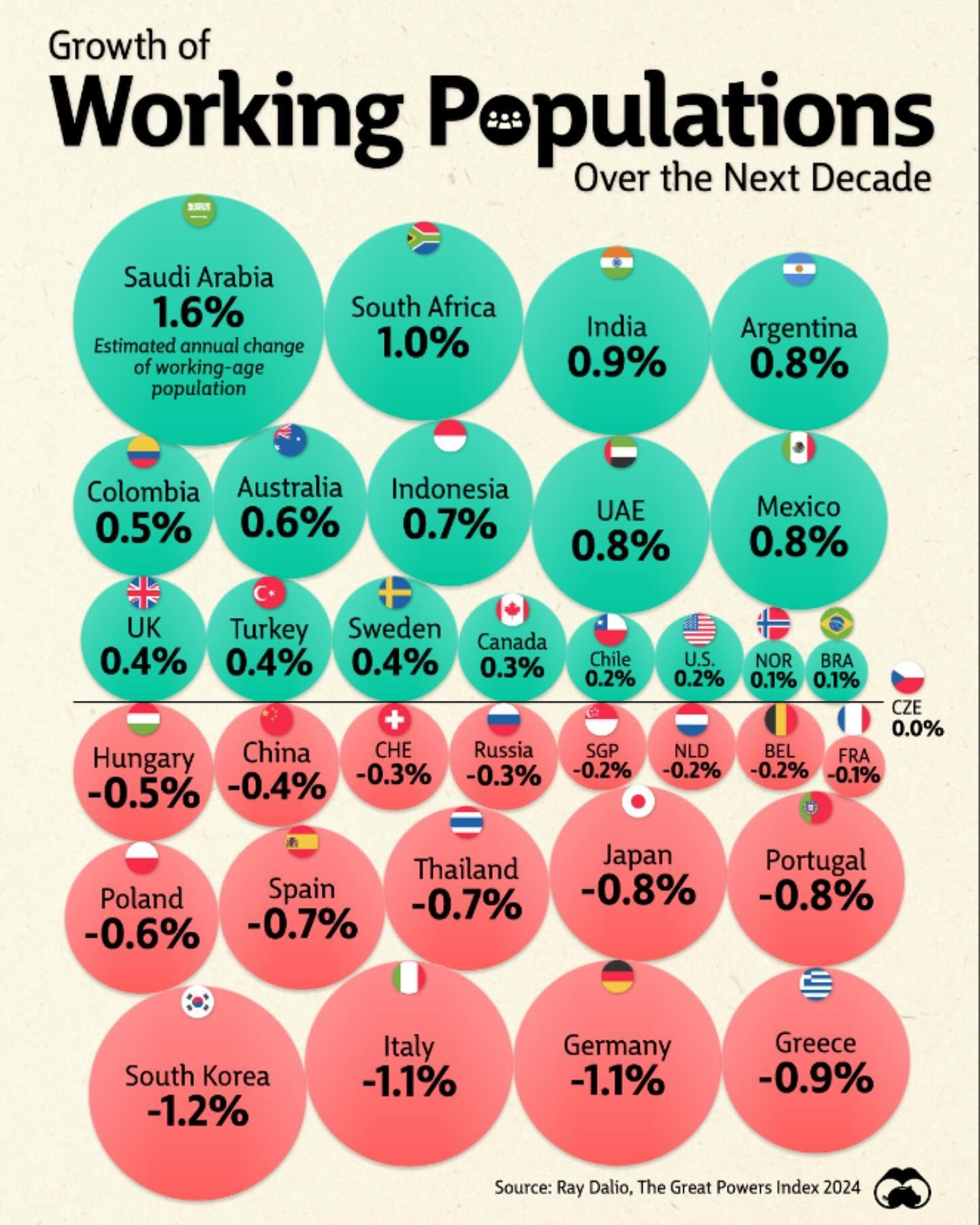
Population Growth Projections by Economy
The projected growth of working populations presents a critical shift in the global workforce. This shift is influenced by demographic factors, including birth rates and immigration. Saudi Arabia is expected to lead with the fastest-growing workforce. Ray Dalio's "Great Powers Index 2024" provides valuable insights into these changes and their implications for economic growth and productivity.
Why This Matters
With advanced economies like Japan, South Korea, and Germany experiencing significant declines, the global economic landscape is poised for a major shift. The dynamics of the workforce, driven by demographic changes, will influence economic growth, productivity, and innovation.
Main Discussion
Saudi Arabia’s Rising Workforce
Saudi Arabia stands out with a projected annual growth rate of 1.6% in its working-age population. This growth is fueled by two key factors: high birth rates and a rising number of expatriates.
Birth rates in Saudi Arabia have been notably high, contributing significantly to its population growth. Additionally, the influx of expatriates, drawn by economic opportunities and the country's strategic initiatives, enhances the workforce numbers. The combination of these factors positions Saudi Arabia as a leader in workforce expansion among major economies.
Global Trends
In contrast, many advanced economies are grappling with aging populations and low birth rates. Japan, for instance, faces one of the steepest declines, with a projected -1.2% annual change. Similarly, countries like Germany, Italy, and South Korea are also expected to experience significant population declines.
Countries like India, Indonesia, and the UAE are projected to see modest growth rates of 0.9%, 0.4%, and 0.8% respectively. These rates are driven by a combination of higher birth rates and immigration policies that attract a diverse workforce.
European and Asian Dynamics
European countries show varied trends. Nations like Hungary, Poland, and Spain are projected to see declines. Factors contributing to these declines include economic stagnation and emigration. In contrast, countries like Australia, Canada, and Chile exhibit modest growth driven by higher immigration rates.
In Asia, while countries like India and Indonesia are experiencing growth, China, Japan, and South Korea are projected to face declines. The aging populations in these countries, coupled with persistent low birth rates, pose challenges for future workforce stability. These demographic shifts will have profound implications for economic policies, infrastructure, and social services.
Implications of Population Shifts
The projected growth and decline in working-age populations will impact various sectors. For instance, industries dependent on a young, skilled workforce, such as technology and innovation, may benefit from countries with growing populations. Conversely, sectors reliant on an aging workforce, such as healthcare and social services, may face challenges in countries with declining populations.
Practical Tips
For governments, understanding these projections can inform policy decisions. Governments of nations with declining populations might focus on policies to attract and retain skilled labor, including immigration reforms and incentives. Meanwhile, countries with growing populations should prioritize education and workforce development to ensure a skilled labor force.
For businesses, the implications are equally significant. Companies may need to adapt their talent acquisition strategies, focusing on regions with growing workforces. Investments in technology and automation can also mitigate the impact of labor shortages in countries experiencing population declines.
Economic and Social Policy Adaptations
In response to these demographic shifts, many countries are already implementing policies to manage the impact. For example, Japan is exploring robotic automation to offset labor shortages. Other nations are focusing on promoting higher birth rates through incentives and family-friendly policies.
Workforce development and training programs are also being emphasized. By investing in education and vocational training, countries can better prepare their populations for future job markets. Policies that encourage labor mobility and international cooperation can also help mitigate the impact of these demographic changes.
Important Takeaways
- Saudi Arabia's Lead: With a 1.6% annual growth rate, Saudi Arabia is set to have the fastest-growing workforce, driven by high birth rates and expatriate labor.
- Global Variances: Advanced economies face significant challenges due to aging populations and low birth rates, while countries like India and Indonesia see moderate growth.
- Policy Adaptations: Governments and businesses must adapt to these demographic shifts through targeted policies and strategic investments.
- Economic Impact: The shifting workforce landscape will influence economic growth, productivity, and innovation, requiring proactive measures to address emerging challenges.
Conclusion
The projected growth and decline of working-age populations present a complex and evolving economic landscape. Countries like Saudi Arabia, with substantial workforce expansion, offer new opportunities, while those with declining populations face substantial challenges. By understanding these trends and adapting policies accordingly, nations can better navigate the future and maintain economic stability.
Watch the Reel
Questions readers ask
What is driving Saudi Arabia's projected 1.6% annual growth in its working-age population?
Saudi Arabia's anticipated workforce growth is primarily driven by high birth rates and a significant increase in expatriates moving to the country. These demographic factors contribute to a larger pool of workers, setting the stage for future economic development.
How does Saudi Arabia's workforce growth compare to that of advanced economies like Japan and Germany?
Saudi Arabia's projected 1.6% annual growth in its working-age population stands in stark contrast to the declining working populations of advanced economies. Japan, South Korea, and Germany are all experiencing significant decreases, which makes Saudi Arabia's growth particularly notable in the global context.
What are the implications of Saudi Arabia's workforce growth for the global economy?
Saudi Arabia's rapid workforce expansion is set to reshape the global economic landscape. This growth can lead to increased productivity, innovation, and economic growth, making Saudi Arabia a key player in the global workforce trends of 2024 and beyond.
How do birth rates and immigration influence Saudi Arabia's workforce growth?
Birth rates and immigration are the primary demographic factors fueling Saudi's workforce growth. High birth rates ensure a continuous influx of young workers, while a surge in expatriates brings in a diverse and skilled labor force, both of which contribute to the country's economic development and population growth.
What insights does Ray Dalio's 'Great Powers Index 2024' provide on Saudi Arabia's workforce expansion?
Ray Dalio's 'Great Powers Index 2024' highlights the significance of Saudi Arabia's workforce growth in the global context. It underscores how demographic shifts, particularly the expansion of Saudi Arabia's working-age population, will influence economic growth, productivity, and innovation in the coming years.
What are the projected global workforce trends in 2024 and how does Saudi Arabia fit into these trends?
The global workforce trends in 2024 are characterized by a shift in the workforce dynamics driven by demographic changes. Saudi Arabia, with its projected rapid expansion, is set to lead the global workforce growth. This growth is in contrast to the decline in working populations in many advanced economies, making Saudi Arabia a pivotal player in the global workforce landscape.
What are the main factors contributing to the decline in working populations in major economies like Japan and Germany?
The decline in working populations in major economies like Japan and Germany is primarily due to low birth rates and aging populations. These factors contribute to a shrinking labor force, which can lead to challenges in maintaining economic productivity and growth, contrasting sharply with Saudi Arabia's expanding workforce.
Recent articles
Fresh deep dives from the latest Reels we unpacked.




Comments
Be the first to comment.