Hidden Debt: Unrecorded Dollar Debt in Non-U.S. Banks and Shadow Banks
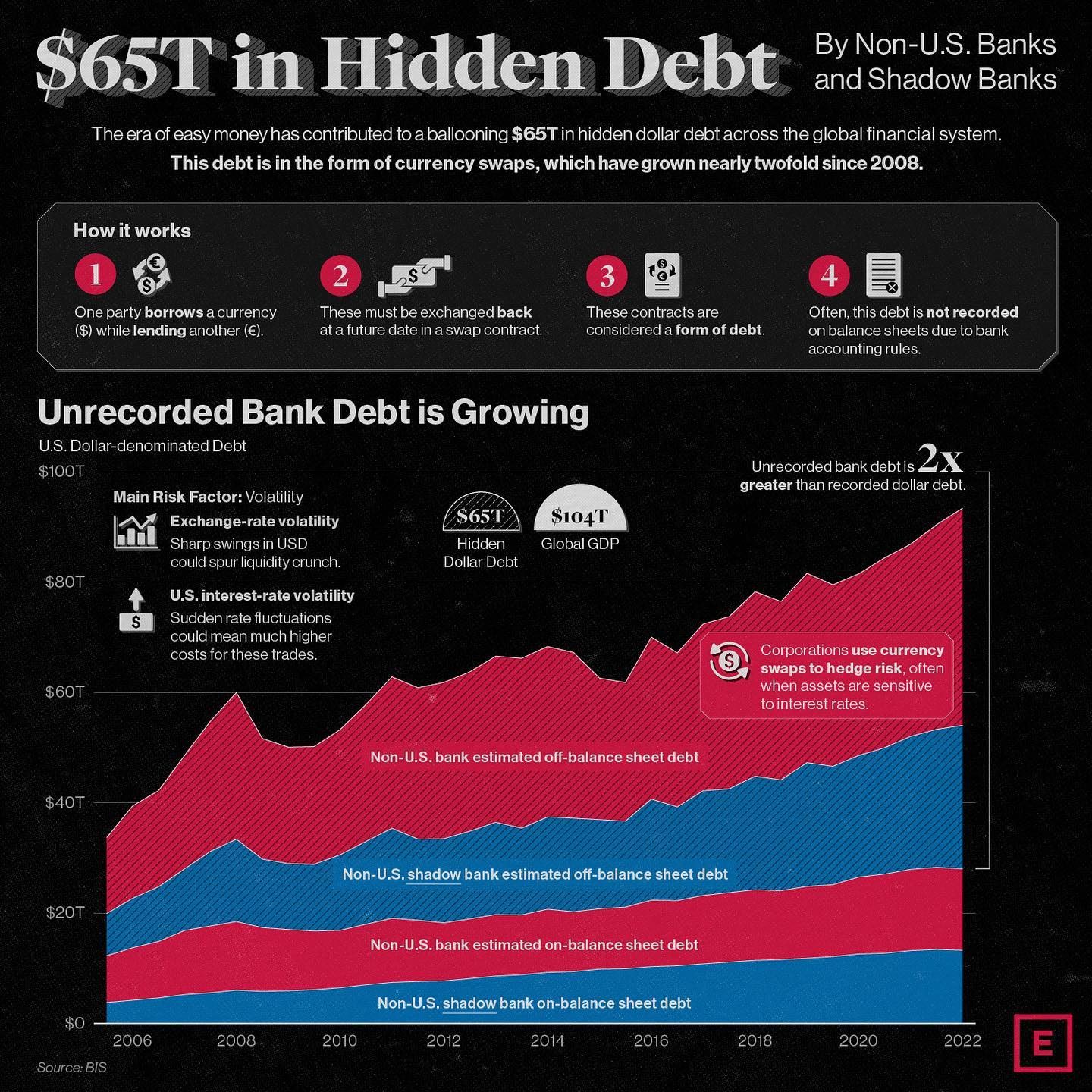
Hidden debt, particularly in the form of currency swaps, is a significant aspect of the global financial system. This type of debt, totaling no less than $65 trillion, circulates through non-U.S. banks and shadow banks. To put this into perspective, the global GDP stands at approximately $104 trillion. This analysis, based on data from the Bank for International Settlements (BIS), explores the rise of hidden dollar debt and its implications.
Context / Why this matters
Understanding the scale and impact of hidden debt is crucial for several reasons. First, it affects global financial stability. The sheer volume of unrecorded debt—in this case, $65 trillion—can pose significant risks to the financial system. Second, it influences monetary policies and regulations. Central banks and financial regulators need to account for this hidden debt when formulating policies to maintain economic stability. Finally, it impacts corporate strategies, as many corporations use currency swaps to hedge risk, particularly when their assets are sensitive to interest rates.
Main discussion
The Concept of Hidden Debt
Hidden debt refers to financial obligations that are not immediately apparent in traditional financial records. These obligations often take the form of currency swaps, where non-U.S. banks and shadow banks engage in agreements to exchange principal and interest payments in different currencies. This practice allows them to manage foreign exchange risk and interest rate exposure.
How Currency Swaps Work
Currency swaps involve two parties exchanging principal and interest payments in different currencies. For example, a European bank might swap euros for dollars with an American bank. This arrangement allows the European bank to borrow in dollars at a lower interest rate while still managing its euro-denominated assets. Similarly, the American bank can access euro-denominated funds at a favorable rate.
The Growth of Hidden Debt
The growth of hidden debt, especially since 2008, has been substantial. This increase can be attributed to several factors, including the need for non-U.S. banks and shadow banks to access dollar-denominated funds at lower interest rates. The financial crisis of 2008 highlighted the importance of dollar liquidity, leading to a surge in currency swaps as a means to manage risk and ensure liquidity.
The Risks Associated with Hidden Debt
The primary risk factor associated with hidden debt is volatility in exchange rates and U.S. interest rates. Fluctuations in these rates can significantly impact the value of the swapped currencies, potentially leading to losses for the parties involved. Additionally, the unrecorded nature of this debt makes it difficult for regulators to assess the true extent of financial risk in the system.
Corporations often use currency swaps to hedge against such risks. For instance, a company with assets sensitive to interest rate changes might enter into a swap agreement to manage its exposure. However, the hidden nature of these swaps means that the overall debt levels are not fully transparent, posing challenges for risk management and regulatory oversight.
Practical tips
For individuals and corporations navigating the complexities of hidden debt, here are some practical tips:
- Stay Informed: Keep up-to-date with global financial trends and regulatory changes that might affect hidden debt.
- Diversify: Consider diversifying your financial holdings to mitigate risks associated with currency swaps and exchange rate volatility.
- Consult Experts: Seek advice from financial advisors and risk management specialists who can provide insights into managing hidden debt.
Important takeaways
- Hidden debt, particularly in the form of currency swaps, is prevalent and significant, totaling $65 trillion.
- The growth of hidden debt is driven by the need for dollar liquidity and lower interest rates.
- Volatility in exchange rates and U.S. interest rates poses significant risks to those involved in currency swaps.
- Corporations use currency swaps to hedge against risk, but the unrecorded nature of this debt complicates risk management.
Conclusion
Hidden debt, particularly in the form of currency swaps, is a critical aspect of the global financial system. With $65 trillion in unrecorded dollar debt circulating through non-U.S. banks and shadow banks, the implications for financial stability, monetary policy, and corporate strategies are profound. Understanding the mechanics of hidden debt, its growth, and associated risks is essential for navigating the complexities of the global financial landscape.
Watch the Reel
Questions readers ask
What are currency swaps and how do they contribute to hidden global debt?
Currency swaps are financial agreements where two parties exchange principal and interest in one currency for principal and interest in another. They contribute to hidden global debt by allowing non-U.S. banks and shadow banks to access U.S. dollar funding without recording it as debt on their balance sheets, leading to a significant amount of unrecorded dollar debts.
Why is the $65 trillion in hidden global debt a concern for financial regulators?
The $65 trillion in hidden global debt is a concern for financial regulators because it represents a large amount of unrecorded liabilities that can pose significant risks to the global financial system. This hidden debt can lead to unexpected financial turmoil, and it can also impact the effectiveness of monetary policies.
How does hidden debt in non-U.S. banks and shadow banks affect global financial stability?
Hidden debt in non-U.S. banks and shadow banks can affect global financial stability by creating uncertainty and potential risks in the financial system. This unrecorded debt can lead to sudden outflows or defaults, causing market disruptions and liquidity crises.
What role do central banks play in managing hidden global debt?
Central banks play a crucial role in managing hidden global debt by monitoring and regulating financial institutions, implementing policies to mitigate risks, and coordinating with other central banks to maintain economic stability. They must consider the impact of unrecorded debts when formulating monetary policies.
How does the scale of hidden debt compare to global GDP?
The scale of hidden debt, at nearly $65 trillion, is substantial when compared to the global GDP of approximately $104 trillion. This means that unrecorded debt makes up a significant portion of the global economy, highlighting the need for careful management and consideration of its potential impacts.
What are shadow banks and why are they significant in the context of hidden debt?
Shadow banks are financial institutions that perform similar functions to traditional banks but operate outside the regular banking system. They are significant in the context of hidden debt because they engage in activities like currency swaps, contributing to the unrecorded dollar debts that circulate through the global financial system.
Recent articles
Fresh deep dives from the latest Reels we unpacked.




Comments
Be the first to comment.