Political Regimes: A Global Analysis
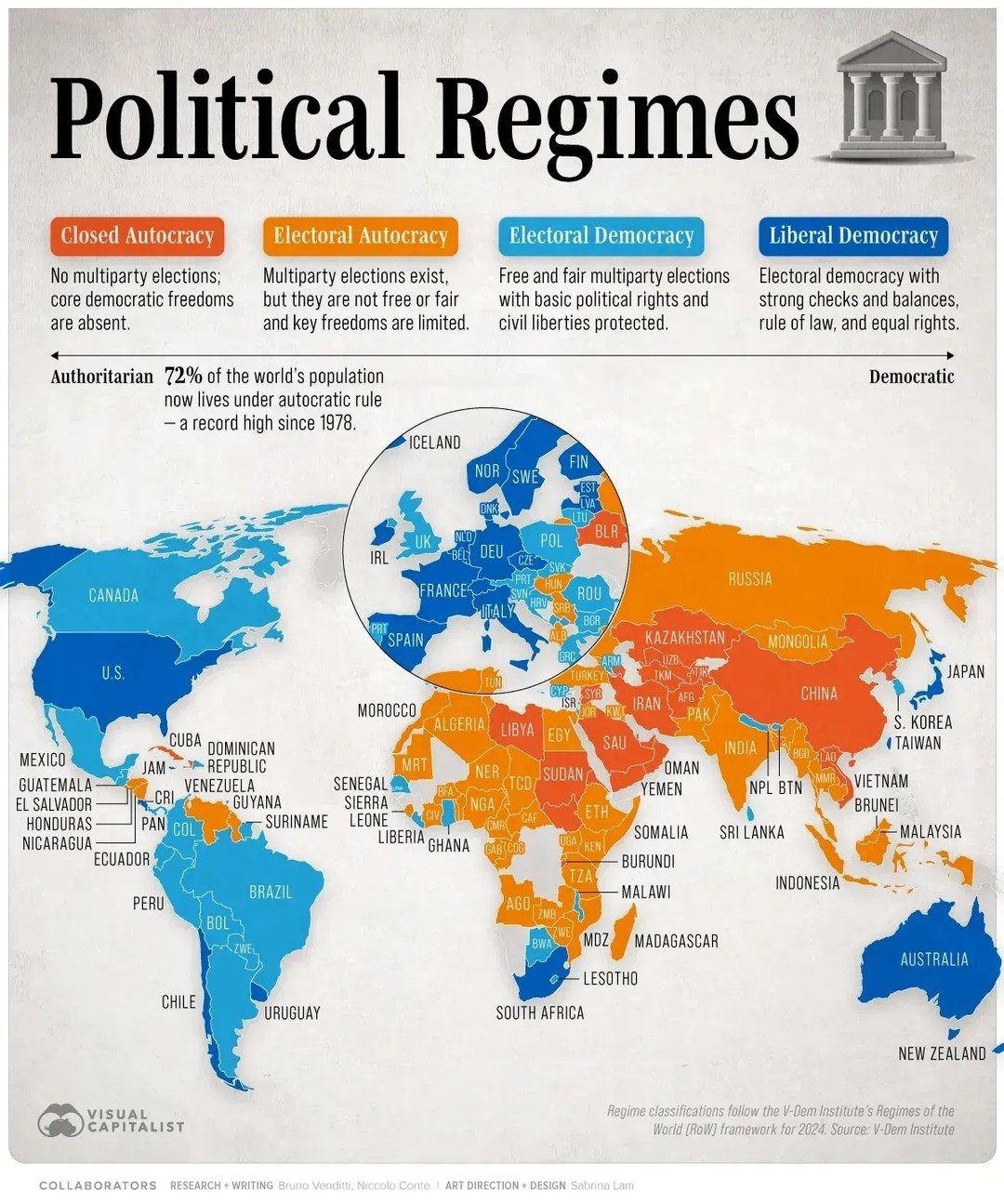
Political regimes shape the world's geopolitical landscape, influencing governance, economic policies, and societal norms. According to the V-Dem Institute’s 2024 Regimes of the World report and the infographic, political regimes are now categorized on a spectrum from 'Closed Autocracy' to 'Liberal Democracy'. Seventy two percent of the world’s population lives under some form of autocratic rule, the highest share since 1978. Electoral autocracies, where multi-party elections exist but are not free or fair and where key freedoms are limited, have become the most common regime type globally. In contrast, liberal democracies are concentrated in Western Europe, North America, Oceania, and parts of East Asia.
Context: The Importance of Political Regime Analysis
Understanding political regimes is crucial for a variety of reasons. It helps in assessing the stability of nations, predicting political trends, and evaluating the effectiveness of governance. Moreover, it provides insights into the distribution of power, the state of civil liberties, and the level of corruption within a country. By mapping out political regimes, we can better understand the factors that drive global politics and the challenges that different regions face.
Main Discussion
The Spectrum of Political Regimes
The classification of political regimes can be broken down into several categories, each with its unique characteristics and implications.
Closed Autocracy
Countries under a closed autocracy are characterized by the absence of multi-party elections and severe restrictions on civil liberties. Key freedoms such as freedom of speech, assembly, and religion are heavily curtailed. The political power is typically concentrated in the hands of a single leader or a small ruling elite, with limited or no checks and balances. Examples of countries that fall into this category include Syria and Turkmenistan.
Electoral Autocracy
Electoral autocracies are a bit more complex. These regimes hold multi-party elections, but these elections are neither free nor fair. The ruling party often manipulates the electoral process to maintain power, and opposition parties face significant barriers. Civil liberties are limited, and the media is often controlled by the state. Examples can include several countries in Central and West Asia, such as Kazakhstan and Uzbekistan.
Electoral Democracy
Electoral democracies have free and fair elections, but they may lack some of the checks and balances that are characteristic of liberal democracies. Civil liberties are generally respected, but issues such as corruption and the influence of money in politics can be significant. These democracies are more common in Latin America and parts of Africa, such as Brazil and South Africa.
Liberal Democracy
Liberal democracies are characterized by free and fair elections, strong checks and balances, and robust protection of civil liberties. These regimes prioritize individual rights, the rule of law, and the separation of powers. Examples of liberal democracies include countries like Iceland, Sweden, and Norway in Europe and Canada and the United States in North America.
Geographical Distribution of Political Regimes
The geographical distribution of political regimes reveals significant patterns. Liberal democracies are predominantly found in Western Europe, North America, and Oceania. These regions have a long history of democratic governance, strong institutions, and a commitment to civil liberties.
Electoral autocracies, on the other hand, are more common in Central and Eastern Europe, Central Asia, and parts of Africa and the Middle East. These regimes often emerge from historical, cultural, and economic factors that make democratic governance more challenging. The shift towards electoral autocracies in recent years highlights the increasing complexity of global politics and the need for nuanced approaches to governance.
Closed autocracies are often found in regions with a history of authoritarian rule, such as the Middle East and some parts of Africa. However, it's important to note that there are also examples of closed autocracies in other parts of the world, such as North Korea. These regimes face significant challenges in transitioning to more democratic forms of governance, often due to entrenched power structures and a lack of institutional support for democratic reforms.
Practical Tips for Understanding Political Regimes
To better understand the political regimes of different countries, consider the following tips:
Stay Informed
Staying informed about global politics and governance trends is crucial. Regularly read reliable sources of news and analysis, and follow experts in the field. This will help you stay up-to-date with the latest developments in political regimes and their implications.
Use Visual Aids
Visual aids, such as infographics and maps, can be invaluable tools for understanding political regimes. They provide a clear and concise overview of the distribution of different regimes and can help identify trends and patterns.
Engage with Multiple Perspectives
Engaging with multiple perspectives can deepen your understanding of political regimes. Read analyses from different sources, including those from countries with varying political systems, and consider how cultural, historical, and economic factors shape governance.
Important Takeaways
Several key takeaways emerge from this analysis. First, the global landscape of political regimes is diverse and complex, with a variety of regime types existing side by side. Second, the distribution of political regimes is shaped by a range of factors, including historical, cultural, and economic conditions. Finally, understanding political regimes requires a nuanced approach that takes into account the unique characteristics and challenges of each regime type.
Conclusion
The study of political regimes is essential for understanding the geopolitical landscape and the factors that shape global governance. By analyzing the different types of political regimes and their distribution, we can gain valuable insights into the challenges and opportunities that different regions face. This knowledge can inform policymaking, diplomacy, and international relations, helping to build a more stable and prosperous world.
Watch the Reel
Questions readers ask
What percentage of the world's population lives under autocratic rule in 2024?
In 2024, 72% of the world's population lives under some form of autocratic rule. This is the highest percentage since 1978, indicating a significant global shift in political regimes.
What is an electoral autocracy and how does it differ from a liberal democracy?
An electoral autocracy is a regime where multi-party elections occur, but they are not genuinely free or fair, and key civil liberties are restricted. In contrast, a liberal democracy upholds free and fair elections, protects civil liberties, and ensures the separation of powers.
Which regions have the highest concentration of liberal democracies in 2024?
Liberal democracies are primarily concentrated in Western Europe, North America, Oceania, and parts of East Asia. These regions tend to have strong institutions, rule of law, and respect for individual rights.
What are the different types of autocratic regimes mentioned in the article?
The article mentions 'Closed Autocracy' and 'Electoral Autocracy' as two types of autocratic regimes. Electoral autocracies are more prevalent and are characterized by the presence of multi-party elections that are not free or fair, while closed autocracies do not hold multi-party elections at all.
How has the prevalence of autocratic rule changed over time?
The prevalence of autocratic rule has increased significantly, with 2024 marking the highest level since 1978. This trend reflects a global shift in political regimes, with autocratic systems becoming more common.
What factors contribute to the increase in autocratic rule in 2024?
The increase in autocratic rule can be attributed to various factors, including the rise of populist leaders, the erosion of democratic institutions, and the use of technology for surveillance and control. Additionally, the lack of free and fair elections and suppression of civil liberties contribute to this trend.
Recent articles
Fresh deep dives from the latest Reels we unpacked.




Comments
Be the first to comment.