AI Investment Growth
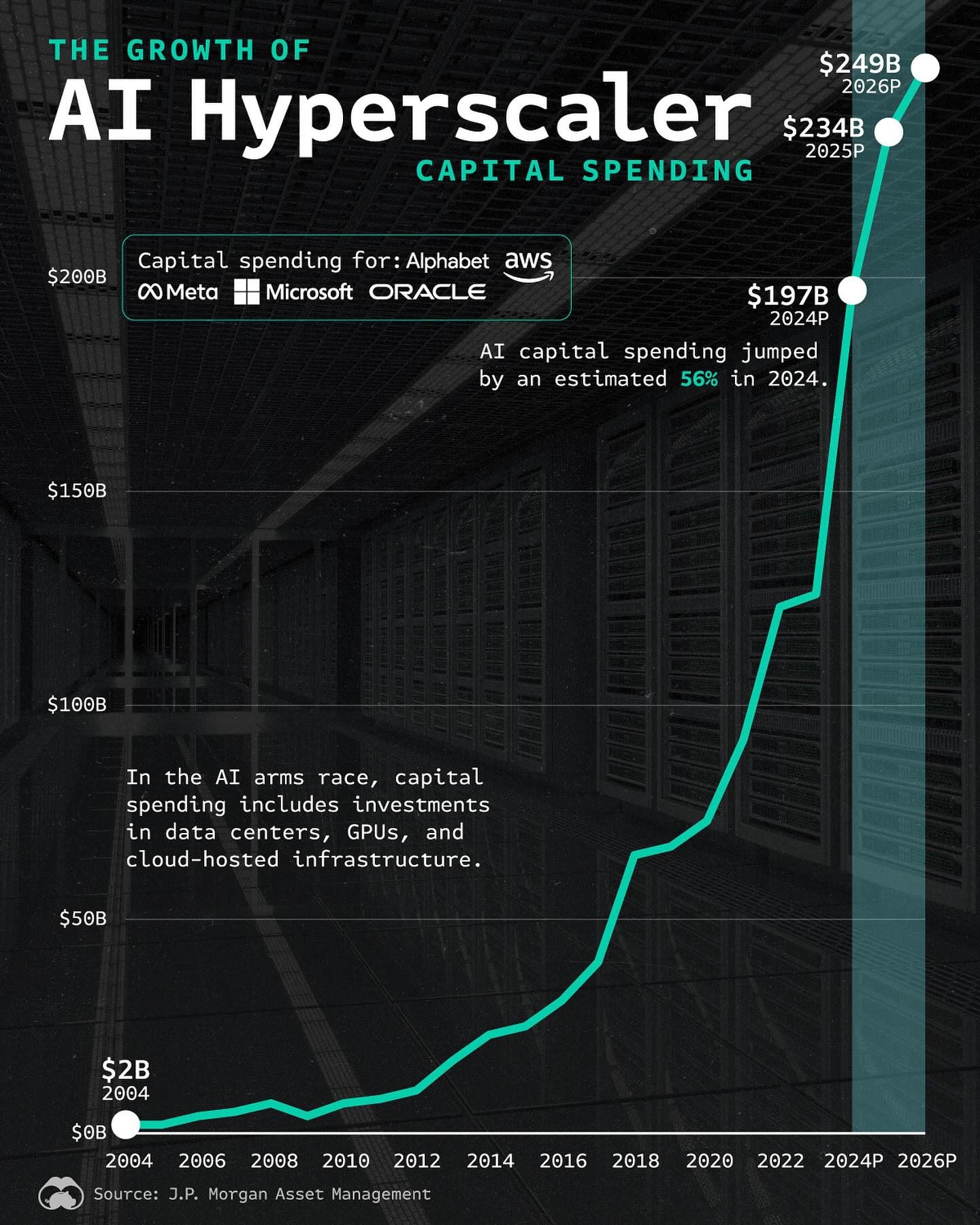
AI infrastructure investment has surged, with major tech giants pouring significant capital into data centers, graphics processing units (GPUs), and cloud-hosted infrastructure. In 2024 alone, companies like Microsoft, Alphabet, Meta, Amazon, and Oracle allocated an estimated $197 billion to AI infrastructure, and this spending is expected to continue rising.
Why this matters
The escalating investments in AI infrastructure underscore the strategic importance of AI in the modern corporate landscape. The data centers, GPUs, and cloud infrastructure serve as the backbone for powering and training AI models, which are becoming increasingly integral to business operations and competitive advantage. Understanding the trends and investments in this sector provides valuable insights into the future of technology and the broader economic landscape.
AI hyperscaler capital spending
The rise of AI infrastructure investments
The growth in AI hyperscaler capital spending is nothing short of remarkable. According to data from J.P. Morgan Asset Management, the spending on AI infrastructure has seen a steady increase over the years, with significant jumps in recent times. The estimated $197 billion spent in 2024 is projected to rise to $234 billion by 2025 and further to $249 billion by 2026. This trend highlights the intense focus of major tech companies on AI and their commitment to leading the AI revolution.
Key players and their investments
Several major tech companies are at the forefront of this investment surge. Alphabet, AWS (Amazon Web Services), Microsoft, and Oracle are among the key players contributing significantly to the AI arms race. These companies are not only investing in AI models but also in the infrastructure required to support them. Data centers, GPUs, and cloud-hosted infrastructure are the primary areas of focus for these investments. The data centers provide the necessary computing power, while GPUs help in training complex AI models efficiently. Cloud-hosted infrastructure ensures scalability and accessibility, enabling companies to leverage AI capabilities globally.
The role of data centers
Data centers are the backbone of AI infrastructure. They house the high-performance servers and storage systems required to process vast amounts of data and execute complex AI algorithms. The increasing demand for AI capabilities has led to a surge in the demand for data centers. These facilities are equipped with advanced cooling systems, redundant power supplies, and robust security measures to ensure optimal performance and reliability.
The construction and operation of data centers require significant capital investments. Companies are not only building new data centers but also upgrading existing ones to meet the growing AI demands. The strategic location of data centers is also crucial, as it impacts latency and data transfer speeds.
The significance of GPUs
Graphics processing units (GPUs) play a crucial role in AI infrastructure. Originally designed for rendering graphics, GPUs have proven to be highly efficient in processing parallel tasks, making them ideal for training AI models. The parallel processing capability of GPUs enables faster training of complex models, which is essential for developing advanced AI applications.
The demand for GPUs has surged, leading to supply shortages and increased prices. Companies are investing heavily in acquiring GPUs and developing custom solutions to meet their AI training needs. The competition for GPU resources has intensified, with companies exploring various strategies to secure access to these critical components.
The importance of cloud-hosted infrastructure
Cloud-hosted infrastructure provides the scalability and flexibility needed to support AI applications. It allows companies to scale their AI capabilities up or down based on their needs, without the hassle of managing physical infrastructure. Cloud services offer a range of AI tools and frameworks, making it easier for companies to develop and deploy AI solutions.
Cloud providers are continuously innovating to offer more advanced AI capabilities. They are investing in AI research and development, building on their expertise in cloud computing to provide cutting-edge AI solutions. The trend towards cloud-hosted AI infrastructure is expected to continue, driven by the need for scalability, flexibility, and cost-efficiency.
Practical tips
For companies looking to invest in AI infrastructure, here are some practical tips to consider:
-
Assess your needs: Understand your AI requirements and choose the infrastructure that best meets your needs. Consider factors such as computing power, storage, and scalability.
-
Invest in data centers: Ensure you have reliable and high-performance data centers to support your AI operations. Consider factors such as location, cooling, power, and security.
-
Acquire GPUs: Invest in high-performance GPUs to accelerate your AI model training. Explore options for custom GPUs tailored to your specific needs.
-
Leverage cloud services: Utilize cloud-hosted infrastructure to gain scalability and flexibility. Choose a cloud provider that offers a range of AI tools and frameworks.
-
Plan for future growth: Anticipate future AI demands and plan your infrastructure investments accordingly. Ensure your infrastructure can scale as your AI capabilities grow.
Important takeaways
The surge in AI infrastructure investments highlights the strategic importance of AI in the modern corporate landscape. Companies are investing heavily in data centers, GPUs, and cloud-hosted infrastructure to support their AI initiatives. Understanding the trends and investments in this sector provides valuable insights into the future of technology and the broader economic landscape.
The intense competition in the AI arms race is driving significant investments in AI infrastructure. Companies are exploring various strategies to secure access to critical components and build advanced AI capabilities. The role of data centers, GPUs, and cloud-hosted infrastructure cannot be overstated, as they provide the foundation for AI operations.
Conclusion
AI infrastructure investments are on a trajectory of significant growth, driven by the increasing demand for advanced AI capabilities. Companies are investing heavily in data centers, GPUs, and cloud-hosted infrastructure to support their AI initiatives. The strategic importance of AI in the modern corporate landscape is underscored by these investments, which are expected to continue rising in the coming years.
Watch the Reel
Questions readers ask
Which companies are leading the AI investment surge in 2024?
Major tech firms such as Microsoft, Alphabet, Amazon, Meta, and Oracle are at the forefront of the AI investment surge in 2024. These companies are allocating significant capital to enhance their AI infrastructure, including data centers, GPUs, and cloud-hosted infrastructure.
What is the projected AI infrastructure spending for 2026?
The AI infrastructure spending is anticipated to grow from $197 billion in 2024 to $249 billion by 2026. This projection reflects the increasing importance of AI in business operations and the competitive landscape.
Why is there a rise in AI infrastructure investments in 2024?
The rise in AI infrastructure investments is driven by the growing integration of AI into the modern corporate landscape. Businesses are recognizing that AI models have become essential for various operations and competitive strategies.
What are the key components of AI infrastructure?
The key components of AI infrastructure are data centers, graphics processing units (GPUs), and cloud-hosted infrastructure. These elements work together to power and train AI models, ensuring they are effective and efficient.
How do AI investments contribute to business operations?
AI investments contribute to business operations by enhancing data management, improving analytics, and enabling advanced predictive models. These improvements can lead to increased efficiency, better decision-making, and a competitive edge in the market.
What role do hyperscalers play in AI investments?
Hyperscalers, such as Microsoft, Alphabet, Amazon and Oracle, are playing a pivotal role in AI investments by providing the necessary infrastructure for data processing, storage, and AI model training. Their investments in data centers and cloud services support the development and deployment of AI technologies.
How does the growth of AI infrastructure impact asset management?
The growth of AI infrastructure impacts asset management by providing advanced tools for predictive maintenance, risk assessment, and operational optimization. This can lead to more efficient asset utilization and better strategic planning within organizations.
Related deep dives
Similar reads based on topic and creator.


Recent articles
Fresh deep dives from the latest Reels we unpacked.




Comments
Be the first to comment.