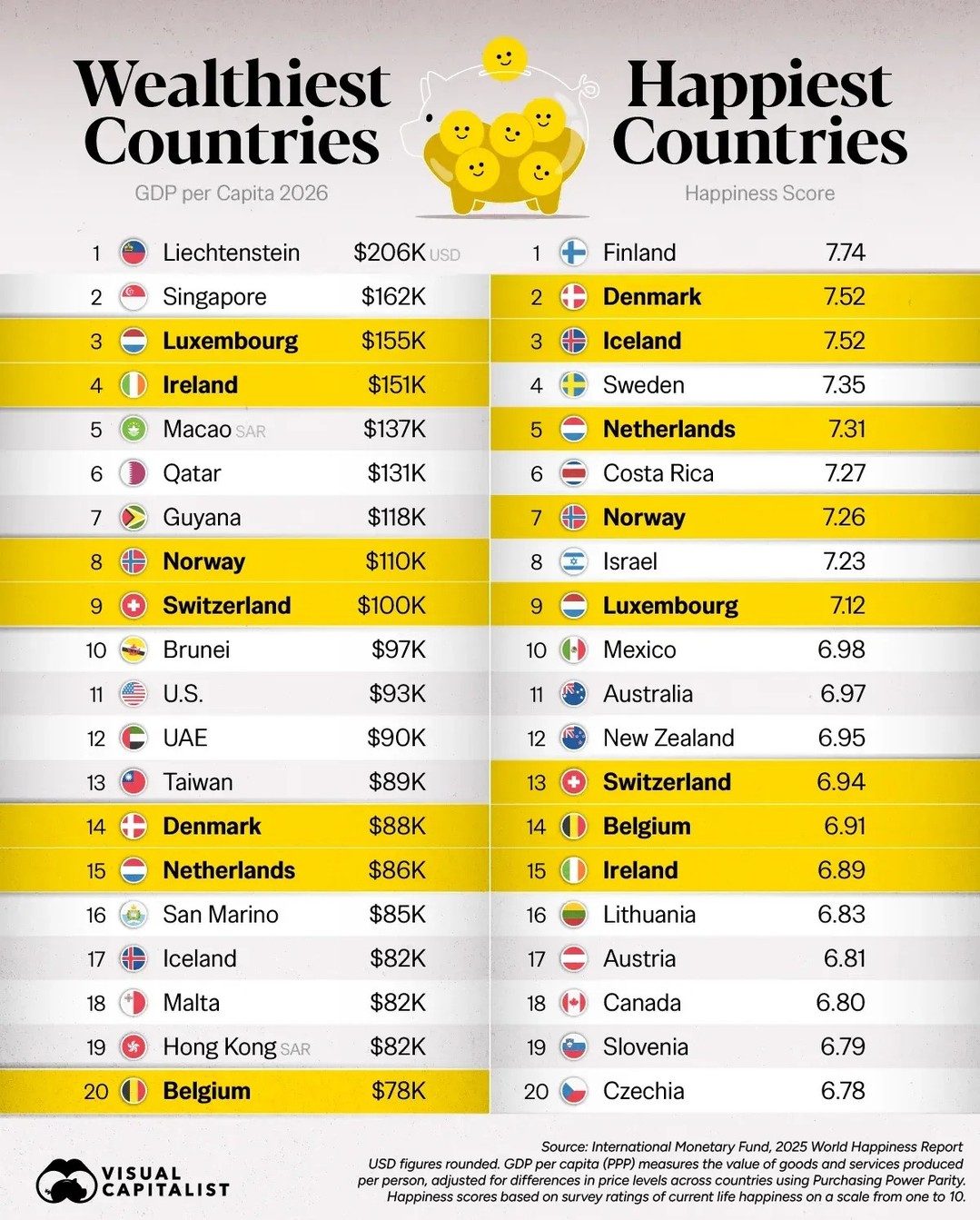
Wealthiest and Happiest Countries
A look at the richest and happiest countries worldwide reveals some surprising insights. While many of the wealthiest nations boast high levels of life satisfaction, there are notable exceptions. Several Nordic countries, in particular, stand out for their impressive rankings in both wealth and happiness. This analysis delves into the data from the International Monetary Fund (IMF) and the 2025 World Happiness Report to understand these trends.
Nordic Countries Lead the Way
Nordic countries consistently rank high in both wealth and happiness. These nations include Finland, Denmark, Sweden, and Norway. According to the data, Finland tops the happiness charts with a score of 7.74, while Denmark and Sweden follow closely with scores of 7.52 and 7.35, respectively. These countries also rank high in GDP per capita (PPP), with Norway boasting $110,000 USD per person. This combination of economic prosperity and high life satisfaction makes the Nordic countries a compelling study in national success.
GDP per Capita vs. Happiness Scores
Top Wealthiest Countries
The GDP per capita (PPP) is a critical measure of a country’s economic performance. When comparing these figures, Liechtenstein leads with an astonishing $206,000 USD per person. Following closely are Singapore at $162,000 USD and Luxembourg at $155,000 USD. Although these countries are economically robust, they do not always translate this wealth into high happiness scores. For instance, Singapore and Qatar, despite their impressive GDP figures, do not make the top 20 for happiness.
Top Happiest Countries
Happiness scores are based on survey ratings of current life satisfaction. Finland leads the list with a score of 7.74, closely followed by Denmark and Iceland, both scoring 7.52. The Nordic countries dominate the top 10, reflecting a strong correlation between their economic success and life satisfaction. However, this relationship is not universal. Luxembourg, for example, ranks high in wealth but seems to lag in happiness, coming in at 7.12.
The Wealth-Happiness Correlation
While many of the wealthiest countries are also among the happiest, this relationship is not perfect. For example, Singapore and Qatar have some of the highest GDP per capita figures but do not rank high in happiness. This disparity highlights that economic prosperity alone does not guarantee high life satisfaction. Conversely, some countries with moderate wealth, like Costa Rica with a GDP per capita that does not make the top 20, rank high in happiness with a score of 7.27.
Why This Matters
Understanding the relationship between wealth and happiness is crucial for policymakers and individuals alike. It underscores the importance of factors beyond economic prosperity, such as social support, freedom, and a sense of community. While economic success is undoubtedly beneficial, it is not the sole determinant of happiness. This nuanced view allows for a more comprehensive approach to national well-being, focusing on both material and intangible aspects of life.
Practical Tips for Enhancing National Well-being
Prioritize Social Support
Social support networks, including family, friends, and community, are vital for happiness. Policies that foster strong social connections and community engagement can significantly enhance overall well-being.
Promote Work-Life Balance
While economic success is important, it should not come at the expense of personal well-being. Policies that encourage work-life balance, such as flexible working hours and adequate vacation time, can help maintain a healthy equilibrium.
Invest in Healthcare and Education
Access to quality healthcare and education is fundamental to life satisfaction. Investing in these sectors can lead to a healthier, more productive population, contributing to both economic prosperity and happiness.
Encourage Personal Freedom and Choice
Individual freedom and the ability to make personal choices are key to happiness. Policies that promote civil liberties and personal autonomy can lead to higher levels of life satisfaction.
Important Takeaways
Economic Prosperity is Not Enough
While wealth is important, it is not the sole determinant of happiness. Other factors, such as social support, personal freedom, and work-life balance, play a crucial role in overall well-being.
Nordic Countries Offer a Model
The success of Nordic countries in balancing economic prosperity and high life satisfaction offers valuable insights. Their policies on social support, work-life balance, and public services provide a model for other nations.
Comprehensive Approach to Happiness
Policymakers should consider a comprehensive approach that includes both economic and social factors. This holistic view can lead to more effective policies that enhance both wealth and happiness.
Conclusion
The relationship between wealth and happiness is complex and multifaceted. While economic prosperity is essential, it is not the sole determinant of life satisfaction. This comparison of GDP per capita and happiness scores highlights the importance of social, emotional, and policy factors in enhancing overall well-being. As we strive for a better future, it is crucial to consider the broader aspects of human happiness beyond mere economic success.
Watch the Reel
Questions readers ask
Which Nordic country ranks highest in the 2023 World Happiness Report?
Finland tops the 2023 World Happiness Report with a score of 7.74, indicating exceptional life satisfaction among its population.
What is the correlation between wealth and happiness in Nordic countries?
Nordic countries such as Finland, Denmark, Sweden, and Norway demonstrate a strong correlation between wealth and happiness. They consistently rank high in both wealth, as measured by GDP per capita, and in happiness reports.
How does the purchasing power parity (PPP) affect the ranking of Nordic countries in wealth comparisons?
Purchasing power parity (PPP) is crucial in wealth comparisons as it adjusts for the cost of living. Nordic countries, despite high costs of living, maintain high rankings due to their robust economies and strong standards of living.
Why are Nordic countries often highlighted in discussions about national success?
Nordic countries are highlighted for their ability to balance economic prosperity with high levels of contentment. This dual achievement makes them compelling case studies in national success, blending wealth with overall well-being.
What data sources are used to measure the wealth and happiness of Nordic countries?
Data from the International Monetary Fund (IMF) and the World Happiness Report are frequently used to measure the wealth and happiness of Nordic countries. These sources provide metrics such as GDP per capita and life satisfaction scores.
Recent articles
Fresh deep dives from the latest Reels we unpacked.




Comments
Be the first to comment.