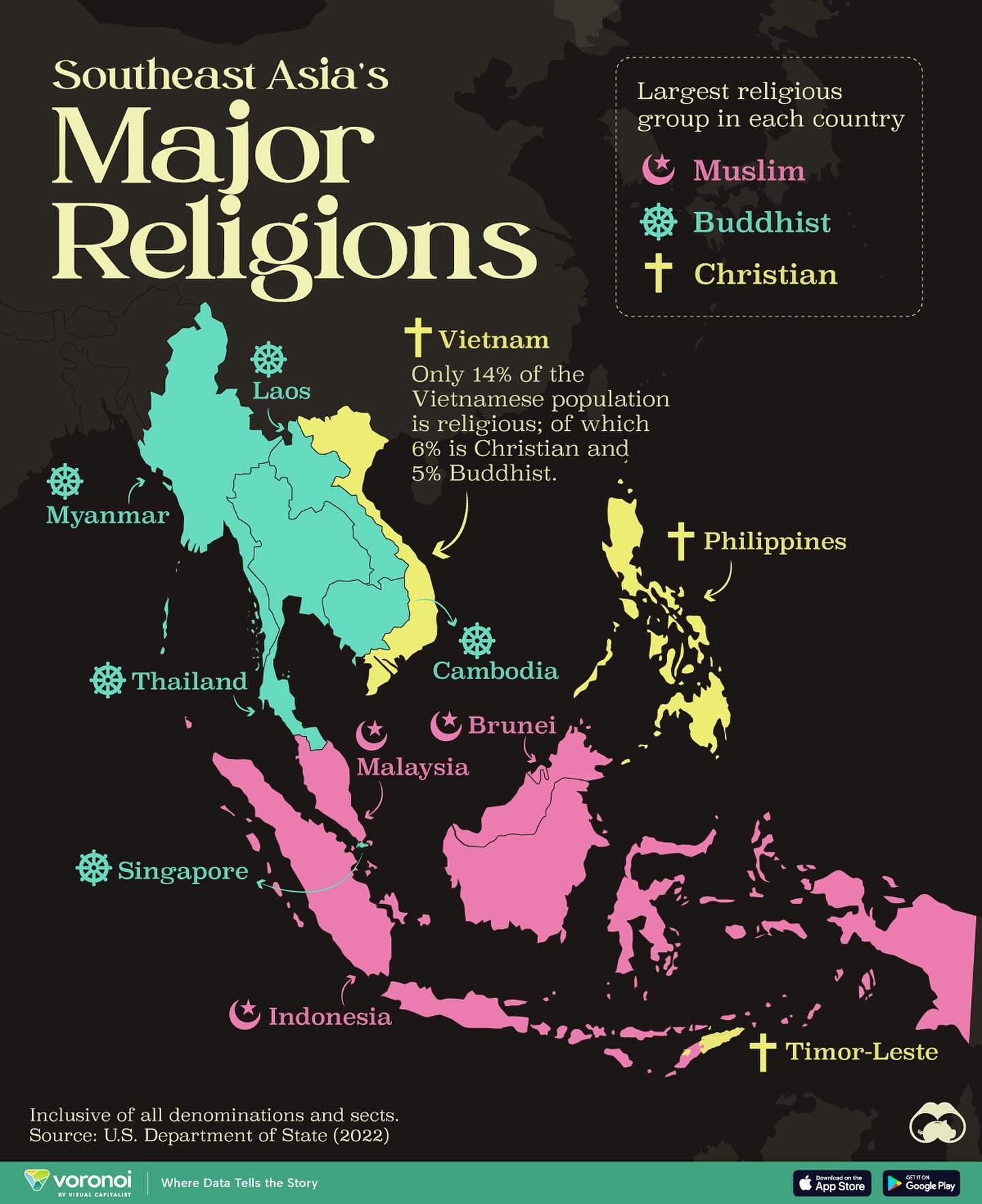
Southeast Asia's Religious Landscape
Southeast Asia is a tapestry of diverse beliefs, where ancient traditions coexist with modern practices. This region is home to some of the most religiously diverse countries in the world, such as Singapore and Vietnam. Conversely, it also includes one of the least religiously diverse countries, Timor-Leste. Understanding the religious makeup of Southeast Asia provides insight into the cultural and social dynamics of the region.
Why This Matters
Religion plays a pivotal role in shaping the cultural, political, and social landscapes of Southeast Asian countries. It influences everything from daily rituals and festivals to governance and social policies. By examining the dominant religious groups in each country, we can better understand the forces that drive societal norms and interactions. This analysis can provide a clearer perspective on the region's stability, conflict, and progress.
Exploring the Region's Major Faiths
Vietnam: A Secular Country
Vietnam presents an intriguing case, as only 14% of its population identifies as religious. Among this minority, 6% are Christian and 5% are Buddhist. The remaining 80% either identify as non-religious or do not practice any specific faith. This secular trend is unique in a region dominated by deeply religious societies, making Vietnam a standout in Southeast Asia.
Laos and Thailand: Buddhist Heartlands
Laos and Thailand are predominantly Buddhist, with the majority of their populations adhering to Theravada Buddhism. This faith permeates every aspect of life, from daily rituals to government policies. Buddhist temples, known as wats, are ubiquitous, serving as community centers and places of worship. Festivals such as Loy Krathong and Songkran are celebrated with great fervor, highlighting the cultural significance of Buddhism in these countries.
The Philippines: A Predominantly Christian Nation
The Philippines stands out in Southeast Asia as the only predominantly Christian country, with the majority of its population identifying as Roman Catholic. This legacy is a direct result of Spanish colonial rule, which introduced Catholicism to the islands. The influence of the Catholic Church is profound, shaping education, healthcare, and social policies. The Philippines celebrates numerous religious holidays, with Christmas being one of the most important, showcasing the deep-rooted faith of its people.
Myanmar: Buddhist But Divided
Myanmar is another predominantly Buddhist nation, but its religious landscape is complicated by political and ethnic divisions. The majority of the population practices Theravada Buddhism, but there are significant Christian and Muslim minorities. The Rohingya crisis, involving the Muslim minority, has drawn international attention, highlighting the complex interplay of religion, politics, and ethnic identity in Myanmar.
Indonesia: The World's Largest Muslim Population
Indonesia is the world's largest Muslim-majority country, with Islam forming the backbone of its cultural and social fabric. The majority of Indonesians practice Sunni Islam, although there are significant Shia and Sufi communities. Indonesia's religious diversity is celebrated through its numerous festivals, such as Ramadan and Eid al-Fitr. However, the country also faces challenges in balancing religious freedom with the need to maintain social harmony.
Malaysia: A Melting Pot of Faiths
Malaysia is home to a mix of Islam, Christianity, Buddhism, Hinduism, and animist beliefs. Islam is the official religion, but the country is also a hotspot for religious pluralism. Kuala Lumpur, the capital city, embodies this diversity, with places of worship for various faiths located side by side. The country's approach to religious tolerance is often hailed as a model for coexistence in a diverse society.
Singapore: A Multifaith Society
Singapore, a small city-state, boasts a diverse array of faiths, including Buddhism, Christianity, Islam, and Hinduism. The country's multiculturalism is celebrated through its festivals, such as Hari Raya, Chinese New Year, and Deepavali. Singapore's government promotes religious harmony, ensuring that each community can practice its faith freely within a shared social framework.
Cambodia: A Buddhist Revival
In Cambodia, Buddhism, particularly Theravada Buddhism, is the dominant faith. The country's rich cultural heritage, including the Angkor Wat temple complex, is a testament to the enduring influence of Buddhism. Cambodia’s recent history, including the Khmer Rouge regime, has significantly impacted its religious landscape. However, the country has shown resilience, with Buddhism serving as a unifying force.
Brunei: A Devout Muslim Sultanate
Brunei, a small but affluent sultanate, is home to a predominantly Muslim population. Under the rule of the Sultan, Brunei has implemented strict Sharia law, reflecting the conservative Islamic values of the ruling elite. The country’s religious policies and social norms are deeply intertwined, making it a unique case study in Islamic governance.
Timor-Leste: A Catholic Island
Timor-Leste, or East Timor, is one of the newest and least religiously diverse countries in Southeast Asia. More than 90% of its population is Catholic, a legacy of Portuguese colonial rule. The Catholic Church has played a crucial role in the country’s struggle for independence and continues to influence its political and social landscape.
Practical Tips for Exploring Southeast Asia's Religions
Visiting Southeast Asia offers a rich tapestry of religious experiences. Whether you're interested in temple architecture, spiritual practices, or cultural festivals, here are some practical tips to enhance your journey:
Respect Local Customs
Always respect local customs and traditions. Dress modestly when visiting religious sites, and follow any specific rules, such as removing shoes or covering hair. In some countries, it's polite to ask before taking photographs of religious ceremonies or sacred places.
Engage with Locals
Engaging with locals can provide a deeper understanding of their faith. Don’t hesitate to join in festivals, ask questions about religious practices, or visit temples and mosques. Locals often welcome the opportunity to share their beliefs and traditions.
Time Your Visit
Plan your visits around religious festivals and holidays. These events offer unique insights into the cultural significance of faith. For example, celebrating Chinese New Year in Singapore or Songkran in Thailand can be enriching experiences.
Visit Historical Sites
Many historical sites in Southeast Asia are tied to religious practices. Exploring these sites can offer a historical perspective on the evolution of religions in the region. Places like Borobudur in Indonesia, Angkor Wat in Cambodia, and the Golden Temple of Dambulla in Sri Lanka are must-visit locations.
Important Takeaways
Southeast Asia is a region of remarkable religious diversity, where ancient beliefs coexist with modern practices. From the predominantly Buddhist nations of Laos and Thailand to the Muslim-majority Indonesia and the Christian Philippines, each country has a unique religious identity. Understanding this diversity is key to appreciating the cultural richness of Southeast Asia.
Conclusion
Religion in Southeast Asia is an intricate web of traditions, practices, and beliefs that shape the region's identity. Whether you're a traveler, a scholar, or simply curious, exploring the religious landscape of Southeast Asia offers a deeper appreciation of its cultural heritage. By understanding the religious makeup of each country, we can better navigate the complexities of this dynamic region.
Watch the Reel
Questions readers ask
What are the major religions in Southeast Asia?
Southeast Asia is home to a mix of major world religions. Buddhism is predominant in countries like Thailand, Myanmar, Cambodia, and Laos. Christianity is dominant in the Philippines and Timor-Leste, while Islam is the majority religion in Indonesia and Malaysia. Additionally, Hinduism has a significant presence in countries like Singapore, Indonesia and Malaysia.
How does religious diversity in Vietnam contrast with that of Timor-Leste?
Vietnam is known for its rich religious diversity, with Buddhism, Catholicism, and ancestral worship being the most prevalent. In contrast, Timor-Leste is one of the least religiously diverse countries in the region, with a vast majority of the population adhering to Roman Catholicism.
Which countries in Southeast Asia have significant Buddhist populations?
Buddhism is a dominant religion in several Southeast Asian countries. Some of the countries with significant Buddhist populations include Thailand, Myanmar, Cambodia, Laos, and Vietnam. Additionally, Buddhism plays a key role in the cultural and social life of these countries.
What role does religion play in the political landscape of Southeast Asia?
Religion significantly influences the political landscape of Southeast Asia. It shapes governance, social policies, and even affects the political affiliations of individuals and groups. For instance, religious leaders often hold considerable sway in societal matters and may even occupy political positions.
Which regions in Southeast Asia are considered religiously diverse?
Southeast Asia contains a range of religiously diverse areas. For example, Singapore is known for its diverse religious demographics, with Buddhism, Islam, Christianity, Taoism, and Hinduism coexisting. Similarly, Vietnam and Indonesia also exhibit a high degree of religious diversity.
How has the religious landscape of Southeast Asia evolved in recent years?
The religious landscape of Southeast Asia has seen shifts and changes in recent years. There has been an increase in religious syncretism, where elements of different faiths blend together. Additionally, there has been a rise in interfaith dialogues and initiatives aimed at promoting religious tolerance and understanding.
What are some of the significant religious events celebrated in Southeast Asia?
Southeast Asia is home to a variety of significant religious events. Some notable examples include Vesak, the celebration of Buddha's birth, enlightenment, and death, celebrated widely in Buddhist countries. Thailand hosts the Royal Barge Procession, a grand ceremonial event, while the Philippines holds the Black Nazarene procession, a major event for Filipino Catholics.
Related deep dives
Similar reads based on topic and creator.

Recent articles
Fresh deep dives from the latest Reels we unpacked.




Comments
Be the first to comment.