Recession Resilient Sectors
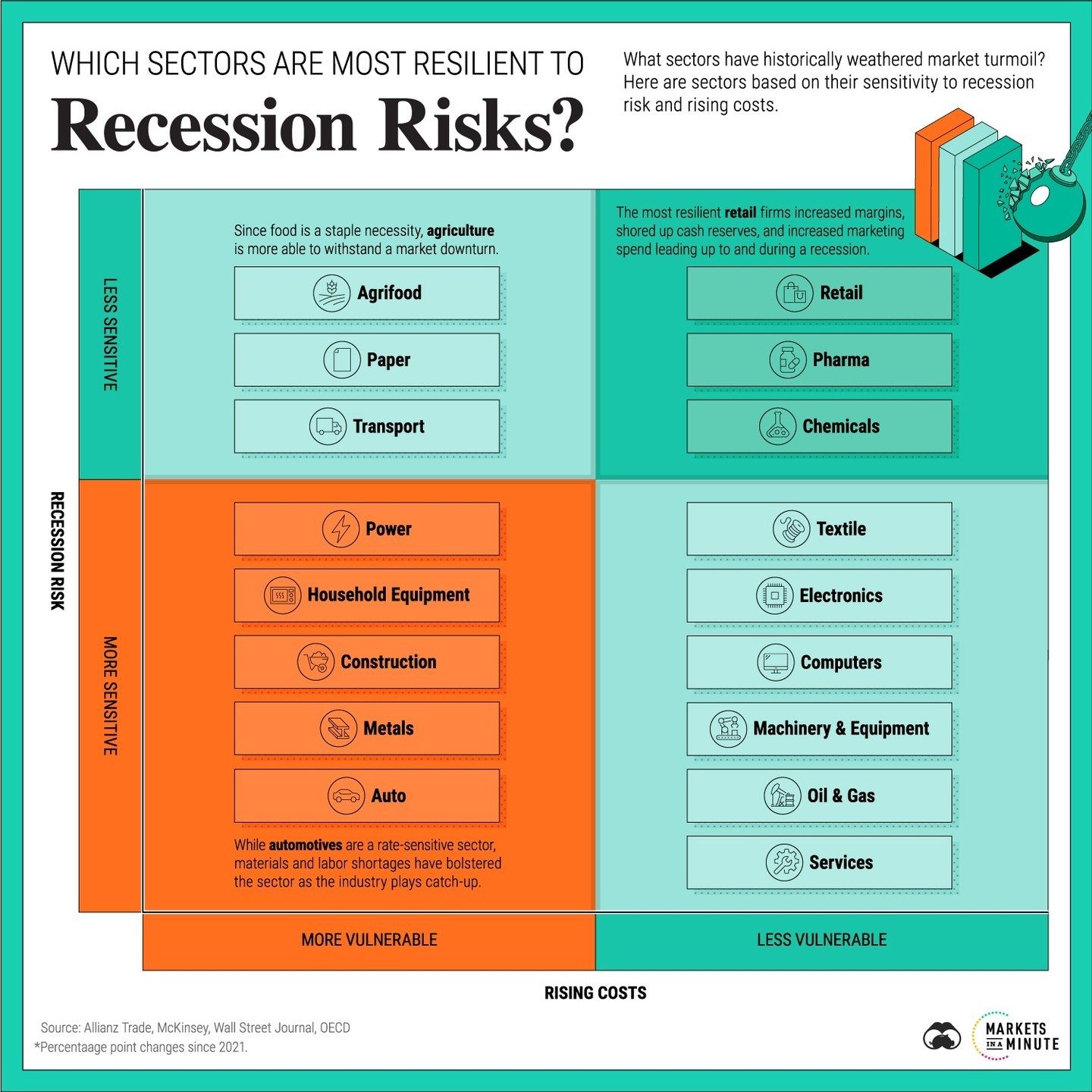
When economic downturns loom, certain sectors tend to fare better than others. Understanding which sectors are more resilient to recession risks and rising costs can provide valuable insights for investors and businesses alike. Key factors that contribute to a sector's resilience include less cyclical exposure, lower rate sensitivity, higher cash levels, and lower capital expenditures. These qualities help sectors weather economic storms more effectively.
Context / Why this matters
Economic recessions are periods of significant decline in general economic activity, typically defined by a fall in GDP in two successive quarters. During these times, consumer spending and business investments often decrease, leading to job losses and financial strain. However, not all sectors experience these effects equally. Some sectors, due to their inherent characteristics, are better equipped to navigate these turbulent waters. Identifying these resilient sectors can help in making informed decisions about investments, career choices, and business strategies.
Main discussion
Characteristics of Resilient Sectors
Sectors that are less affected by economic cycles, or are less cyclical, tend to perform better during recessions. These sectors often provide essential goods and services that people continue to demand regardless of economic conditions. Additionally, sectors with lower rate sensitivity are less impacted by changes in interest rates, making them more stable during economic downturns. Higher cash levels and lower capital expenditures also contribute to a sector's resilience by providing a financial cushion and reducing the need for external funding.
Sectors with Higher Cash Levels
Sectors like agriculture, retail, and pharmaceuticals (pharma) tend to have higher cash levels. These sectors often generate steady revenue streams and have lower capital expenditure requirements, allowing them to maintain financial stability even during economic downturns. Agriculture, for instance, is crucial for food supply and generally performs well even in recessions.
Lower Capital Expenditures
Sectors with lower capital expenditures are less likely to suffer from cash flow issues during recessions. This is because they do not need to invest heavily in new equipment, machinery, or infrastructure, which can be a significant drain on resources. For example, paper and agri-food sectors often have lower capital expenditures, making them more resilient.
Less Cyclical Exposure
Sectors with less cyclical exposure are less sensitive to fluctuations in the economy. These sectors provide essential goods and services that people need regardless of economic conditions. For example, the pharmaceutical industry is relatively insulated from economic downturns because people continue to need medical care and medications. Similarly, the retail sector, especially essential goods retailers, tends to be less affected by recessions.
Lower Rate Sensitivity
Sectors that are less sensitive to changes in interest rates are also more resilient. High-interest rates can increase borrowing costs and reduce consumer spending, but sectors like transportation and power often have stable demand and are less affected by these changes. This stability makes them less vulnerable to economic downturns.
Practical tips
Diversifying Investments
Diversifying investments across resilient sectors can help mitigate risks during economic downturns. By spreading investments across agriculture, retail, and pharmaceuticals, investors can protect their portfolios from the volatility associated with more cyclical sectors.
Building Cash Reserves
Businesses should focus on building cash reserves to provide a financial cushion during recessions. Sectors with higher cash levels, such as agriculture and retail, often fare better in economic downturns because they have the financial flexibility to weather the storm.
Managing Capital Expenditures
Controlling capital expenditures is crucial for maintaining financial health during recessions. Sectors like paper and agri-food, which have lower capital expenditure requirements, can benefit from strategic planning to reduce unnecessary spending and prioritize essential investments.
Staying Informed
Keeping up-to-date with economic indicators and market trends can help businesses and investors make informed decisions. Sectors that are less sensitive to economic cycles and interest rate changes, such as transportation and power, are likely to be more stable during recessions.
Important takeaways
Economic recessions can significantly impact various sectors, but some are better equipped to handle these challenges than others. Understanding the characteristics that contribute to a sector's resilience, such as less cyclical exposure, lower rate sensitivity, higher cash levels, and lower capital expenditures, can provide valuable insights. Sectors like agriculture, retail, and pharmaceuticals often have higher cash levels and lower capital expenditures, making them more resilient. Similarly, sectors with less cyclical exposure and lower rate sensitivity, such as transportation and power, tend to perform better during economic downturns. By diversifying investments, building cash reserves, managing capital expenditures, and staying informed, individuals and businesses can navigate recessions more effectively.
Conclusion
Economic downturns present unique challenges, but certain sectors are inherently more resilient. By focusing on sectors with less cyclical exposure, lower rate sensitivity, higher cash levels, and lower capital expenditures, investors and businesses can better prepare for economic turbulence. Understanding these dynamics can help in making informed decisions and safeguarding financial stability during uncertain times.
Watch the Reel
Questions readers ask
What makes certain sectors more resilient during economic recessions?
Resilient sectors typically have lower cyclical exposure, meaning they are less affected by economic cycles. They also have lower rate sensitivity, higher cash levels, and lower capital expenditures, which help them maintain stability when consumer spending and business investments decrease.
Why is agriculture considered a recession-proof sector?
Agriculture is considered recession-proof because it provides essential goods, like food, that are always in demand, regardless of economic conditions. Additionally, agricultural products often have lower price elasticity, meaning demand does not decrease significantly with price increases.
How does the retail sector fare during recessions?
While some segments of retail may struggle during recessions, others can thrive. Essential goods retailers, such as grocery stores and discount retailers, often see increased demand as consumers focus on necessities. However, luxury and non-essential retail may face significant declines.
What role do pharmaceuticals play in a recession?
The pharmaceutical industry is highly recession-resistant because it provides essential healthcare products and services. Demand for pharmaceuticals tends to remain stable or even increase during recessions, as people still need medications and healthcare services, regardless of economic conditions.
What types of businesses are more likely to weather economic downturns?
Businesses that provide essential goods and services, such as grocers, pharmacies, and healthcare providers, tend to be more recession-resistant. Additionally, businesses with strong cash reserves and lower capital expenditure needs are better equipped to handle financial strain during economic downturns.
Which sectors should investors consider during a recession?
Investors may want to consider sectors that provide essential goods and services, such as healthcare, agriculture, and certain segments of retail. These sectors tend to be less affected by economic downturns and can provide more stable returns during recessions.
How does a recession impact trade industries?
Trade industries, particularly those involved in the transportation and logistics of essential goods, may see increased demand during recessions. However, non-essential goods trade may face significant declines. The overall impact depends on the specific goods being traded and the regions involved.
Recent articles
Fresh deep dives from the latest Reels we unpacked.




Comments
Be the first to comment.