Real Estate Bubble Risk: An Analysis of Global Property Markets
For the past decade, low interest rates have fueled substantial price growth in property markets worldwide. While this trend has been beneficial for many, experts have raised concerns about the formation of real estate bubbles. These bubbles occur when asset values escalate rapidly beyond their intrinsic worth, often leading to a significant contraction or "crash." Understanding the dynamics of these bubbles is crucial for investors, homeowners, and policymakers alike.
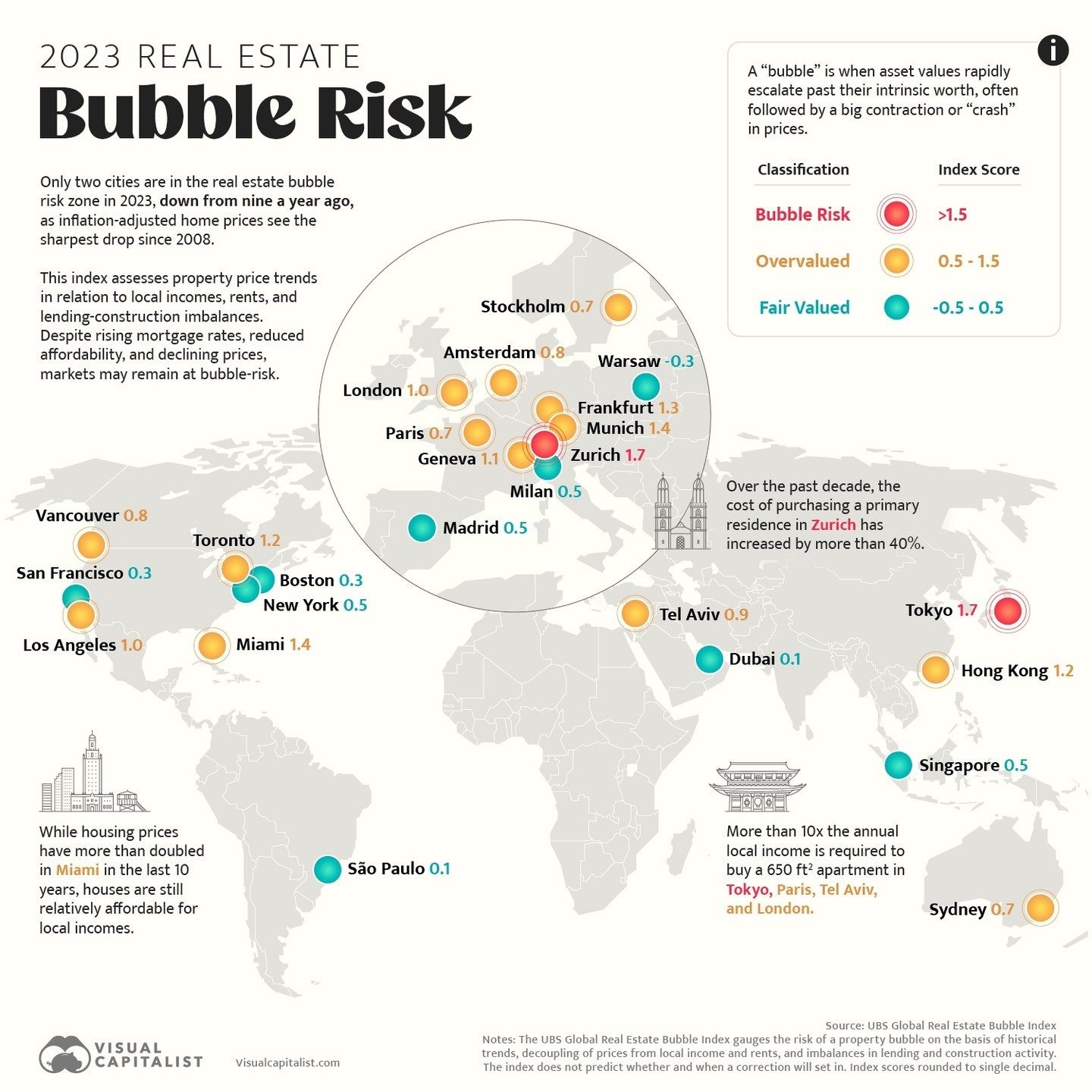
The UBS Global Real Estate Bubble Index provides a comprehensive analysis of property markets in 25 major cities. The index assigns a score between -0.5 and 2.0, with higher scores indicating a greater risk of a bubble. Let's delve into the key points and implications of this analysis.
Understanding the UBS Global Real Estate Bubble Index
The UBS Global Real Estate Bubble Index is a valuable tool for assessing the health of global property markets. The index evaluates property price trends in relation to local incomes, rents, and lending activities. This method provides a nuanced view of whether a market is fairly valued, overvalued, or at risk of a bubble.
Index Classification and Scores
The index classifies cities based on their scores:
- Bubble Risk (>1.5): Cities in this category are at high risk of a real estate bubble.
- Overvalued (0.5 - 1.5): Markets here are overpriced but may not be at immediate risk of a bubble.
- Fair Valued (-0.5 - 0.5): These cities have property prices that align with local incomes and rents.
- Undervalued (< -0.5): Markets in this range are likely undervalued, offering potential investment opportunities.
Cities at High Risk
Several cities have scores indicating high bubble risk:
- Tokyo (1.7): Despite a modest 3.6% price increase in the past year, Tokyo's high score suggests significant imbalances.
- Zurich (1.7): Similar to Tokyo, Zurich's score indicates a high risk of a bubble, though price growth has been relatively stable.
- Miami (1.4): Miami's score indicates a high risk, with a notable 1.4% price increase in the past year.
- Frankfurt (1.4): Despite a 13.8% price decline, Frankfurt's high score suggests ongoing concerns.
Cities with Fair Valuation
Some cities have scores indicating fair valuation:
- Vancouver (0.8): Vancouver's score suggests the market is overvalued but not in immediate bubble risk.
- Toronto (1.2): Toronto's score indicates a moderate risk, with a 6.0% price increase over the past year.
- Los Angeles (1.0): Los Angeles is overvalued but not in immediate bubble risk, with a 3.7% price decline.
Cities with Overvalued Markets
Several cities fall into the overvalued category:
- Stockholm (0.7): Stockholm's overvalued status is supported by a 22.1% price decline, indicating potential for correction.
- Paris (0.7): Paris' score shows overvaluation, with a 10.5% price decline.
Property Price Growth: A Global Perspective
Inflation-adjusted property price growth varies significantly across cities. Over the past year, some cities have seen notable increases and decreases. For example, San Francisco experienced a 14.6% price increase, while Stockholm saw a 22.1% decline.
Practical Tips for Navigating Real Estate Bubbles
- Stay Informed: Keep up with local market trends and economic indicators. Resources like the UBS Global Real Estate Bubble Index can provide valuable insights.
- Diversify Investments: Avoid putting all your assets into a single property or market. Diversification can help mitigate risks.
- Consider Long-Term Goals: Real estate investments should align with your long-term financial goals and risk tolerance.
- Monitor Local Economic Indicators: Pay attention to local incomes, rents, and lending activities. These factors can indicate potential market imbalances.
- Seek Professional Advice: Consulting with a financial advisor or real estate expert can provide tailored guidance.
Important Takeaways
- Risk Assessment: The UBS Global Real Estate Bubble Index is a valuable tool for assessing bubble risk. Cities with high scores like Tokyo and Zurich warrant close monitoring.
- Market Fluctuations: Property price growth varies widely, with some cities experiencing significant increases and others seeing declines.
- Diversification and Monitoring: Investors should diversify their portfolios and stay informed about local economic indicators.
Conclusion
The UBS Global Real Estate Bubble Index offers a comprehensive view of global property markets, highlighting cities at risk of real estate bubbles and those with fair valuations. Understanding these dynamics is essential for navigating the complex world of real estate investments. By staying informed, diversifying investments, and monitoring economic indicators, investors can make more informed decisions and better manage their risks.
Watch the Reel
Questions readers ask
Which cities are considered high risk in the 2023 UBS Global Real Estate Bubble Index?
The index identifies several cities as high risk, including Toronto, Frankfurt, and Zurich, which have scores close to or above 2.0. These cities are deemed to have a significant possibility of experiencing a real estate bubble. Other cities like Hong Kong and London also indicate high risk, though slightly lower than the top three.
What causes a real estate bubble and why do they pose a risk?
A real estate bubble occurs when real estate prices surge far beyond their intrinsic property value. This is often driven by factors such as low interest rates and high demand. Bubbles pose a risk because they can lead to a significant market correction or crash, causing substantial financial loss for investors and homeowners.
How does the UBS Global Real Estate Bubble Index work?
The index evaluates 25 major cities based on factors such as property market growth, real estate prices 2023, and other relevant economic indicators. Each city is assigned a score between -0.5 and 2.0, with higher scores indicating a greater risk of a real estate bubble. This helps investors and policymakers identify high risk real estate markets and make informed decisions.
When does a real estate bubble burst?
Predicting the exact moment a real estate bubble will burst is challenging, as it depends on a variety of factors. However, common indicators include a significant increase in housing prices, high demand with low supply, and excessive speculation. Generally, a burst occurs when demand suddenly drops due to higher interest rates or economic downturns.
What should investors do if they are concerned about a real estate bubble?
Investors should monitor key indicators such as local economic conditions, interest rates, and property market growth. Diversifying investments and avoiding high-risk markets are prudent strategies. Paying close attention to the UBS Real Estate Bubble Index can also help identify which cities are at higher risk, allowing investors to make data-driven decisions.
How can policymakers mitigate the risks of a real estate bubble?
Policymakers can employ a variety of strategies to mitigate risks, such as adjusting interest rates, implementing stricter lending regulations, and promoting affordable housing initiatives. Monitoring high risk real estate markets closely and taking proactive measures can help stabilize property markets and prevent significant market corrections.
What are the signs of a real estate price bubble in a city?
Signs can include rapid and unsustainable property market growth, a high ratio of property prices to income, and a significant influx of speculative investments. Additionally, a large number of new developments and low vacancy rates can indicate that a bubble may be forming, as these factors can drive real estate prices far beyond their intrinsic property value.
Recent articles
Fresh deep dives from the latest Reels we unpacked.




Comments
Be the first to comment.