Economic Imports: A Global Ranking
The United States imported $3.4 trillion worth of goods in 2023, amounting to 12% of its GDP. This figure highlights the significance of international trade for the U.S. economy. However, how does this compare to other major economies around the world? By examining the import dependency of the world's largest economies, we can gain a deeper understanding of global trade dynamics and economic interdependencies.
Context / Why This Matters
Economic imports are a crucial indicator of a country's economic health and its integration into the global market. They reflect a nation's reliance on foreign goods and services, which can be influenced by factors such as domestic production capabilities, trade agreements, and consumer demand. Understanding the import dependency of major economies provides insights into the strengths and vulnerabilities of different economic systems. This knowledge is valuable for policymakers, businesses, and investors who seek to navigate the complexities of international trade.
Main Discussion
Significance of Imports
Imports play a pivotal role in the economic landscape of any country. They not only fulfill domestic demand for goods and services that cannot be produced locally but also drive economic growth and innovation. By importing a wide range of products, countries can benefit from global specialization, which allows them to focus on sectors where they have a comparative advantage.
Global Import Dependency
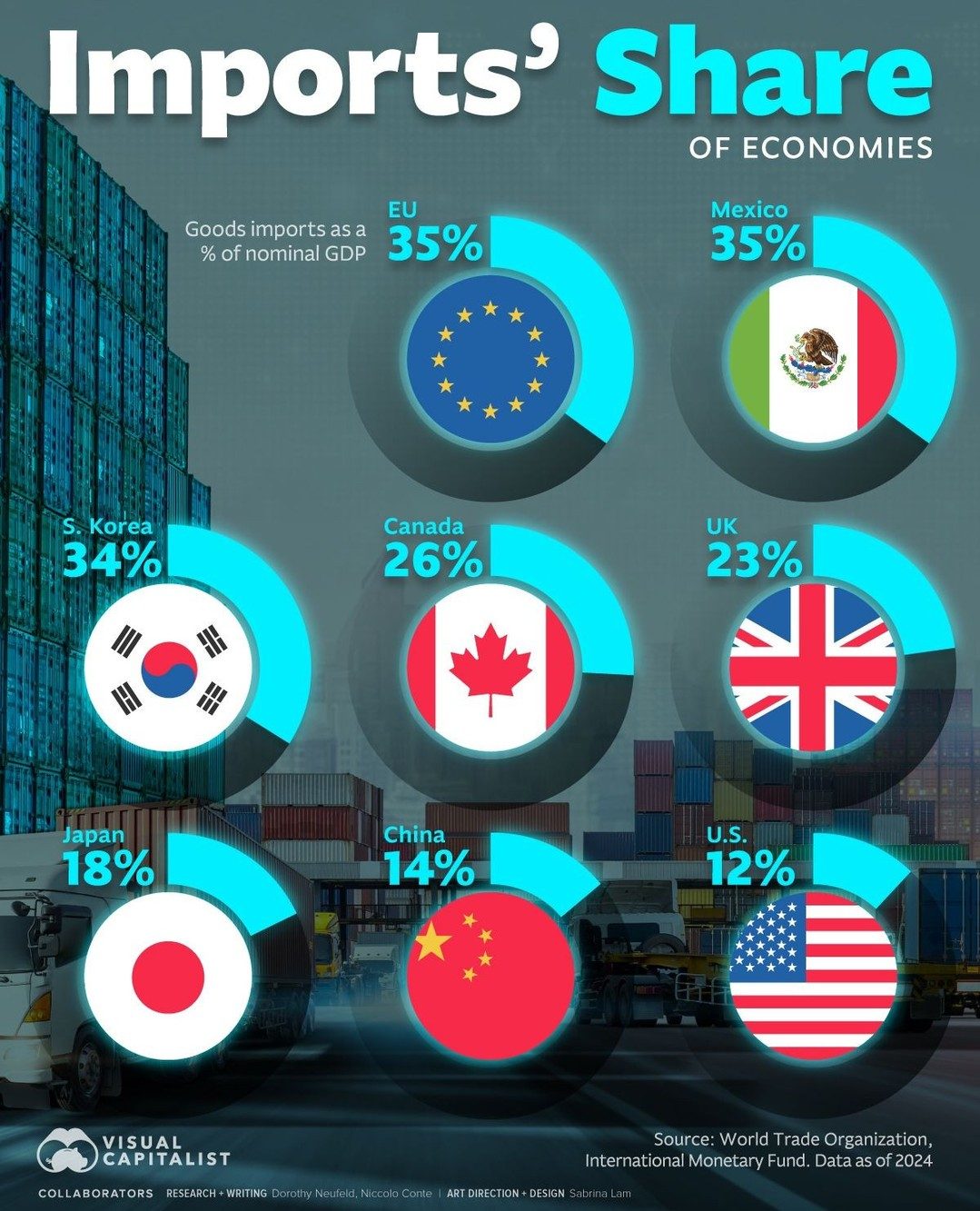
To understand the import dependency of the world's largest economies, we need to look at the share of goods imports as a percentage of nominal GDP. This metric provides a clear picture of how reliant a country is on foreign goods. According to recent data, the following countries and regions have varying levels of import dependency:
- South Korea: 34% of nominal GDP
- Japan: 18% of nominal GDP
- China: 14% of nominal GDP
- United States: 12% of nominal GDP
- UK: 23% of nominal GDP
- Canada: 26% of nominal GDP
- Mexico: 35% of nominal GDP
- European Union: 35% of nominal GDP
These figures reveal that while the U.S. has a significant import share, several other major economies are even more reliant on imports. South Korea, Mexico, and the EU stand out with the highest import dependencies, indicating their heavy reliance on foreign goods to sustain their economies.
Regional and Country-Specific Insights
South Korea and Japan
South Korea and Japan are among the top importers in terms of percentage of GDP. South Korea's 34% import dependency is the highest among the listed countries, highlighting its extensive reliance on foreign goods. Japan, with an 18% share, also demonstrates a substantial import dependency, driven by its advanced manufacturing sector, which requires a steady supply of raw materials and components.
China and the United States
China's 14% import share reflects its status as a major manufacturing hub. Despite being the world's largest exporter, China still relies on imports for raw materials, technology, and intermediate goods. The U.S., with a 12% import share, has the lowest dependency among the major economies listed. This relatively lower figure can be attributed to the country's large and diversified domestic production capabilities and high consumer demand.
UK, Canada, and Mexico
The UK's 23% import share indicates a moderate level of dependency on foreign goods. This can be attributed to the country's strong service sector and its historical reliance on international trade. Canada, with a 26% import share, has a higher dependency due to its extensive trade relationships with the U.S. and other major economies. Mexico's 35% import share is driven by its close economic ties with the U.S. and its role as a manufacturing hub for various industries, including automotive and electronics.
European Union
The EU's 35% import share is the highest among the listed regions, reflecting its deep integration into global trade networks. The EU's reliance on imports is driven by its vast and diverse economic landscape, which encompasses a wide range of industries and consumer markets. The EU's import dependency highlights the importance of international trade for its economic stability and growth.
Sources and Data
The data presented in this article is sourced from the World Trade Organization and the International Monetary Fund, providing a comprehensive view of global import dependencies as of 2024. These sources offer reliable and up-to-date information, ensuring that the insights provided are grounded in credible and authoritative data.
Practical Tips
Understanding global import dependencies can provide valuable insights for businesses, investors, and policymakers. Here are some practical tips for leveraging this information:
-
Businesses: Companies looking to expand their operations globally can identify potential markets with high import dependencies. This can help in tailoring their products and services to meet the specific needs and demands of these markets.
-
Investors: Investors can use import dependency data to assess the economic health and stability of different countries. Higher import dependencies may indicate a greater reliance on global trade, which can be both an opportunity and a risk factor.
-
Policymakers: Policymakers can use this information to develop trade policies that promote economic growth and stability. By understanding the import dependencies of different economies, they can create strategies that enhance international trade and mitigate potential risks associated with high import reliance.
Important Takeaways
- Global Trade: Economic imports are a critical component of global trade, driving economic growth and innovation.
- Import Dependency: The share of goods imports as a percentage of nominal GDP provides a clear picture of a country's reliance on foreign goods.
- Regional Variability: Different regions and countries have varying levels of import dependency, reflecting their economic structures and trade relationships.
- Insights for Businesses, Investors, and Policymakers: Understanding import dependencies can provide valuable insights for strategic decision-making and policy development.
Conclusion
The global landscape of economic imports is complex and dynamic, with different countries and regions exhibiting varying levels of import dependency. By examining the share of goods imports as a percentage of nominal GDP, we gain a deeper understanding of how reliant these economies are on foreign goods. This knowledge is invaluable for businesses, investors, and policymakers seeking to navigate the intricacies of international trade and economic development. Whether it's the U.S. with its relatively lower import share or South Korea with its high dependency, each economy's import profile tells a unique story of trade, growth, and global interdependence.
Watch the Reel
Questions readers ask
Which country had the highest import dependency in 2023?
South Korea had the highest import dependency among the countries analyzed in 2023, with imports accounting for 34% of its GDP. This indicates a significant reliance on foreign goods and services for the country's economic activity.
How do the import dependencies of the United States and Japan compare?
The United States had an import dependency of 12% of its GDP in 2023, while Japan's import dependency was slightly higher at 16%. This means that Japan is more reliant on imports relative to the size of its economy compared to the United States.
What does a high import dependency indicate about a country's economy?
A high import dependency suggests that a country is heavily reliant on foreign goods and services. This can be due to various factors, including limited domestic production capabilities, strong consumer demand for foreign products, or strategic trade agreements.
Which major economies had the lowest import dependency in 2023?
Among the major economies, the United States had one of the lowest import dependencies at 12% of GDP. Other countries with relatively low import dependencies include India and Brazil, although specific figures for these countries are not provided in the article.
How do import dependencies reflect global trade dynamics?
Import dependencies provide insights into how integrated a country is within the global market. High import dependencies indicate strong interdependencies among nations, while low import dependencies may suggest a more self-sustaining economy or specific trade barriers.
What factors can influence a country's import dependency?
Several factors can influence a country's import dependency, including domestic production capabilities, trade agreements, tariffs, and consumer demand for foreign goods. Additionally, a country's economic policies and industrial strategies play a significant role in shaping its import reliance.
Recent articles
Fresh deep dives from the latest Reels we unpacked.




Comments
Be the first to comment.