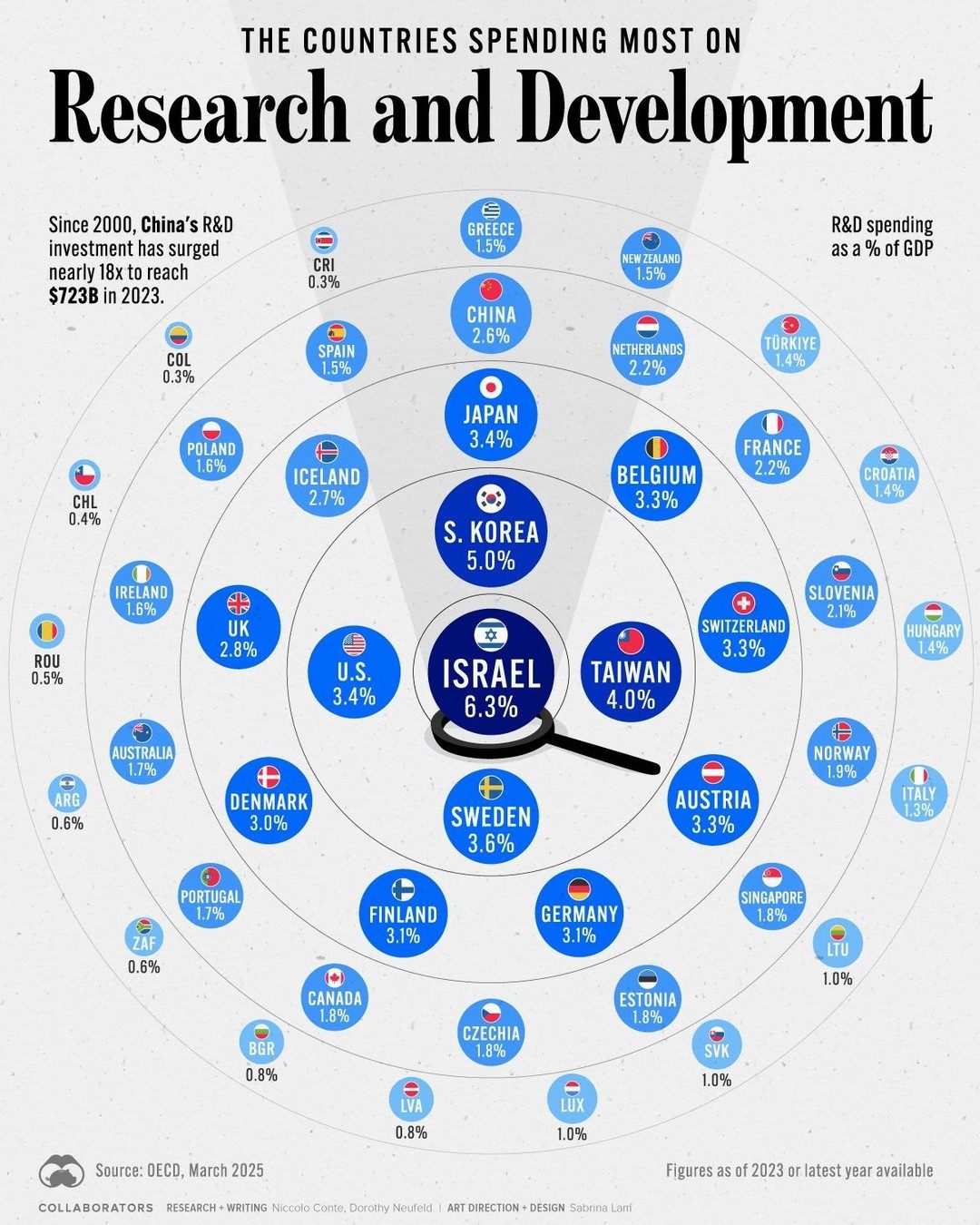
R&D Spending by Country
Research and development (R&D) investment is a critical driver of innovation and economic growth. Globally, countries allocate varying percentages of their GDP to R&D, reflecting their commitment to technological advancement and economic competitiveness. In 2023, Israel led the pack, spending $28.3 billion, which amounted to 6.3% of its GDP. This figure is more than double the average spending by OECD countries, highlighting Israel's significant R&D investment. In contrast, the United States, with the highest overall R&D spending globally, allocated 3.4% of its GDP, totaling $823.4 billion.
Why This Matters
Understanding R&D spending as a percentage of GDP provides valuable insights into a country's priorities and future growth potential. High R&D investment often correlates with technological advancements, new product innovations, and improved economic performance. Countries that prioritize R&D are better poised to tackle global challenges, foster entrepreneurship, and maintain a competitive edge in the global market. This spending fuels advancements not only in technology but also in healthcare, education, and environmental sustainability.
Main Discussion
Global Leaders in R&D Investment
While Israel and the United States are at the forefront of R&D spending, other countries are also making substantial investments. South Korea, for instance, allocated 5.0% of its GDP to R&D, emphasizing its commitment to technological innovation. Taiwan followed closely with 4.0% of its GDP invested in R&D, showcasing a strong focus on research and development.
Rising Stars in R&D
Several countries have shown remarkable growth in their R&D spending. Notably, China's R&D investment has surged significantly since 2000, indicating a rapid acceleration in its commitment to innovation. This surge is a testament to China's strategic focus on becoming a global leader in technology and innovation.
Denmark, Sweden, and Switzerland have also made significant strides. Denmark and Switzerland each contributed 3.0% and 3.3% of their GDP to R&D, respectively, while Sweden invested 3.6%. These countries are known for their robust innovation ecosystems and high-quality research institutions, contributing to their economic growth and competitiveness.
Emerging Economies
Emerging economies like Argentina, Portugal, and Greece are seeing increasing R&D spending, although still relatively lower than leading countries. For instance, Argentina allocated 0.6% of its GDP, Portugal 1.7%, and Greece 0.3%. While these figures might seem modest, they reflect a growing recognition of the importance of R&D in driving future economic growth and innovation.
Practical Tips
For countries looking to enhance their R&D capabilities, several strategies can be effective:
-
Increase Public Funding: Governments can allocate more funds to R&D to foster innovation and attract private investment. Public funding often catalyzes private sector involvement, leading to more substantial overall R&D investments.
-
Encourage Private Sector Participation: Creating incentives for the private sector to invest in R&D through tax breaks, grants, and other forms of support can significantly boost innovation. Collaborative research between public and private entities can lead to groundbreaking discoveries and technological advancements.
-
Invest in Education and Training: Developing a skilled workforce with advanced knowledge in science, technology, engineering, and mathematics (STEM) fields is crucial. Investment in education and training programs ensures a steady supply of talent capable of driving innovation.
-
Promote International Collaboration: Collaborations with other countries can facilitate the exchange of knowledge, technology, and best practices. International partnerships can accelerate innovation and help countries achieve their R&D goals more efficiently.
-
Foster a Supportive Innovation Ecosystem: Creating an environment that supports entrepreneurship, startups, and small and medium-sized enterprises (SMEs) is essential. This includes providing access to funding, mentoring, and market opportunities.
Important Takeaways
-
High R&D Spending Leads to Innovation: Countries that invest heavily in R&D are generally at the forefront of technological and scientific advancements, which drive economic growth and competitiveness.
-
Public and Private Sector Collaboration: Effective collaboration between public and private sectors can maximize the impact of R&D investments. Public funding often triggers private sector involvement, leading to more substantial overall R&D investments.
-
Education and Training: Investing in STEM education and training programs is crucial for developing a skilled workforce capable of driving innovation.
-
Global Trends: Countries across the globe are increasingly recognizing the importance of R&D spending, with both developed and emerging economies making significant strides in this area.
Conclusion
R&D investment is a cornerstone of economic growth and innovation. Countries around the world are making substantial investments in R&D, with varying degrees of success and impact. Leading countries like Israel, South Korea, and the United States exemplify the benefits of high R&D spending, while emerging economies are also increasing their investments. Understanding global R&D trends and best practices can help countries develop effective strategies to boost their innovation capabilities and economic competitiveness.
Watch the Reel
Questions readers ask
Which country spent the highest percentage of its GDP on R&D in 2023?
Israel spent the highest percentage of its GDP on R&D in 2023, allocating 6.3% of its GDP, which amounted to $28.3 billion. This was more than double the average spending by OECD countries.
How does the United States compare to other countries in terms of R&D spending?
The United States had the highest overall R&D spending in 2023, with $823.4 billion allocated to R&D, which was 3.4% of its GDP. This puts it among the top countries in terms of R&D investment but not the highest as a percentage of GDP.
What insights can be gained from comparing R&D spending as a percentage of GDP?
Comparing R&D spending as a percentage of GDP offers insights into a country's focus on innovation and future growth. Higher percentages often indicate a stronger commitment to technological advancement and economic competitiveness.
How has R&D spending by China evolved in recent years?
China has significantly increased its R&D spending in recent years, reflecting its growing focus on innovation and technological self-sufficiency. It is one of the top countries in terms of overall R&D investment and has shown a strong upward trend in R&D spending since 2000.
Why is it significant that Israel's R&D spending is more than double the OECD average?
Israel's R&D spending being more than double the OECD average highlights the country's exceptional commitment to innovation. This significant investment suggests a strong emphasis on developing advanced technologies and maintaining a competitive edge in the global economy.
Which countries are typically included in R&D investment comparisons, and why?
Countries like Israel, the United States, and China are typically included in R&D investment comparisons due to their high levels of investment. These countries have a substantial impact on global innovation trends, making them key players in R&D investment analysis.
What is the trend in R&D spending since 2000, and which countries have shown notable increases?
Since 2000, there has been a general upward trend in R&D spending globally, with countries like China showing notable increases. This trend reflects a growing recognition of the importance of innovation in driving economic growth and competitiveness.
Related deep dives
Similar reads based on topic and creator.


Recent articles
Fresh deep dives from the latest Reels we unpacked.




Comments
Be the first to comment.