Market Liquidity and Volatility
Market liquidity and volatility are pivotal components of financial markets, and recent actions by the Federal Reserve, such as interest rate hikes and quantitative tightening (QT), have significantly impacted these dynamics. QT refers to the process by which the Federal Reserve reduces its holdings of Treasuries and mortgage-backed securities. This reduction in the central bank's balance sheet has led to a drying up of liquidity across markets, which in turn has amplified volatility and uncertainty.
Why This Matters
Understanding the relationship between liquidity, volatility, and central bank policies is crucial for investors, traders, and financial analysts. Liquid markets facilitate smooth trading and stable prices, while volatility reflects the market's uncertainty and risk. When liquidity declines, markets can become more volatile, making it challenging to execute trades and manage portfolios effectively.
Main Discussion
Quantitative Tightening and Market Liquidity
Quantitative tightening is the reverse process of quantitative easing (QE). While QE involves purchasing assets to inject liquidity into the market, QT involves selling these assets or allowing them to mature without reinvestment. This reduction in the money supply can lead to a decrease in market liquidity. As the Federal Reserve begins QT, it reduces its holdings of Treasuries and mortgage-backed securities, which in turn impacts the overall liquidity in the market.
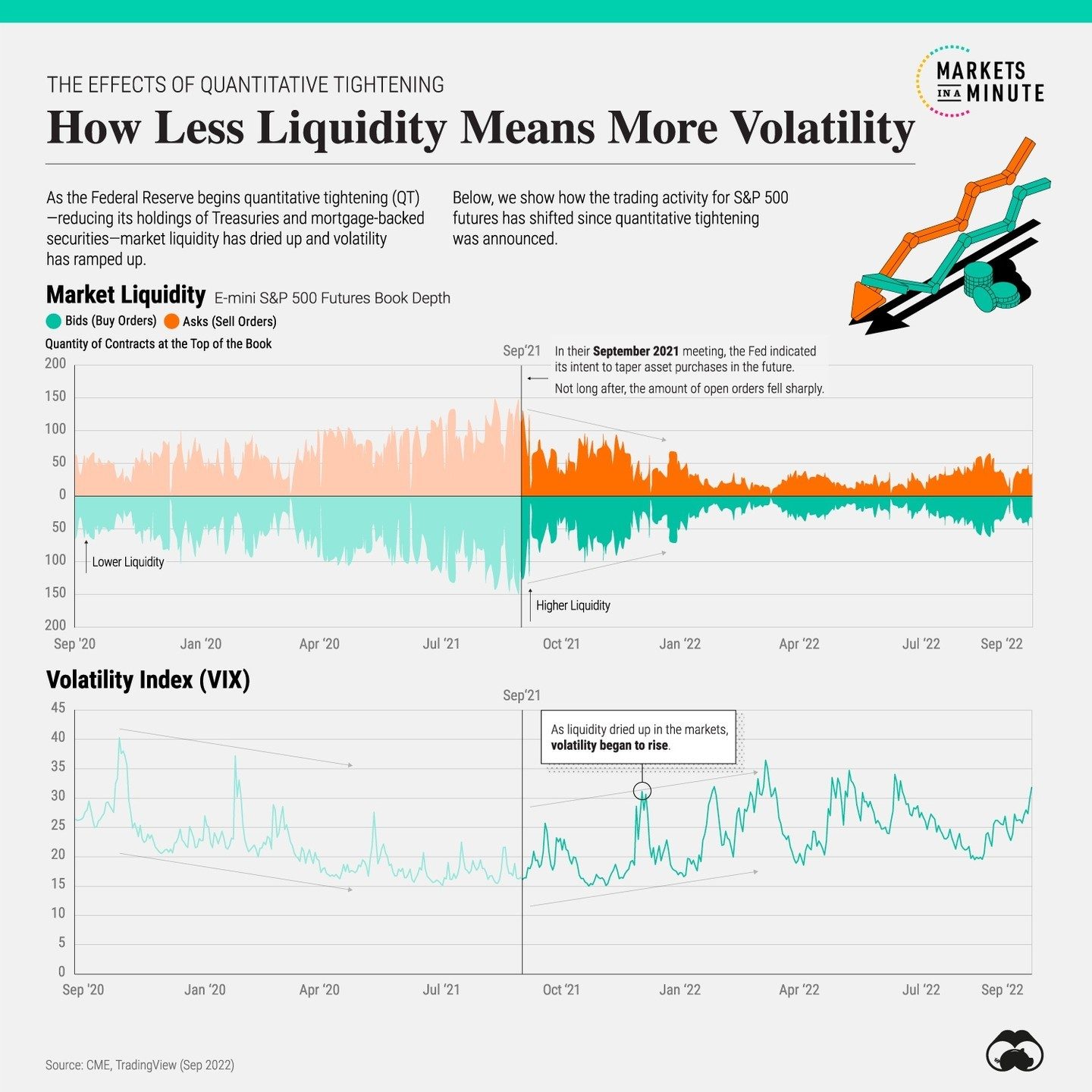
The E-mini S&P 500 futures book depth provides a clear illustration of this phenomenon. The book depth refers to the number of contracts available at different price levels. When market liquidity dries up, the depth of the order book decreases, meaning there are fewer contracts available for trading. This reduction in available contracts can lead to increased market volatility, as traders find it more difficult to execute trades at desired prices.
Impact on the Volatility Index (VIX)
The volatility index, often referred to as the VIX, is a measure of market expectations of near-term volatility conveyed by S&P 500 index option prices. As market liquidity declines, the VIX tends to rise, indicating increased market uncertainty and risk. The VIX serves as a barometer for market sentiment and is closely watched by investors and traders.
When liquidity dries up, the VIX can spike, reflecting heightened market anxiety. For instance, the VIX began to rise significantly as the Federal Reserve initiated QT, coinciding with a decline in the E-mini S&P 500 futures book depth. This correlation underscores the crucial role that liquidity plays in maintaining market stability and predictability.
Practical Tips
-
Monitor Liquidity Indicators: Keep an eye on liquidity indicators such as order book depth and trading volumes. Decreases in these metrics can signal impending volatility.
-
Diversify Your Portfolio: Diversification can help mitigate the risks associated with market volatility. By spreading investments across different asset classes and sectors, investors can reduce their exposure to any single source of risk.
-
Use Risk Management Tools: Implement risk management strategies, such as stop-loss orders and position sizing, to protect your portfolio from sudden market movements.
-
Stay Informed About Monetary Policy: Understand the implications of central bank policies, including QT, on market liquidity and volatility. Staying informed can help you anticipate market shifts and adjust your investment strategies accordingly.
-
Leverage Volatility Indices: Use the VIX and other volatility indices to gauge market sentiment and make informed trading decisions. These indices can provide valuable insights into the market's expectations of future volatility.
Important Takeaways
-
Quantitative Tightening Reduces Liquidity: As the Federal Reserve reduces its holdings of Treasuries and mortgage-backed securities, market liquidity declines, leading to increased volatility.
-
Liquidity and Volatility are Intricately Linked: A decrease in market liquidity, as evidenced by a shrinking order book depth, can lead to a rise in market volatility and uncertainty.
-
Monitor Key Indicators: Regularly monitor liquidity indicators, such as order book depth and trading volumes, to anticipate potential volatility.
Conclusion
The impact of quantitative tightening on market liquidity and volatility cannot be overstated. As the Federal Reserve continues to reduce its balance sheet, investors and traders must remain vigilant and adapt their strategies to navigate the changing market landscape. By understanding the relationship between liquidity, volatility, and central bank policies, financial market participants can better manage risk and capitalize on opportunities. Keep a close watch on liquidity indicators, diversify your portfolio, and leverage risk management tools to protect your investments in an ever-changing market environment.
Watch the Reel
Questions readers ask
What is quantitative tightening (QT) and how does it affect market liquidity?
Quantitative tightening is a process used by the Federal Reserve to reduce its holdings of Treasuries and mortgage-backed securities, which decreases the money supply in the market. This reduction can lead to a drying up of liquidity, making it more difficult for investors to buy and sell assets quickly and at stable prices.
How does QT impact market volatility?
By reducing liquidity, QT can amplify market volatility. With fewer assets available for trading, price movements can become more dramatic, and markets may experience greater uncertainty, making trading and portfolio management more challenging.
What are the implications of QT for investors and traders?
Investors and traders need to be aware of the potential for increased volatility and reduced liquidity during periods of QT. It's crucial to adjust strategies to accommodate these changes, such as using limit orders to ensure trades execute at desired prices.
Can QT affect different asset classes differently?
Yes, QT can have varying impacts on different asset classes. For example, the stock market might experience heightened volatility, while the bond market could see more significant liquidity constraints due to the direct reduction in Treasury holdings.
How do interest rate hikes and QT work together to impact the market?
Interest rate hikes and QT can work in tandem to tighten financial conditions. Rate hikes increase the cost of borrowing, while QT reduces the money supply, both of which can lead to lower market liquidity and higher volatility.
What strategies can investors use to navigate markets during QT?
Investors can consider diversifying their portfolios, focusing on high-liquidity assets, and using risk management tools. Additionally, staying informed about Federal Reserve policies and market conditions can help in making more informed trading decisions.
How does QT affect market depth and order flow?
QT can lead to a decrease in market depth as there are fewer market makers and participants willing to provide liquidity. This can result in wider bid-ask spreads and less consistent order flows, making it harder for large orders to be executed without impacting prices.
Recent articles
Fresh deep dives from the latest Reels we unpacked.




Comments
Be the first to comment.