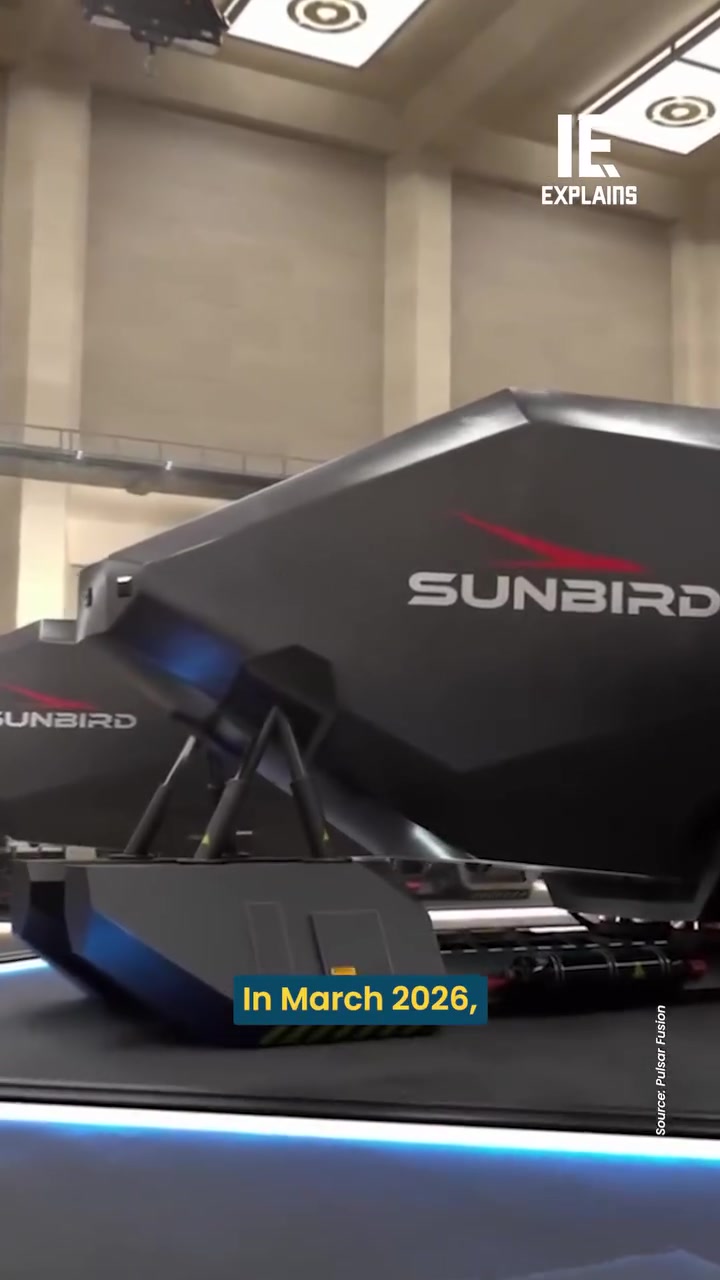
The Sunbird rocket engine ignites a new era of space propulsion. “In March 2026,” narrates a voiceover, “a British company switched on a fusion rocket engine and got plasma glowing inside it.” This is Pulsar Fusion’s Sunbird, an advanced engine aiming to transform space travel.
The Rocket Engine Created With Pulsar Fusion
The Sunbird is a fusion rocket engine developed as part of a 2026 project by Pulsar Fusion. Unlike traditional chemical rockets, Sunbird harnesses magnetic fields to accelerate charged particles with electric currents. The key breakthrough: utilizing krypton as its propellant, Sunbird's technology can accelerate this charged plasma so effectively that it promises to revolutionize space travel. The magnetic pinch holds charged particles in place and accelerates them in a highly efficient manner. While the test conducted in 2026 showcased plasma glow inside the engine, actual fusion was not achieved. However, this was an anticipated milestone that tested the exhaust end of Sunbird’s engine, ensuring its core components function as designed. The engine's performance can be measured by tracking how thrust-generating components, or krypton velocity, the kinetic energy generated by charged particles, and how strong fields hold them in place.
Paving the Path to Future Space Exploration
Space exploration thrives on innovation, and Sunbird epitomizes this spirit. Recent years have seen increased emphasis on fast, efficient travel. Sunbird’s specifications position it at the cutting edge of propulsion technology. The engine's efficiency is pivotal in reducing travel times for high-speed space missions. The Sunbird aims to propel spacecraft to Mars in just 150 days, showcasing potential for shorter travel times for current missions to Mars, which take around 6–8 months, or to the edge of the solar system for future voyages.
Measuring Up to the Challenge
The Scientific Underpinnings
Sunbird’s groundwork involves a proprietary combination of electric and magnetic fields. Instead of combusting fuel, the engine holds and accelerates charged particles. This is achieved by using rare-earth superconducting magnets, which create strong fields essential for accelerating the plasma. At its core, the Sunbird achieves control with the use of RF heating and rotating magnetic fields. The complexity of the technology goes beyond the simple scientific principles required for propulsion. It incorporates Pulsar’s expertise with the UK Atomic Energy Authority on how neutron radiation impacts reactor walls and magnets, crucial for its long-term durability.
Validation Through Testing
Beyond the technical specifications, Sunbird’s engine relies on rigorous testing methods. To prove its capabilities, a thrust balance system and high-powered sensors monitor performance metrics like thrust and exhaust velocity. These tools validate that Sunbird is performing as designed, ensuring that the technology is not only ahead of its time but reliable for current space travel.
International Collaboration
Pulsar’s Sunbird benefits from global collaboration, as highlighted by the company's work with the UK Atomic Energy Authority. This collaboration addresses the crucial aspect of neutron radiation. This collaboration aids in understanding how neutron radiation can impact magnet and reactor components. The goal is to make Sunbird’s technology robust and lasting.
The Rockets of Tomorrow
Aneutronic Fusion Fuel
A key milestone, the Sunbird aims to utilize aneutronic fusion fuel. This type of fuel does not generate neutrons, making it safer and more efficient. This fuel promises to be the cornerstone of advanced spacecraft propelled by Sunbird – with the long-term target of facilitating shorter, safer missions. On paper, the Sunbird promises 2 megawatts of power. This level of power is essential for future space travel endeavors, making the deliveries possible in a shorter amount of time to previously inaccessible locations.
The Promise of Space Travel
The Sunbird’s expected mission to Mars in approximately 150 days is just one example of its potential. The engine’s high thrust and efficient exhaust velocity are poised to redefine space missions. By accelerating these particles at high velocities, Pulsar Fusion aims to reduce travel times significantly, revolutionizing space travel. This development reflects a broader trend in space exploration: the quest for more efficient, faster, and reliable means of propulsion.
The Sunbird’s Potential for Aspiring Space Enthusiasts
- Fuel Efficiency: The Sunbird uses krypton as its propellent, promising better efficiency and reduced fuel consumption compared to traditional rockets.
- Testing Specifications: For enthusiasts: The thrust balance and sensors on the Sunbird are critical for measuring its performance.
- Long-Term Impact: The Sunbird engine offers a glimpse into the future of space travel. With its ability to reach Mars in under 150 days, Pulsar Fusion’s development signifies a leap towards faster and safer space missions. Aspiring space experts and enthusiasts can expect a future where space travel becomes even more accessible and less complicated. A final note: Sunbird's focus is on creating a paradigm shift in space propulsion. As the spotlight on Pulsar Fusion’s redefining technologies continues, fuel efficiency and travel time will remain at the forefront.
Watch the Reel
Related deep dives
Similar reads based on topic and creator.
Recent articles
Fresh deep dives from the latest Reels we unpacked.




Comments
Be the first to comment.