Public Opinion on Tariffs between the United States and Canada
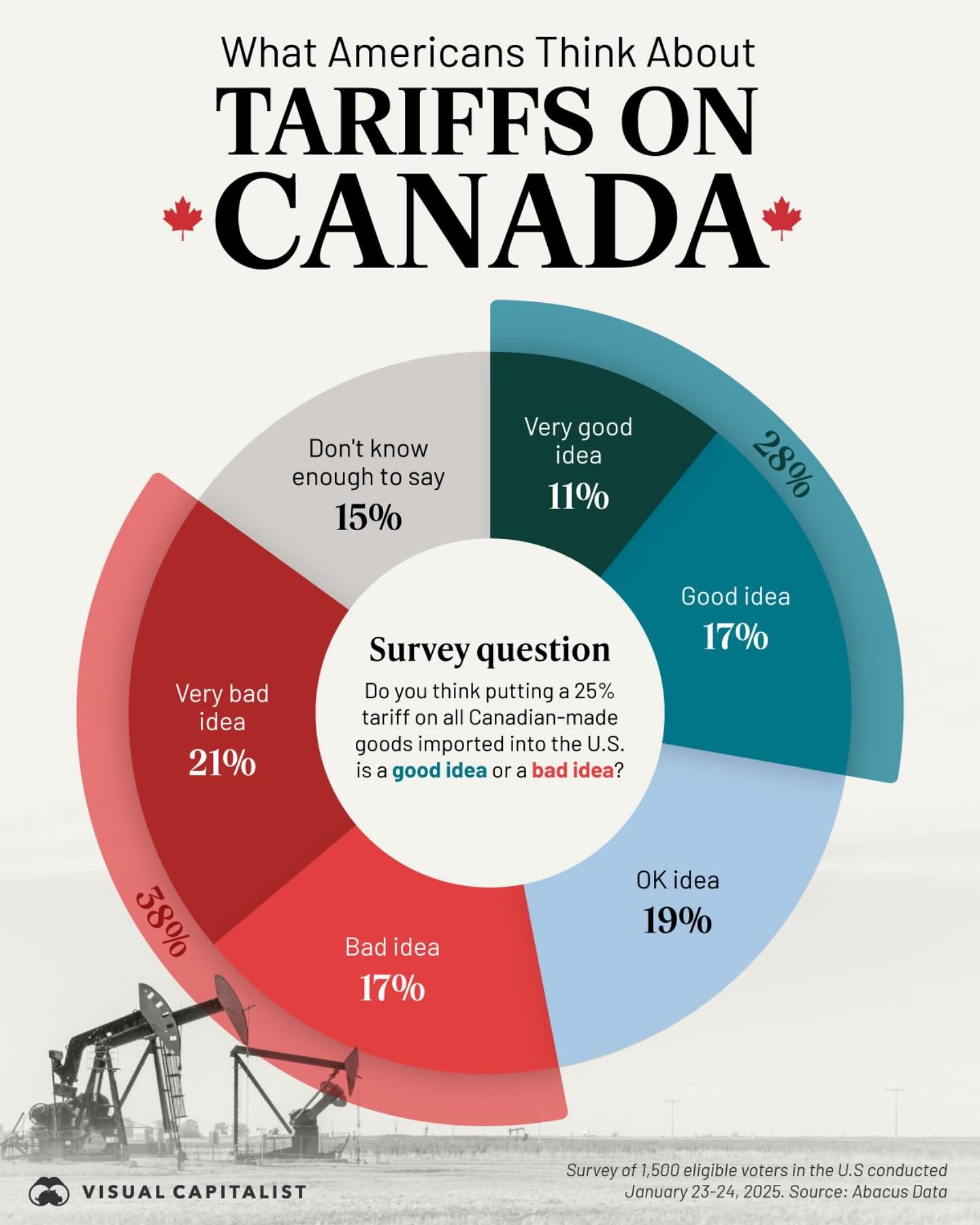
Tariffs on Canadian goods have been a contentious issue, particularly during the presidency of Donald Trump. The proposal for a 25% tariff on all Canadian-made goods imported into the U.S. and a 10% tariff on Canadian energy, although put on hold, ignited a significant debate. To understand the public sentiment surrounding this issue, a survey was conducted among 1,500 eligible voters in the U.S. by Abacus Data and GZERO Media. The results provide valuable insights into how Americans perceive tariffs on Canadian imports.
Among the survey participants, 28% of Americans felt that tariffs on Canadian goods were a good idea. This sentiment was broken down further into specific opinions:
- 11% thought it was a "Very good" idea.
- 17% considered it a "Good" idea.
- 19% viewed it as an "OK" idea.
- 17% thought it was a "Bad" idea.
- 21% deemed it a "Very bad" idea.
- 15% did not know enough to form an opinion.
These statistics highlight the diversity of public opinion on the matter, indicating that while a notable portion of the population supports or is indifferent to the tariffs, a significant majority holds negative views.
Context: Why This Matters
Tariffs are a critical tool in international trade policy, often used to protect domestic industries from foreign competition. However, they can also lead to retaliatory measures from trading partners, potentially escalating into broader trade wars. Understanding public opinion on tariffs is essential for policymakers to gauge the political feasibility and potential public backlash of such measures.
Main Discussion
Historical Context of U.S.-Canada Trade Relations
The trade relationship between the United States and Canada is one of the most significant in the world. The two countries share the world's largest bilateral trade relationship, with billions of dollars in goods and services exchanged annually. This deep economic integration is underpinned by several trade agreements, including the North American Free Trade Agreement (NAFTA), later replaced by the United States-Mexico-Canada Agreement (USMCA).
The Tariff Proposal
President Trump's proposal for a 25% tariff on all Canadian-made goods and a 10% tariff on Canadian energy was part of a broader strategy to renegotiate trade terms and address trade deficits. The tariffs were intended to pressure Canada into negotiating more favorable terms for the U.S. However, the proposal sparked significant debate, with critics arguing that it could harm bilateral relations and lead to economic repercussions for both countries.
Public Opinion and Political Implications
The survey results reveal a divided public opinion on tariffs, which has important implications for political leaders. Policymakers must consider public sentiment when formulating and implementing trade policies. The significant portion of Americans who view tariffs negatively suggests that any move towards increased tariffs would likely face substantial opposition.
Economic Impact
Tariffs can have a profound impact on the economy, affecting both consumers and producers. Higher tariffs on imports increase the cost of goods, which can lead to inflation and reduced purchasing power for consumers. For producers, tariffs can create both opportunities and challenges. Domestic producers may benefit from reduced competition, but increased tariffs can also lead to higher input costs, particularly for industries that rely on imported materials.
Public Sentiment and Consumer Behavior
Consumer behavior is closely tied to public sentiment. Negative public opinion on tariffs can influence purchasing decisions, as consumers may avoid goods from countries with high tariffs. This can have a ripple effect on the broader economy, affecting retail sales, employment, and overall economic growth.
Energy Sector Implications
The proposed 10% tariff on Canadian energy is particularly notable, given the significant role of energy in the U.S.-Canada trade relationship. Canada is a major supplier of oil and gas to the U.S., and any disruption in this supply chain could have severe consequences for both countries. The survey results suggest that a substantial portion of the public is against tariffs on energy, indicating potential resistance to any policy that threatens energy security and affordability.
Practical Tips
For those interested in understanding the broader implications of tariffs, here are some practical tips:
- Stay Informed: Follow developments in trade policy and public opinion through credible news sources and research institutions.
- Engage in Dialogue: Participate in discussions with policymakers, industry experts, and fellow citizens to share your views and learn from others.
- Educate Yourself on Trade Agreements: Understand the provisions and implications of key trade agreements, such as the USMCA, to better grasp the context of current trade debates.
- Consider Economic Impact: Evaluate how tariffs could affect different sectors of the economy and your personal finances.
Important Takeaways
The survey results on tariffs between the United States and Canada highlight several key points:
- Public opinion on tariffs is divided, with a significant portion viewing them as a "Very bad" idea.
- Tariffs can have wide-ranging economic and political implications, affecting everything from consumer prices to international relations.
- Understanding public sentiment is crucial for policymakers in formulating effective and politically feasible trade policies.
- Tariffs on energy, in particular, can have significant implications for both economic stability and energy security.
Conclusion
The debate over tariffs on Canadian goods underscores the complex interplay between economic policy, public opinion, and international relations. The survey results provide a snapshot of American sentiment, revealing a divided public with significant concerns about the potential impact of tariffs. As the U.S. and Canada continue to navigate their economic relationship, understanding and addressing these public sentiments will be essential for shaping effective and sustainable trade policies.
Watch the Reel
Questions readers ask
Why did Trump propose tariffs on Canadian goods?
Trump proposed tariffs on Canadian goods, specifically a 25% tariff on all imported items and a 10% tariff on energy, as part of broader trade negotiations. He aimed to reduce the trade deficit and protect American industries, although these tariffs were eventually put on hold.
How do most Americans feel about Trump's tariffs on Canada?
According to a survey by Abacus Data and GZERO Media, a majority of Americans, 72%, are skeptical about tariffs on Canadian goods. Only 28% of Americans supported the idea, with 11% viewing it as a very good idea and 17% seeing it as somewhat good.
What impact did the tariffs have on US-Canada relations?
The proposed tariffs sparked significant debate and tension between the US and Canada. While the tariffs were ultimately put on hold, they highlighted the complexities of trade negotiations and the potential consequences of imposing tariffs on important trading partners.
What are the main arguments for and against Trump's tariffs on Canada?
Supporters of the tariffs argue that they can protect American jobs and industries, while opponents contend that they can lead to retaliation, increased prices for consumers, and disruption of supply chains. Additionally, critics point out that Canada is a significant trading partner for the US, and tariffs could strain diplomatic relations.
What specific goods were targeted by Trump's proposed tariffs on Canada?
Trump's proposed tariffs targeted a broad range of Canadian goods, with a 25% tariff on all imported items and a 10% tariff specifically on Canadian energy products. These tariffs, if implemented, would have affected a wide array of industries and consumer products.
How reliable is the survey data on Americans' views on Trump's tariffs?
The survey conducted by Abacus Data and GZERO Media involved 1,500 eligible voters in the U.S., providing a robust sample size. The results offer a reasonable snapshot of public opinion, but it's important to note that views can evolve, and individual experiences may vary.
What are the potential economic consequences of Trump's tariffs on Canadian goods?
The potential economic consequences of Trump's tariffs on Canadian goods include increased prices for American consumers, retaliation from Canada, and disruption of supply chains. These factors could have a broader impact on the economy, affecting businesses and industries that rely on trade between the two countries.
Recent articles
Fresh deep dives from the latest Reels we unpacked.




Comments
Be the first to comment.