Global GDP per Capita Comparison
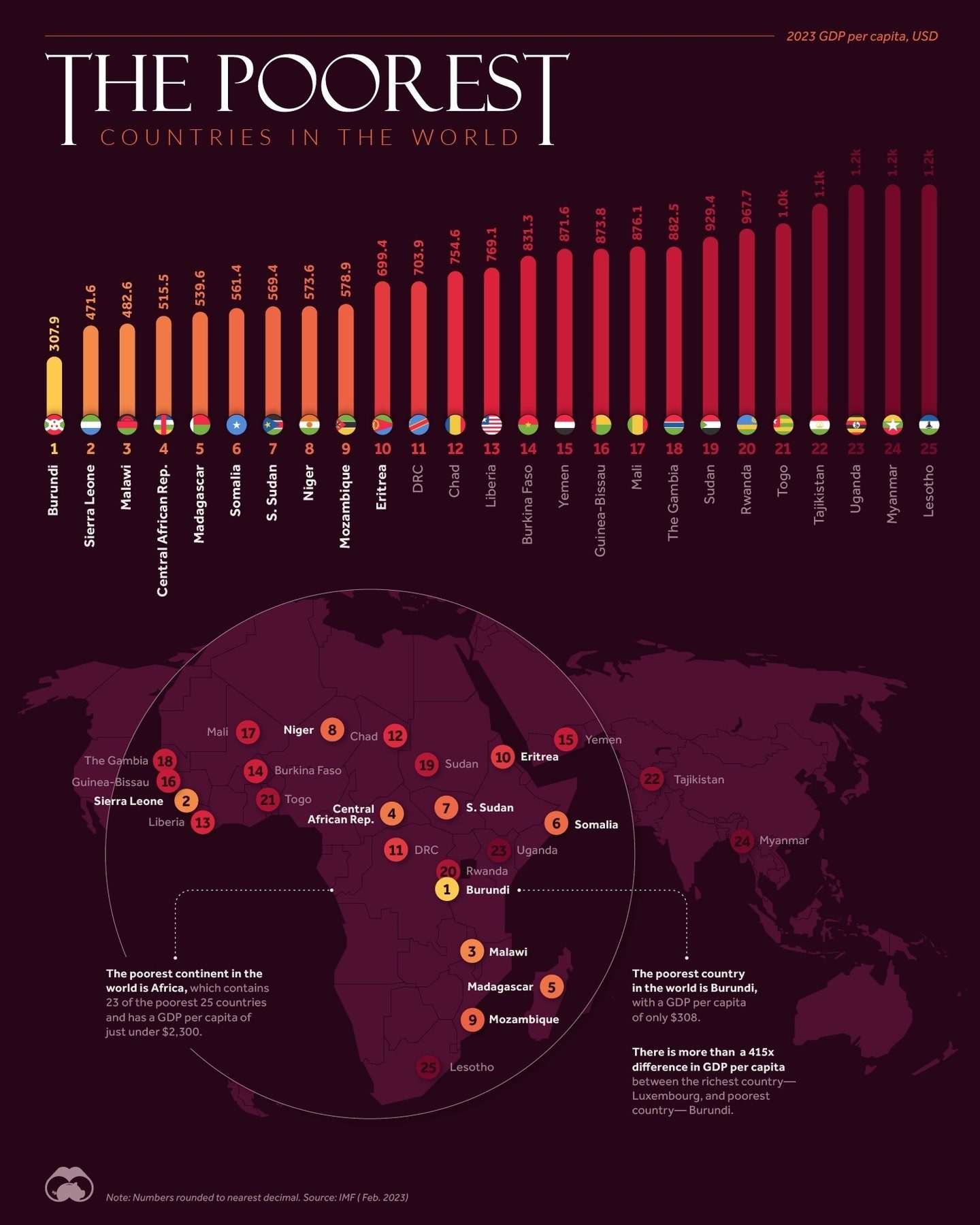
Global wealth disparities are starkly highlighted when examining GDP per capita, a critical measure of economic prosperity on an individual basis. The latest projections from the International Monetary Fund (IMF) for 2023 offer a clear perspective on which countries are facing significant economic challenges.
Why This Matters
Understanding the economic landscape of different countries is vital for several reasons. It helps in identifying regions that may need international aid, informing policy decisions, and understanding global trade dynamics. GDP per capita is a straightforward way to compare the economic output of countries, adjusted for population size, providing a clear view of the average income per person.
The Economic Landscape of the Poorest Countries
The Poorest Continent
Africa stands out as the continent with the most economic challenges. According to the IMF's 2023 projections, Africa is home to 23 of the 25 poorest countries in the world. The continent's average GDP per capita is just under $2,300, significantly lower than any other region. This stark economic reality underscores the urgent need for development strategies and support for the continent.
The Poorest Countries
Burundi leads the list of the poorest countries globally, with a GDP per capita of a mere $156. This is a stark reminder of the economic hardships faced by a significant portion of the world's population. Following Burundi, countries like Sierra Leone, Malawi, and Central African Republic are also among the poorest, with GDP per capita figures barely exceeding a few hundred dollars.
Countries in the Poorer World
Beyond Burundi, the list of the poorest countries includes:
- Sierra Leone with a GDP per capita of $307.9
- Malawi with a GDP per capita of $471.6
- Central African Republic with a GDP per capita of $482.5
- Madagascar with a GDP per capita of $532.6
- South Sudan with a GDP per capita of $569.4
- Mozambique with a GDP per capita of $573.6
- Eritrea with a GDP per capita of $578.9
- Liberia with a GDP per capita of $609.4
- Chad with a GDP per capita of $703.9
These countries, along with others like the Democratic Republic of the Congo, Guinea, Burkina Faso, and Togo, face severe economic challenges. Their GDP per capita figures are all below $1,000, highlighting the depth of their economic struggles.
Understanding GDP per Capita
What is GDP per Capita?
GDP per capita is a measure of the total economic output of a country divided by its population. It provides a snapshot of the average economic productivity of a country's citizens. This metric is crucial for comparing the economic performance of different countries, as it adjusts for population size.
Why GDP per Capita Matters
GDP per capita is a key indicator of a country's standard of living. It helps in identifying economic disparities and areas that may require policy interventions. For instance, countries with lower GDP per capita often face challenges in providing basic services like healthcare, education, and infrastructure.
Practical Tips for Engaging with Economic Data
Critical Analysis
When analyzing economic data, it's essential to consider multiple factors. GDP per capita alone does not tell the whole story. Other indicators like income inequality, poverty rates, and access to basic services should also be considered. This holistic approach provides a more accurate picture of a country's economic situation.
Contextual Understanding
Economic data should be understood within its context. For example, a country's GDP per capita might be low due to factors like conflict, natural disasters, or political instability. Understanding these factors is crucial for developing effective solutions.
Use of Reliable Sources
Relying on data from reliable sources like the IMF ensures that the information is accurate and up-to-date. This is particularly important for making informed decisions, whether at the policy level or for personal investments.
Important Takeaways
The global economic landscape is diverse, with significant disparities between countries. Africa, in particular, faces significant economic challenges, with 23 of the 25 poorest countries in the world. Burundi, with a GDP per capita of $156, is the poorest country globally, highlighting the extent of economic hardship in some regions.
Understanding the economic context of different countries is vital for addressing global poverty and inequality. GDP per capita is a critical metric in this regard, but it should be complemented by other indicators for a comprehensive understanding.
Conclusion
The latest IMF projections for 2023 offer a stark reminder of the economic disparities that exist globally. Countries like Burundi and Sierra Leone face significant economic challenges, while Africa as a continent is home to 23 of the 25 poorest countries. Understanding these disparities is the first step toward developing strategies to address them. By engaging with reliable economic data and considering multiple factors, we can work towards a more equitable global economic landscape.
Watch the Reel
Questions readers ask
Which countries are considered the poorest in 2023 according to the IMF?
According to the IMF's 2023 projections, the poorest countries are predominantly in Africa, with 23 of the 25 poorest nations located there. These countries have GDP per capita figures that are quite low, often not exceeding a few hundred dollars.
What is GDP per capita and why is it important for comparing economic wealth?
GDP per capita is a metric that measures the economic output of a country divided by its population. This provides a clear view of the average income per person, making it a valuable tool for comparing the economic wealth of different countries on an individual basis, regardless of population size.
How does the IMF determine the ranking of countries based on economic wealth?
The IMF ranks countries based on their GDP per capita, which is calculated using the latest economic projections. This ranking helps identify which countries are facing significant economic challenges and may need international support.
What are some specific examples of the poorest countries in Africa according to the 2023 IMF rankings?
Countries such as Burundi and Sudan are notable examples among the poorest in Africa. Both nations have GDP per capita figures that are significantly low, reflecting the economic challenges they face.
Why is understanding the global GDP per capita comparison essential for policy decisions?
Comparing global GDP per capita helps in identifying regions that may require international aid and assistance. It also informs policymakers about global trade dynamics and economic disparities, enabling them to make more informed decisions.
How do the IMF's 2023 economic projections help in understanding world GDP comparison?
The IMF's 2023 economic projections provide a detailed analysis of the economic landscape by comparing GDP per capita across different countries. This helps in understanding the wealth disparities and identifying countries that need support to improve their economic conditions.
What insights does the IMF provide about the economic landscape of the poorest countries in 2023?
The IMF highlights that the poorest countries in 2023, primarily in Africa, have GDP per capita figures that are exceptionally low. This analysis is crucial for understanding the depth of economic challenges these countries face and for guiding international support efforts.
Recent articles
Fresh deep dives from the latest Reels we unpacked.




Comments
Be the first to comment.