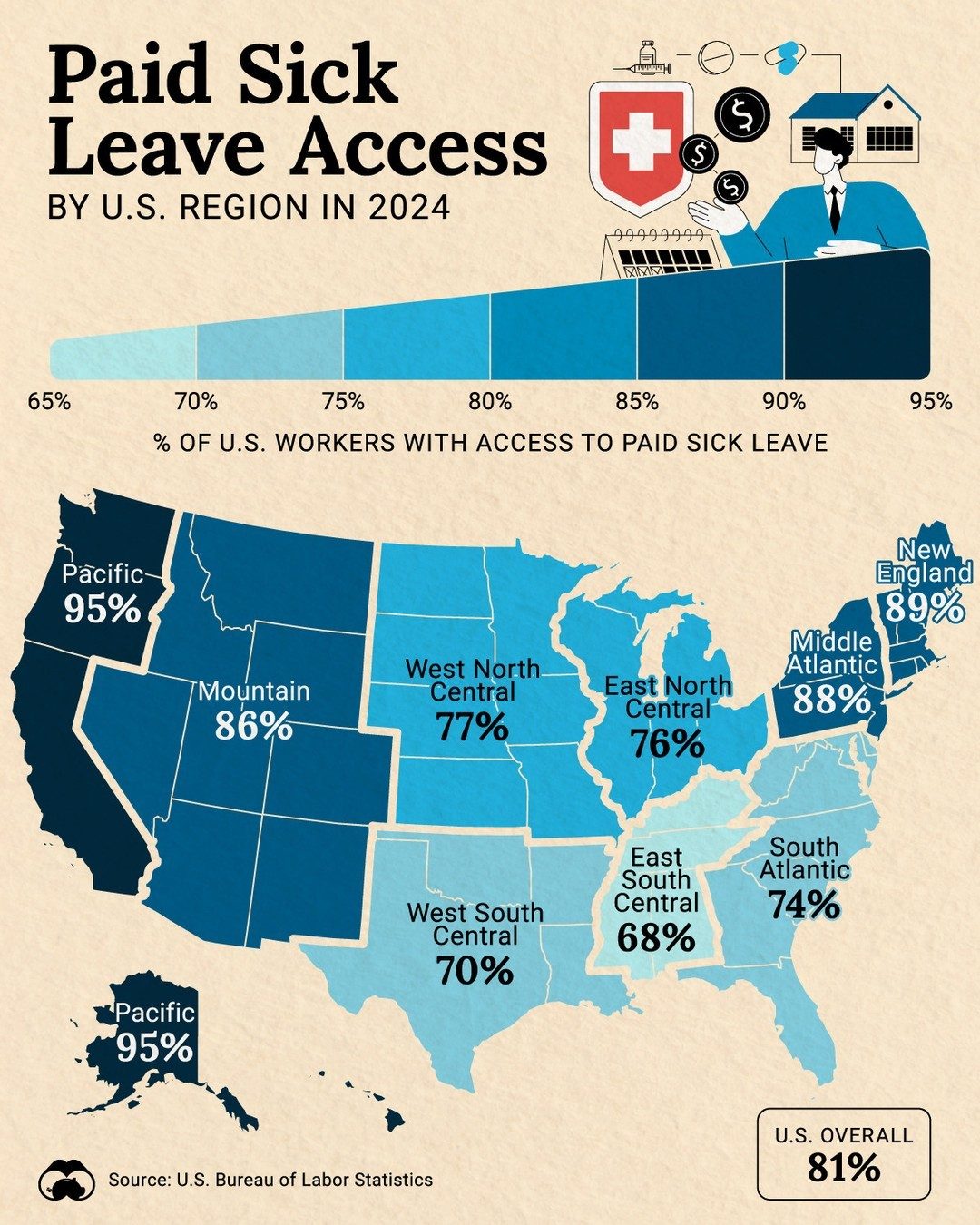
Paid sick leave access varies significantly across the United States, with some regions offering nearly universal coverage while others lag behind. Understanding these disparities is crucial for workers and policymakers alike, as access to paid sick leave is a critical component of workers' overall well-being.
Context
Policies surrounding paid sick leave are a vital aspect of labor laws, directly impacting the health and economic stability of workers. The U.S. Bureau of Labor Statistics (BLS) provides valuable data on this topic, highlighting regional differences in access to paid sick leave. These variations reflect underlying labor laws and employer policies, which can have far-reaching effects on public health and economic productivity.
Why This Matters
The availability of paid sick leave is more than just a workplace benefit; it is a public health issue. Workers who can take time off when sick are less likely to spread illnesses, including common infectious diseases and more severe pathogens. Additionally, paid sick leave helps prevent financial strain on workers and their families, as it ensures they can still receive income when they are unable to work due to illness. This issue is especially important in light of recent public health crises, where the ability to stay home when sick has been a critical factor in controlling disease spread.
Main Discussion
Regional Differences in Paid Sick Leave
The data from the BLS shows that the Pacific region, encompassing Alaska, Hawaii, Washington, Oregon, and California, leads the nation in paid sick leave access. Approximately 95% of workers in this region have access to this benefit. This high level of coverage can be attributed to progressive labor laws in these states, which mandate paid sick leave for workers. This region's proactive approach to worker benefits sets a strong benchmark for the rest of the country.
Best and Worst in Paid Sick Leave Coverage
The Pacific region's 95% coverage rate stands out, but other regions also show substantial variation. The Mountain region, which includes states like Colorado, Montana, and Wyoming, has an impressive 86% coverage rate. The New region also performs well, with 92% of its workers having access to paid sick leave. These high-performing regions likely benefit from a combination of state-level mandates and employer initiatives.
On the other end of the spectrum, the South Atlantic region, which includes states like Virginia, North Carolina, and South Carolina, has the lowest coverage rate at 74%. The West South Central region, encompassing Texas, Oklahoma, and Louisiana, follows closely with 70% coverage. These regions lag behind, potentially due to less stringent labor laws and fewer employer-driven initiatives.
Overall U.S. Paid Sick Leave Access
When considering the entire United States, approximately 81% of workers have access to paid sick leave. This figure provides a general sense of the overall landscape but masks significant regional variations. The 81% national average indicates that while a majority of workers have access to this benefit, there is still a considerable portion of the workforce that does not. This disparity underscores the need for more comprehensive policies and employer initiatives to ensure broader coverage.
Practical Tips
For Employees
- Know Your Rights: Be aware of your state's labor laws regarding paid sick leave. If you work in a state with mandatory paid sick leave, familiarize yourself with the specifics of the policy.
- Check with Your Employer: Even in states without mandates, some employers offer paid sick leave as a benefit. Review your employment contract or ask your HR department for details.
- Advocate for Change: If your workplace does not offer paid sick leave, consider joining or initiating a workplace advocacy group to push for better benefits.
For Employers
- Evaluate Your Benefits Package: Offering paid sick leave can improve employee satisfaction, reduce absenteeism, and enhance overall productivity. Consider incorporating this benefit if you haven't already.
- Stay Informed About Local Laws: Be aware of any changes in state or local labor laws that may require you to provide paid sick leave. Non-compliance can result in legal penalties and damage to your company's reputation.
- Communicate Clearly: Ensure that all employees understand their rights and benefits regarding paid sick leave. Clear communication can prevent misunderstandings and promote a positive work environment.
For Policymakers
- Promote Comprehensive Legislation: Advocate for federal or state-level legislation that ensures all workers have access to paid sick leave. This can help bridge the current gaps in coverage.
- Support Research and Data Collection: Encourage continued collection and analysis of data on paid sick leave access. This information is crucial for crafting effective policies.
- Engage with Stakeholders: Collaborate with employers, workers, and other stakeholders to develop policies that are both practical and beneficial for all parties involved.
Important Takeaways
Paid sick leave access is a critical component of worker well-being, impacting both public health and economic stability. The data highlights significant regional variations, with the Pacific and Mountain regions leading the way, while the South Atlantic and West South Central regions lag behind. These disparities underscore the need for continued efforts to ensure broader access to paid sick leave across the United States.
Conclusion
Understanding the regional differences in paid sick leave access is essential for workers, employers, and policymakers. While some regions have made significant strides, others still need to catch up. By staying informed and advocating for comprehensive policies, we can work towards a future where all workers have access to this vital benefit.
Watch the Reel
Questions readers ask
Which U.S. region has the highest access to paid sick leave in 2024?
The Pacific region has the highest access to paid sick leave, with 95% of workers having coverage. This region includes states like California, Washington, and Oregon, which have robust labor laws supporting paid sick leave.
How does the Eastern region compare in terms of paid sick leave access?
The Eastern region has relatively high access to paid sick leave, though it does not surpass the Pacific region. States like New York and Massachusetts have strong policies, contributing to a higher percentage of workers with paid sick leave in this part of the country.
What are the implications of regional disparities in paid sick leave access?
Regional disparities in paid sick leave access can lead to significant differences in public health outcomes and economic stability. Workers without paid sick leave may be more likely to go to work while ill, potentially spreading diseases and reducing overall productivity.
How reliable are the data from the U.S. Bureau of Labor Statistics on paid sick leave?
The U.S. Bureau of Labor Statistics (BLS) provides comprehensive and reliable data on paid sick leave. This data is crucial for understanding the labor landscape and informing policy decisions, as it is based on extensive surveys and research methods.
Why is understanding regional differences in paid sick leave important for workers?
Understanding regional differences in paid sick leave helps workers know their rights and negotiate better employment terms. It also enables them to advocate for improved policies in regions where access is limited, ensuring better health benefits and economic stability.
Which region has the lowest access to paid sick leave in 2024?
The South region typically has the lowest access to paid sick leave. States like Mississippi, Arkansas, and Alabama often lag behind in providing paid sick leave benefits, which can have a notable impact on the health and financial security of workers in these areas.
Can employers in different regions influence paid sick leave policies?
Employers can influence paid sick leave policies through advocacy and by adopting progressive workplace practices. Employers in regions with lower paid sick leave access can set an example by offering these benefits, potentially driving broader policy changes and improving overall worker health and economic stability.
Related deep dives
Similar reads based on topic and creator.


Recent articles
Fresh deep dives from the latest Reels we unpacked.




Comments
Be the first to comment.