The Cost of Hosting the Olympics
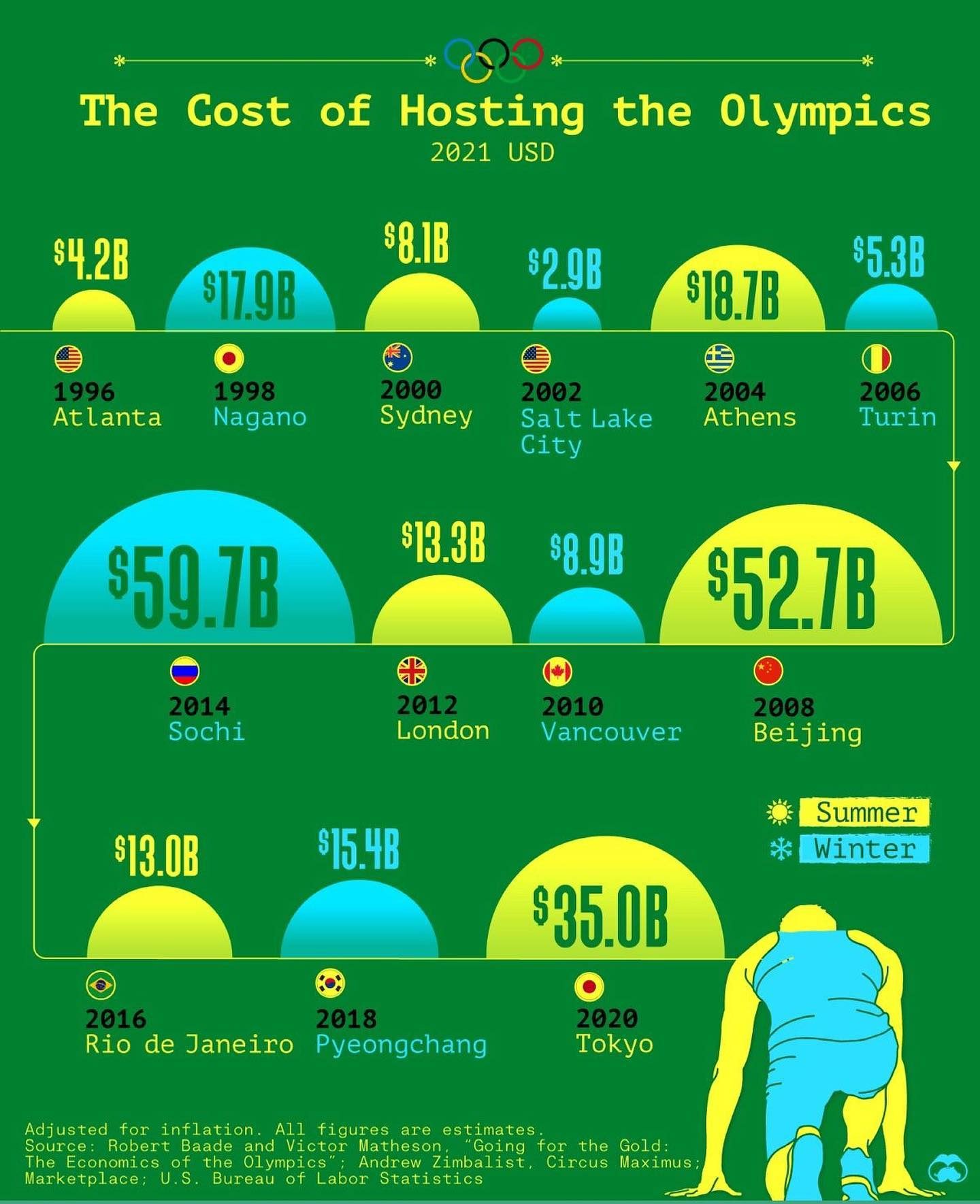
Hosting the Olympic Games is a monumental undertaking that requires significant financial investment. The Paris Olympics, for instance, are projected to cost over $9 billion, making them one of the more economical summer editions in recent history. Olympic hosting costs have varied widely in recent years, ranging from Sochi’s staggering $59.7 billion to Salt Lake City’s more modest $2.9 billion (adjusted to 2021 USD). To understand the scope and variability of these costs, let's delve into the expenses incurred by host cities since the 1996 Atlanta Games.
Why This Matters
The financial burden of hosting the Olympics can have profound impacts on the host city and country. These costs influence local economies, infrastructure development, and public perception. Understanding these financial commitments helps contextualize the benefits and drawbacks of bidding to host such a prestigious event.
The Evolution of Olympic Hosting Costs
Early Costs: 1996 to 2004
The 1996 Atlanta Games marked the beginning of a new era in Olympic spending. With a cost of $4.2 billion (adjusted to 2021 USD), Atlanta's expenses set a benchmark for future Games. The 1998 Nagano Winter Olympics in Japan followed with a cost of $17.9 billion, reflecting the growing scale of these events. Sydney's 2000 Summer Olympics cost $8.1 billion, showcasing the growing investment in infrastructure and facilities. Salt Lake City’s 2002 Winter Olympics were relatively cost-effective at $2.9 billion, while Athens 2004 saw a significant increase to $18.7 billion, largely due to the focus on new construction and modernization of existing facilities.
Mid-2000s Surge: 2006 to 2008
The mid-2000s saw a surge in Olympic hosting costs. Torino's 2006 Winter Olympics cost $5.3 billion, while Beijing's 2008 Summer Olympics were the most expensive to date at $52.7 billion. This enormous expenditure was driven by China's desire to showcase its economic and technological prowess on a global stage. London's 2012 Summer Olympics cost $13.3 billion, reflecting a more balanced approach to spending, focusing on maximizing existing facilities and temporary structures.
Recent Trends: 2010 to 2020
Vancouver's 2010 Winter Olympics cost $8.9 billion, highlighting the rising expenses associated with hosting these events. Sochi's 2014 Winter Olympics again set a new record with a cost of $59.7 billion, driven by extensive infrastructure development and security measures. Rio de Janeiro's 2016 Summer Olympics cost $13 billion, while Pyeongchang's 2018 Winter Olympics cost $15.4 billion. Tokyo's 2020 Summer Olympics, initially slated to be the most expensive, were postponed due to the COVID-19 pandemic and eventually cost $35 billion.
Factors Influencing Olympic Hosting Costs
Several factors contribute to the wide variation in Olympic hosting costs. One of the most significant is infrastructure development. Host cities often invest heavily in building new stadiums, training facilities, and accommodations. For example, Beijing 2008 and Sochi 2014 saw substantial investments in new construction to meet the demands of the Games.
Security is another critical factor. Hosting the Olympics requires extensive security measures to ensure the safety of athletes, spectators, and officials. This includes surveillance, personnel, and logistical support, all of which add to the overall cost.
Additionally, the host country's economic and political motivations play a role. Nations often use the Olympics as a platform to showcase their global standing and technological advancements. This can lead to increased spending on state-of-the-art facilities and amenities, as seen in Beijing and Sochi.
Practical Tips for Future Host Cities
For cities considering a bid to host the Olympics, several practical tips can help manage costs effectively:
- Leverage Existing Infrastructure: Maximize the use of existing facilities and temporary structures to reduce the need for new construction. This approach was successfully implemented in London 2012, where many venues were repurposed from the 2012 Games.
- Prioritize Security: Invest in robust security measures to ensure the safety of participants and attendees. This investment is essential but can be managed efficiently with strategic planning and collaboration with local authorities.
- Involve the Local Community: Engage the local community and private sector to share the financial burden. Public-private partnerships can help distribute the costs and foster community support.
- Focus on Legacy: Plan for the long-term legacy of the Games, ensuring that the investments made during the event benefit the community beyond the competition. This includes designing sustainable infrastructure and creating job opportunities.
Important Takeaways
The cost of hosting the Olympics has varied widely over the years, influenced by factors such as infrastructure development, security, and a host country's economic and political motivations. Future host cities can learn from past experiences and adopt strategies to manage costs effectively while ensuring the success of the Games and the long-term benefits for the community.
Conclusion
The financial investment required to host the Olympic Games is substantial and multifaceted. From Sochi's record-breaking expenditure to Salt Lake City's more modest costs, each edition of the Games presents unique financial challenges and opportunities. By understanding the factors that influence these costs and adopting practical strategies, future host cities can navigate the complexities of hosting the Olympics while maximizing the benefits for their communities.
Watch the Reel
Questions readers ask
What was the cost of hosting the 1996 Atlanta Olympics compared to more recent Games?
The 1996 Atlanta Olympics had a total expenditure of approximately $4.2 billion. In comparison, recent Summer Olympic Games have seen a significant increase in costs, with the 2008 Beijing Olympics costing $52.7 billion and the 2021 Tokyo Olympics $25.3 billion.
Why are the costs of hosting the Olympic Games so high?
The high costs of hosting the Olympics are primarily due to the extensive infrastructure investments required. These include the construction of sports venues, housing for athletes, and improvements to public transportation and other amenities.
Which Olympic Games had the highest financial commitment?
The 2014 Sochi Winter Olympics had the highest financial commitment, with a total cost of $59.7 billion. This is significantly higher than any other Olympic Games, both summer and winter, because of the massive infrastructure investments and construction needed to support the Games in a cold-weather location.
How do the projected costs of the 2024 Paris Olympics compare to other recent Games?
The 2024 Paris Olympics are projected to cost over $9 billion, making them one of the most economical summer Olympic Games in recent history. This is notably lower than the costs of the 2020 Tokyo Olympics ($25.3 billion) and the 2022 Beijing Olympics (51.7 billion), but higher than the 1996 Atlanta Olympics ($4.2 billion).
What factors contribute to the variability in Olympic hosting costs?
Several factors contribute to the variability in Olympic hosting costs, including the size and scale of the host city, the number of new venues required, and the extent of infrastructure upgrades needed. Additionally, factors such as labor costs, construction materials, and local economic conditions can significantly impact the final expenditure.
Related deep dives
Similar reads based on topic and creator.


Recent articles
Fresh deep dives from the latest Reels we unpacked.




Comments
Be the first to comment.