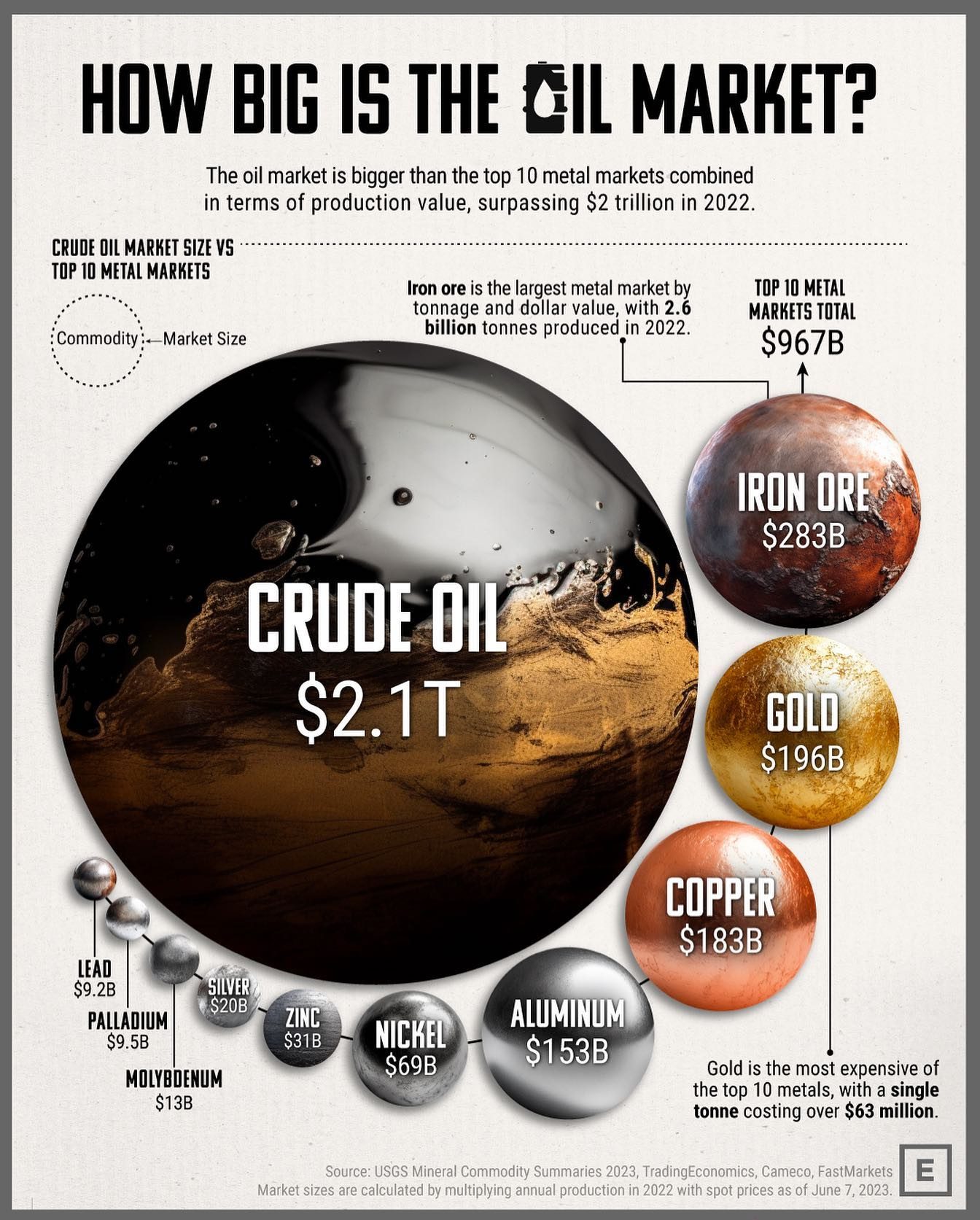
Oil Market Size Comparison
The oil market is vast, dwarfing many other commodity markets. Beyond serving as the primary energy source for transportation, oil is a crucial raw material for industries ranging from plastics and fertilizers to cosmetics and medicine. This makes the global oil market not only enormous in size but also highly influential from both economic and geopolitical standpoints. With a few countries dominating its production, the oil market's scale and impact are undeniable.
Context / Why This Matters
Crude oil's significance in the global economy cannot be overstated. It serves as the backbone of numerous industries and is essential for the functioning of modern society. Understanding the size and influence of the oil market is crucial for grasping its economic and geopolitical implications. This comparison with the top 10 metal markets offers a clear perspective on just how massive the oil market truly is.
Main Discussion
The Oil Market's Dominance
The oil market's production value surpassed $2 trillion in 2022. To put this into perspective, the combined value of the top 10 metal markets only reached $967 billion. This stark contrast highlights the oil market's dominance. The top 10 metal markets include iron ore, gold, copper, lead, silver, molybdenum, nickel, palladium, and aluminum. Among these, iron ore is the largest by tonnage and dollar value, with 2.6 billion tonnes produced in 2022 and a market value of $283 billion. Despite this, the oil market's value is more than double that of all these metal markets combined.
Key Metals and Their Market Values
- Iron Ore: The largest metal market by tonnage and dollar value, with 2.6 billion tonnes produced in 2022 and a market value of $283 billion.
- Gold: The most expensive of the top 10 metals, with a single tonne costing over $63 million. The total market value for gold is $196 billion.
- Copper: With a market value of $183 billion, copper is another significant metal in the top 10.
- Lead, Silver, Molybdenum, Nickel, Palladium, and Aluminum: These metals round out the top 10, with market values ranging from $9.5 billion to $153 billion.
Practical Tips
Understanding the oil market's size and influence can provide valuable insights for investors, policymakers, and industries that rely on oil. Here are some practical tips to help navigate this complex market:
For Investors
- Diversify Your Portfolio: Investing in a variety of commodities, including metals and oil, can help diversify your portfolio and reduce risk.
- Stay Informed: Keep up with market trends, geopolitical events, and economic indicators that can affect the oil market.
- Consider Long-term Investments: The oil market's volatility can be challenging, but long-term investments can often weather short-term fluctuations.
For Industries
- Supply Chain Management: Understanding the oil market's size and influence can help industries better manage their supply chains and mitigate risks.
- Explore Alternative Energy Sources: While oil remains a dominant energy source, exploring alternative energy sources can help industries reduce their reliance on oil and lower their carbon footprint.
- Policy and Regulation: Stay informed about policies and regulations that affect the oil market, as these can significantly impact your industry.
For Policymakers
- Energy Security: Developing policies that promote energy security and reduce reliance on foreign oil can help stabilize the economy and protect national interests.
- Environmental Impact: Policies that address the environmental impact of oil production and consumption are crucial for sustainable development.
- Market Regulations: Implementing regulations that promote fair competition and transparency in the oil market can help mitigate market volatility and ensure a level playing field for all participants.
Important Takeaways
Crude oil is an essential commodity in the global economy, with a market size significantly larger than the combined value of the top 10 metal markets. Its dominance underscores the importance of understanding its economic and geopolitical implications. Whether you are an investor, industry professional, or policymaker, gaining insights into the oil market can provide valuable context for decision-making.
Conclusion
The oil market's sheer size and influence make it a critical component of the global economy. By comparing it to the top 10 metal markets, we gain a clearer understanding of its dominance. This knowledge is invaluable for investors, industries, and policymakers looking to navigate the complexities of the oil market effectively. Whether through diversification, staying informed, or promoting sustainable policies, there are numerous strategies to engage with and benefit from the oil market's vast potential.
Watch the Reel
Questions readers ask
How does the size of the oil market compare to the top metal markets?
The oil market is significantly larger than the top 10 metal markets combined. This is evident when comparing the crude oil market to individual metal markets such as iron ore and gold. The sheer volume and economic impact of oil make it a dominant force in the global commodity markets.
Why is the oil market so influential in the global economy?
The oil market's influence stems from its role as the primary energy source for transportation and a raw material for numerous industries. This includes sectors like plastics, fertilizers, cosmetics, and medicine, making it a vital component in the functioning of modern society.
Which countries are the major producers in the oil market?
The oil market is heavily concentrated, with a few countries dominating its production. Major players include the Middle Eastern countries, Russia, and the United States. This concentration of production gives these countries significant economic and geopolitical influence.
How does the oil market's influence compare to other physical commodity markets?
The oil market's influence is unparalleled among physical commodity markets. Its impact extends beyond raw material value, affecting geopolitical dynamics and economic policy. This influence is due to its critical role in energy and raw materials for various industries, making it a linchpin in global economic stability.
What are the key reasons to understand the size and influence of the oil market?
Understanding the size and influence of the oil market is essential for grasping its economic and geopolitical significance. It helps in making informed decisions regarding investments, policy-making, and strategic planning. Moreover, it provides insights into the interconnectedness of various industries and the global economy.
How does the oil market's economic influence manifest?
The economic influence of the oil market is multifaceted. It affects employment rates, industrial outputs, and overall economic growth. Fluctuations in oil prices can have ripple effects across different sectors, leading to changes in production costs and consumer prices. This makes monitoring the oil market crucial for economic stability.
Why is the global oil market highly influential from a geopolitical standpoint?
The global oil market's geopolitical influence arises from the strategic importance of oil-producing regions and the political dynamics surrounding oil production and distribution. The control over oil reserves and production can be a significant factor in international relations and global power dynamics, making the oil market a key area of geopolitical interest.
Recent articles
Fresh deep dives from the latest Reels we unpacked.




Comments
Be the first to comment.