Oil and Gas Leasing Trends on Federal Lands
Land leases to the oil and gas sector have seen significant fluctuations over the past decade, with notable changes under different presidential administrations. The trends in these leases are crucial for understanding the energy policy landscape and the environmental implications of fossil fuel extraction on public lands.
Context
Land leasing to the oil and gas industry is a critical component of the federal government's management of public lands. These leases allow companies to explore and extract oil and gas resources, contributing to the nation's energy supply. However, the environmental impact of these activities, particularly greenhouse gas (GHG) emissions, has become a focal point of policy debates. The trends in leasing over the past decade reflect these policy shifts and their consequences.
Land Leasing Trends from 2013 to 2023
Obama Administration (2013-2016)
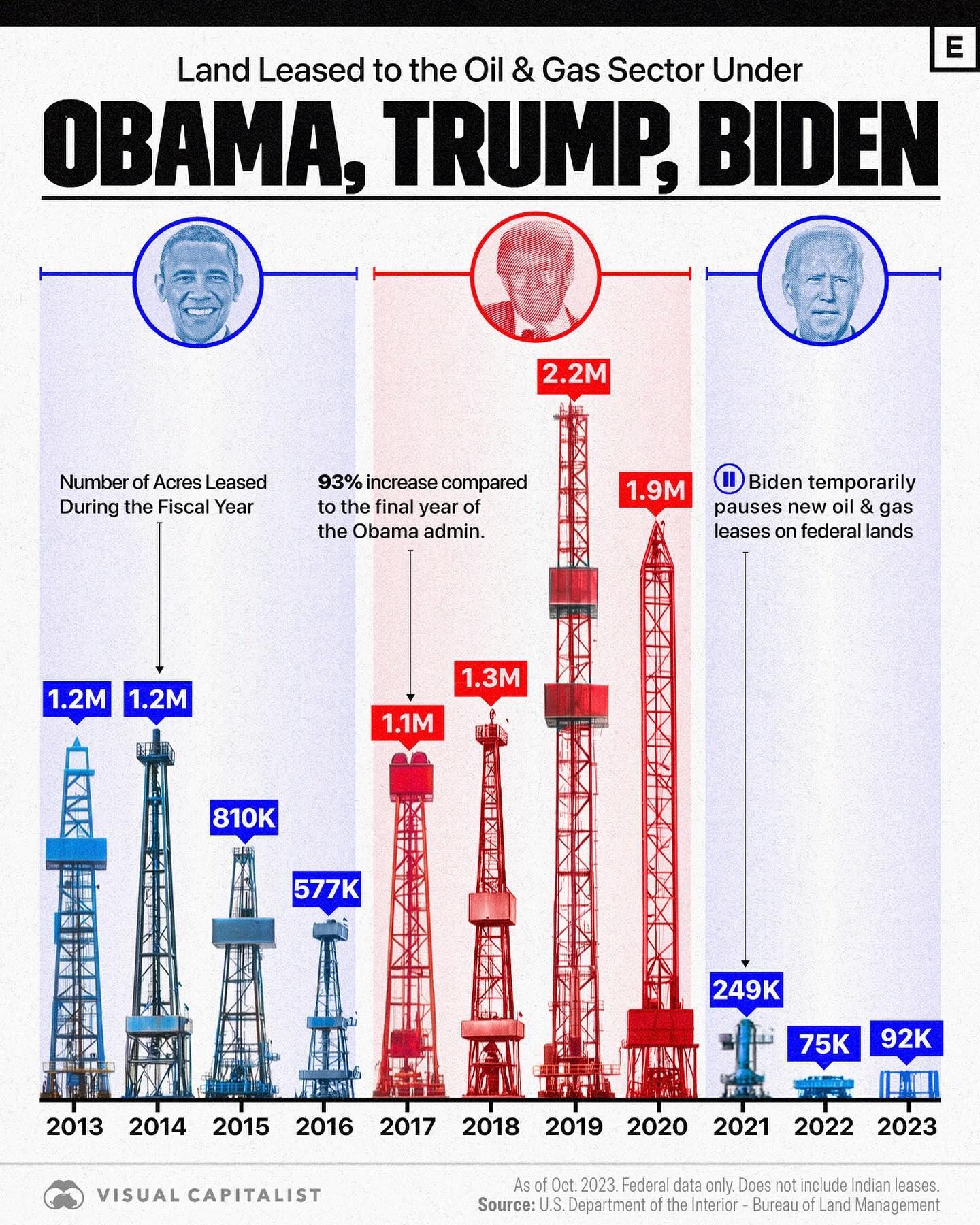
During the Obama administration, the total acreage of land leased to the oil and gas sector saw modest changes. The years 2013 to 2016 were marked by relatively stable leasing activities, with a slight increase in acreage leased in 2015 and 2016. The data indicates that the Obama administration leased around 1.2 million acres in 2015 and 1.1 million acres in 2016, reflecting a steady approach to leasing federal lands for oil and gas exploration.
Trump Administration (2017-2020)
The Trump administration marked a significant shift in land leasing policies. From 2017 to 2020, there was a substantial increase in the acreage leased to oil and gas companies. In 2017, the leased acreage jumped to 1.9 million acres, representing a 93% increase compared to the final year of the Obama administration. This trend continued through 2018 and 2019, with 1.8 million and 2.2 million acres leased, respectively. The administration's policies aimed to expand domestic energy production, leading to a surge in leasing activities.
Biden Administration (2021-Present)
Following a change in administration, the Biden presidency introduced a series of executive actions aimed at reducing GHG emissions from federal lands. As a result, there was a significant drop in new oil and gas leases. In 2021, the leased acreage decreased to 1.2 million acres, and in 2022, it further dropped to 577,000 acres. This reduction reflects the administration's focus on mitigating climate change and transitioning to cleaner energy sources. The Biden administration has temporarily paused new oil and gas leases on federal lands, aligning with its environmental policies.
Why This Matters
The trends in oil and gas leasing on federal lands have significant implications for both the energy industry and the environment. The surge in leasing during the Trump administration supported domestic energy production but raised concerns about environmental impacts, including increased GHG emissions. Conversely, the reduction in leasing under the Biden administration reflects a shift towards sustainability, but it also poses challenges for the energy sector and its reliance on fossil fuels.
Practical Tips for Understanding Land Leasing Trends
Stay Informed
Keep up with the latest data and reports from reliable sources such as the Bureau of Land Management. Understanding the current trends and policy changes can help energy companies and environmental advocates stay informed and prepared.
Track Policy Changes
Policy shifts significantly impact leasing activities. Monitoring changes in administration policies can provide insights into future trends and help stakeholders adapt their strategies accordingly.
Engage with Environmental Reports
Environmental impact assessments and reports are crucial for understanding the broader implications of land leasing. These reports provide valuable data on the environmental consequences of oil and gas extraction, helping to shape informed decisions.
Utilize Interactive Infographics
Visual representations, such as infographics, can simplify complex data and make trends more accessible. Engaging with these visual tools can enhance understanding and facilitate clearer communication about land leasing trends.
Important Takeaways
Policy Shifts Drive Leasing Trends
The data highlights that changes in presidential policies significantly influence oil and gas leasing on federal lands. The Trump administration's focus on energy production led to a surge in leasing, while the Biden administration's environmental policies resulted in a decline.
Environmental Considerations
The reduction in leasing under the Biden administration underscores the growing importance of environmental considerations in energy policy. Policies aimed at reducing GHG emissions are likely to continue shaping future leasing activities.
Data-Driven Insights
Utilizing data from reliable sources like the Bureau of Land Management provides a clear picture of leasing trends. This data is essential for stakeholders to make informed decisions and adapt to changing policies.
Conclusion
The trends in land leasing to the oil and gas sector from 2013 to 2023 reflect significant policy shifts under different presidential administrations. The significant increase during the Trump administration and the subsequent decline under Biden highlight the impact of policy changes on energy production and environmental sustainability. Staying informed about these trends and understanding their implications is crucial for stakeholders in the energy industry and environmental advocacy.
Watch the Reel
Questions readers ask
What were the key differences in oil and gas leasing trends between the Obama and Trump administrations?
During the Obama administration, oil and gas leases on federal lands were relatively stable, with a focus on environmental regulations and reducing greenhouse gas emissions. In contrast, the Trump administration saw a significant surge in leasing, reflecting a priority on increasing domestic energy production and reducing regulatory barriers.
How has the Biden administration approached oil and gas leasing on federal lands?
The Biden administration has implemented policies to reduce the number of new oil and gas leases on federal lands, emphasizing climate change mitigation and the transition to renewable energy sources. This includes a temporary halt on new leases and a review of existing leasing practices.
What role does the Bureau of Land Management (BLM) play in federal land leases for oil and gas?
The Bureau of Land Management (BLM) is responsible for managing public lands for various uses, including oil and gas leasing. The BLM oversees the leasing process, ensuring that environmental assessments are conducted, and that lease sales and operations comply with federal regulations.
How have oil and gas leasing trends on federal lands changed from 2013 to 2023?
From 2013 to 2023, oil and gas leasing trends on federal lands have experienced notable fluctuations. Under the Obama administration, leasing was relatively stable with a focus on environmental considerations. The Trump administration saw a significant increase in leasing, while the Biden administration has moved to reduce new leases and emphasize climate goals.
What are the environmental implications of oil and gas leasing on federal lands?
Oil and gas leasing on federal lands can lead to various environmental impacts, including greenhouse gas emissions, habitat destruction, and water pollution. These impacts have become a central point in policy debates, influencing the approach of different administrations to leasing practices.
How does the leasing process for oil and gas on federal lands typically work?
The leasing process involves several steps, including environmental assessments, public comment periods, and competitive auctions. Companies submit bids for leases, and if successful, they must comply with regulations to ensure minimal environmental impact during exploration and extraction activities.
Related deep dives
Similar reads based on topic and creator.


Recent articles
Fresh deep dives from the latest Reels we unpacked.




Comments
Be the first to comment.