Unemployment Benefits Comparison Among OECD Countries
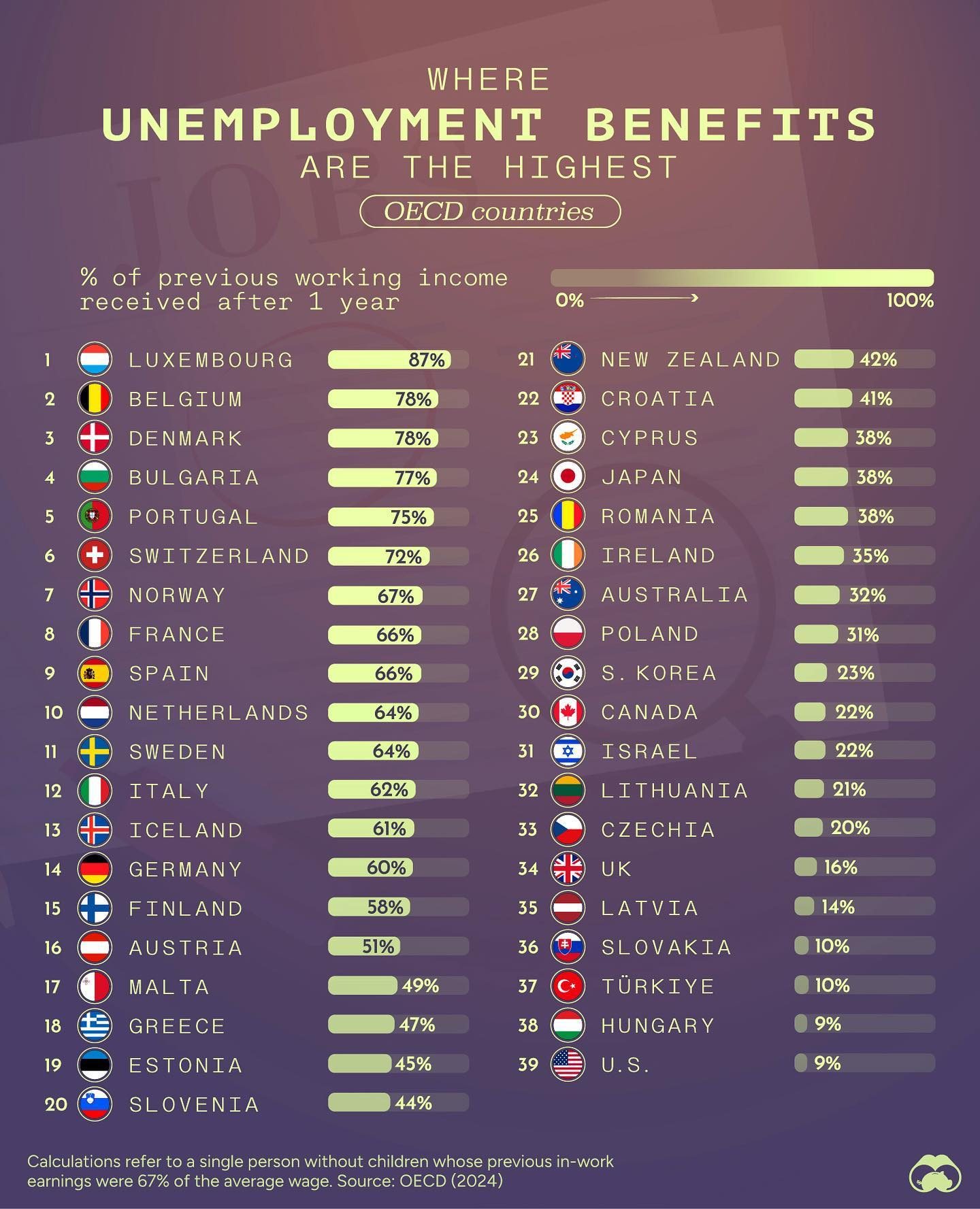
The ranking of OECD (Organisation for Economic Co-operation and Development) countries by unemployment benefits reveals significant disparities. This comparison focuses on single, childless workers who earned 67% of the average wage in their respective countries, highlighting the percentage of previous working income received after one year of unemployment.
Why This Matters
Understanding the variations in unemployment benefits across different countries provides valuable insights into social welfare systems and their impact on workers. These benefits play a crucial role in supporting individuals during periods of unemployment, affecting their financial stability and overall well-being.
Main Discussion
Highest Unemployment Benefits
At the top of the list, Luxembourg stands out with the highest unemployment benefits, providing 87% of previous working income after one year. This high percentage reflects a robust social safety net designed to support individuals during unemployment. Following closely are Denmark and Belgium, both offering 78% of previous income, and Portugal at 75%.
Middle Ground
Several countries fall in the middle range, providing moderate support to their unemployed citizens. Switzerland and Norway offer 72% and 67% respectively, while France, the Netherlands, and Italy all provide around 60-62% of previous income. These countries demonstrate a balanced approach, ensuring that workers receive substantial support without overly burdening the system.
Lower Benefits
On the lower end of the spectrum, countries like Poland, the United Kingdom, and Malta provide between 31% and 49% of previous income. These percentages indicate varying levels of support, reflecting different economic and social policies. While these benefits are lower, they still offer some financial assistance to unemployed workers.
Lowest Benefits
The U.S. and Hungary are at the bottom of the list, offering the lowest unemployment benefits at just 9% of previous income. This stark contrast highlights significant differences in social welfare policies and the level of support provided to unemployed workers in these countries. Workers in the U.S. and Hungary receive minimal assistance, which can impact their ability to meet basic needs during periods of unemployment.
Practical Tips
For individuals navigating unemployment benefits, understanding the policies and available resources in your country is essential. Here are some practical tips:
Research Local Policies
Familiarize yourself with the specific unemployment benefits and eligibility requirements in your country. This knowledge can help you make informed decisions and maximize the support available to you.
Explore Additional Resources
Investigate other forms of assistance, such as job training programs, career counseling, or temporary financial aid. Government websites and local community centers are valuable resources for finding additional support.
Seek Professional Advice
Consulting with a financial advisor or career counselor can provide personalized guidance tailored to your situation. They can help you navigate the complexities of unemployment benefits and develop a plan for financial stability.
Stay Informed
Keep up with changes in unemployment policies and benefits. Social welfare systems are subject to adjustments, and staying informed can help you take advantage of new opportunities or benefits as they become available.
Important Takeaways
The comparison of unemployment benefits among OECD countries reveals significant disparities in support for unemployed workers. While some countries offer robust social safety nets, others provide minimal assistance. Understanding these differences can help individuals navigate unemployment more effectively and advocate for better support systems.
Conclusion
The ranking of OECD countries by unemployment benefits underscores the importance of social welfare policies in supporting workers during periods of unemployment. Whether you are in a country with high benefits like Luxembourg or a lower-benefit country like the U.S., knowing your rights and available resources can make a significant difference. Stay informed and proactive in seeking the support you need to navigate unemployment effectively.
Watch the Reel
Questions readers ask
What criteria does the OECD use to rank countries by unemployment benefits?
The OECD ranks countries based on the percentage of previous working income that unemployed workers receive after one year of unemployment. The focus is on single, childless workers who earned 67% of the average wage in their respective countries.
Why do the unemployment benefits rankings matter for workers?
The rankings provide insights into how countries support their unemployed workers. These benefits help maintain financial stability and overall well-being during periods of unemployment.
Which countries offer the most generous and least generous unemployment benefits?
Luxembourg offers the highest percentage of previous income to unemployed workers, while the U.S. and Hungary provide the lowest. This highlights significant differences in social welfare systems across OECD countries.
How does the U.S. unemployment benefit system compare to other OECD countries?
The U.S. provides one of the lowest percentages of previous working income to unemployed workers compared to other OECD countries. This places it at the lower end of the ranking, indicating less generous unemployment benefits.
Are there notable differences in unemployment benefits for single workers across OECD countries?
Yes, there are substantial differences. For instance, after one year of unemployment, a single, childless worker in Luxembourg receives a significantly higher percentage of their previous income compared to those in the U.S. and Hungary, who receive the lowest percentages.
What is the significance of the 67% average wage threshold in the OECD unemployment benefits ranking?
The 67% average wage threshold is used to standardize the comparison across different countries. It allows for a consistent benchmark to evaluate how much income unemployed workers retain from their previous working earnings, making the comparison more meaningful.
How often does the OECD update its unemployment benefits rankings?
The OECD typically updates its unemployment benefits rankings periodically as part of its broader reports on social welfare and economic indicators. These updates reflect the latest data and changes in unemployment benefit policies across member countries.
Recent articles
Fresh deep dives from the latest Reels we unpacked.




Comments
Be the first to comment.