NHL Team Revenues
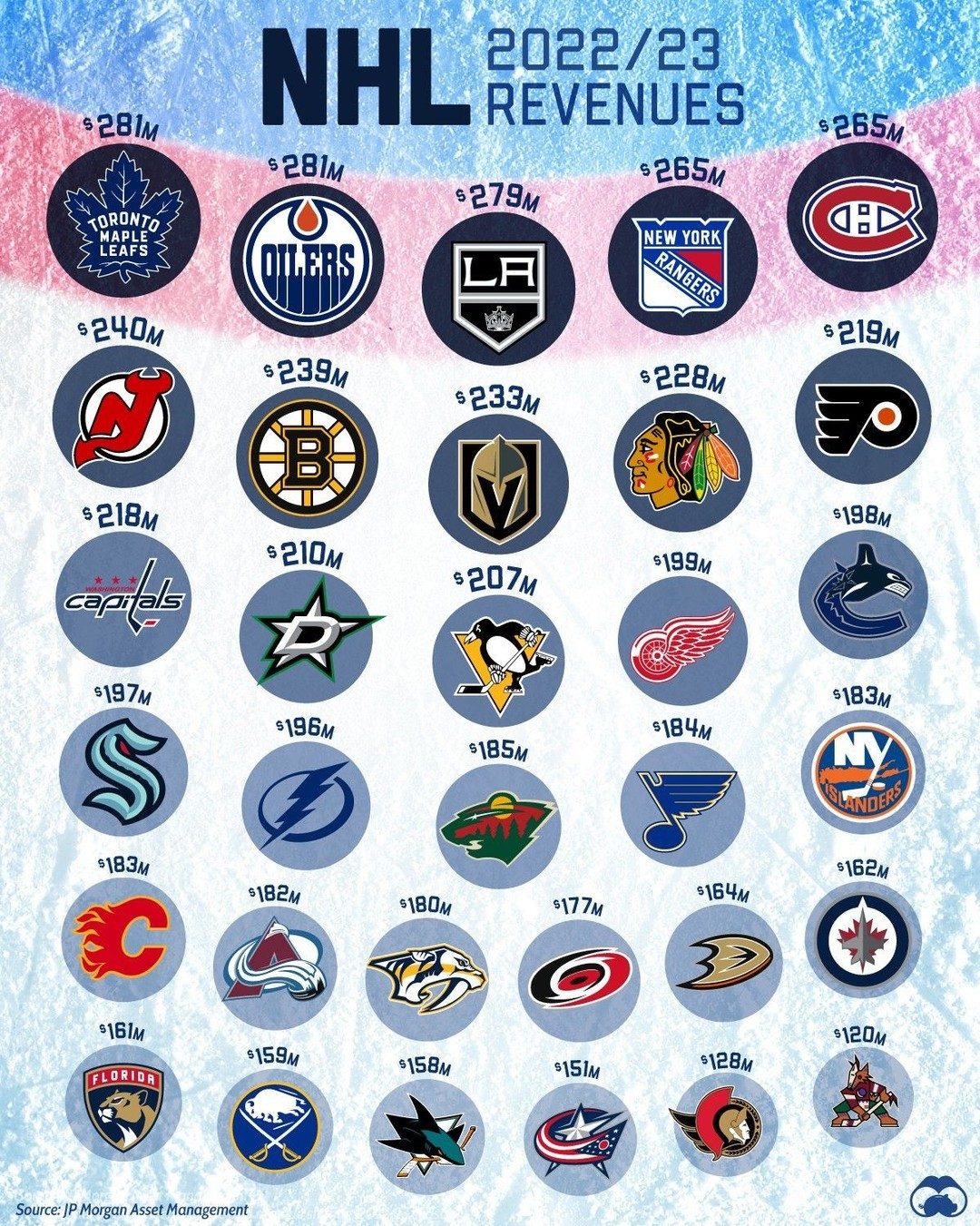
The revenues of National Hockey League (NHL) teams vary widely, with some of the highest-earning franchises bringing in hundreds of millions of dollars annually. The 2024 Stanley Cup champions, the Florida Panthers, sit in the bottom six of the league's revenue rankings, but their 9% growth over the past five years indicates a promising trend in the local hockey market.
Context
Understanding NHL team revenues provides insight into the financial health and market potential of professional hockey. Revenue streams for NHL teams include ticket sales, merchandise, broadcasting rights, and sponsorships. The variance in revenue among teams can be attributed to factors like market size, fanbase, and the team's on-ice success.
Main discussion
Top-Earning Teams
The Toronto Maple Leafs lead the pack with a revenue of $281 million for the 2022/23 season. This is followed by the Chicago Blackhawks at $265 million and the Boston Bruins at $279 million. The Los Angeles Kings trail slightly with $233 million. These teams benefit from large fanbases and significant market influence, which drives higher revenue.
Mid-Range Earners
Teams like the New York Rangers, Colorado Avalanche, and the New Jersey Devils fall into the mid-range category. The Rangers pulled in $228 million, while the Avalanche and Devils earned $239 million and $219 million, respectively. These teams have established fanbases and consistent on-ice performances, contributing to their revenue streams.
Lower-Earning Teams
At the lower end of the spectrum, teams like the Florida Panthers, Edmonton Oilers, and the New York Islanders bring in significantly less revenue. The Panthers, despite their recent Stanley Cup victory, earned $128 million, indicating the challenge of translating on-ice success into significant revenue. The Oilers and Islanders earned $161 million and $158 million, respectively, highlighting the varied financial landscapes within the league.
Revenue Growth and Market Potential
The Florida Panthers' 9% revenue growth over five years is a testament to the emerging potential in their local market. This growth suggests that even teams in lower revenue brackets can build a stronger financial foundation over time. Factors contributing to this growth could include increased local interest, better marketing strategies, and improved on-ice performance.
Practical Tips
For NHL Teams:
-
Engage with Local Communities: Building stronger connections with local fans can drive ticket sales and merchandise revenue. Community engagement events and fan appreciation initiatives can help foster loyalty and attendance.
-
Leverage Social Media: Utilize digital platforms to reach a broader audience, especially younger fans. Engaging content, behind-the-scenes updates, and interactive posts can boost fan engagement and merchandise sales.
-
Diversify Revenue Streams: Beyond ticket sales, teams should explore corporate partnerships, sponsorships, and licensing deals. These can provide additional revenue and help stabilize the team's financial health.
-
Focus on Winning: On-ice success is a significant driver of revenue. Winning teams attract more fans, sell more merchandise, and command higher broadcasting rights. Investing in player development and strategic rosters can lead to long-term financial benefits.
Important Takeaways
- Revenue Variance: There is a significant gap between the highest and lowest-earning NHL teams, highlighting the importance of market size and fanbase engagement.
- Growth Opportunities: Teams like the Florida Panthers demonstrate that revenue growth is possible, even for lower-earning franchises, through strategic efforts and market development.
- Key Revenue Drivers: Ticket sales, merchandise, broadcasting rights, and sponsorships are the primary revenue streams for NHL teams. Focusing on these areas can help teams improve their financial standing.
Conclusion
The financial landscape of the NHL is diverse, with top-earning teams like the Toronto Maple Leafs and lower-earning teams like the Florida Panthers each facing unique challenges and opportunities. Understanding the revenue trends and growth potential in the NHL can provide valuable insights for team management, investors, and fans alike. By leveraging market size, fan engagement, and strategic initiatives, teams can enhance their revenue and build a stronger foundation for long-term success.
Watch the Reel
Questions readers ask
Which NHL team had the highest revenue in the 2022-23 season?
The Toronto Maple Leafs were the top-earning team in the 2022-23 NHL season, generating approximately $281 million in revenue. This is largely due to their large fanbase and the size of their market.
How do smaller market teams like the Florida Panthers fare in terms of revenue?
Smaller market teams like the Florida Panthers typically have lower revenues compared to larger market teams. The Panthers, for instance, were in the bottom six of the league's revenue rankings in the 2022-23 season, despite being the 2024 Stanley Cup champions.
What are the primary sources of revenue for NHL teams?
NHL teams generate revenue from several sources, including ticket sales, merchandise, broadcasting rights, and sponsorships. The size of the market and the team's success on the ice can significantly impact these earnings.
How does the revenue of the NHL's top-earning team compare to that of the lowest-earning team?
In the 2022-23 season, the revenue of the top-earning team, the Toronto Maple Leafs, was over $280 million, while the lowest-earning team had revenues around $128 million. This shows a significant disparity in earnings across the league.
Why is understanding NHL team revenues important for fans and stakeholders?
Understanding NHL team revenues provides valuable insights into the financial health and market potential of professional hockey. It helps fans and stakeholders grasp the economic factors influencing team performance and future prospects.
What trends are evident in the revenues of NHL teams over recent years?
There are promising trends in the revenues of some NHL teams, such as the Florida Panthers, which have shown a 9% growth over the past five years. This indicates a positive trajectory for the team despite their lower ranking in the 2022-23 season.
Recent articles
Fresh deep dives from the latest Reels we unpacked.




Comments
Be the first to comment.