The Pythagorean Theorem and the Remarkable Work of New Orleans Students
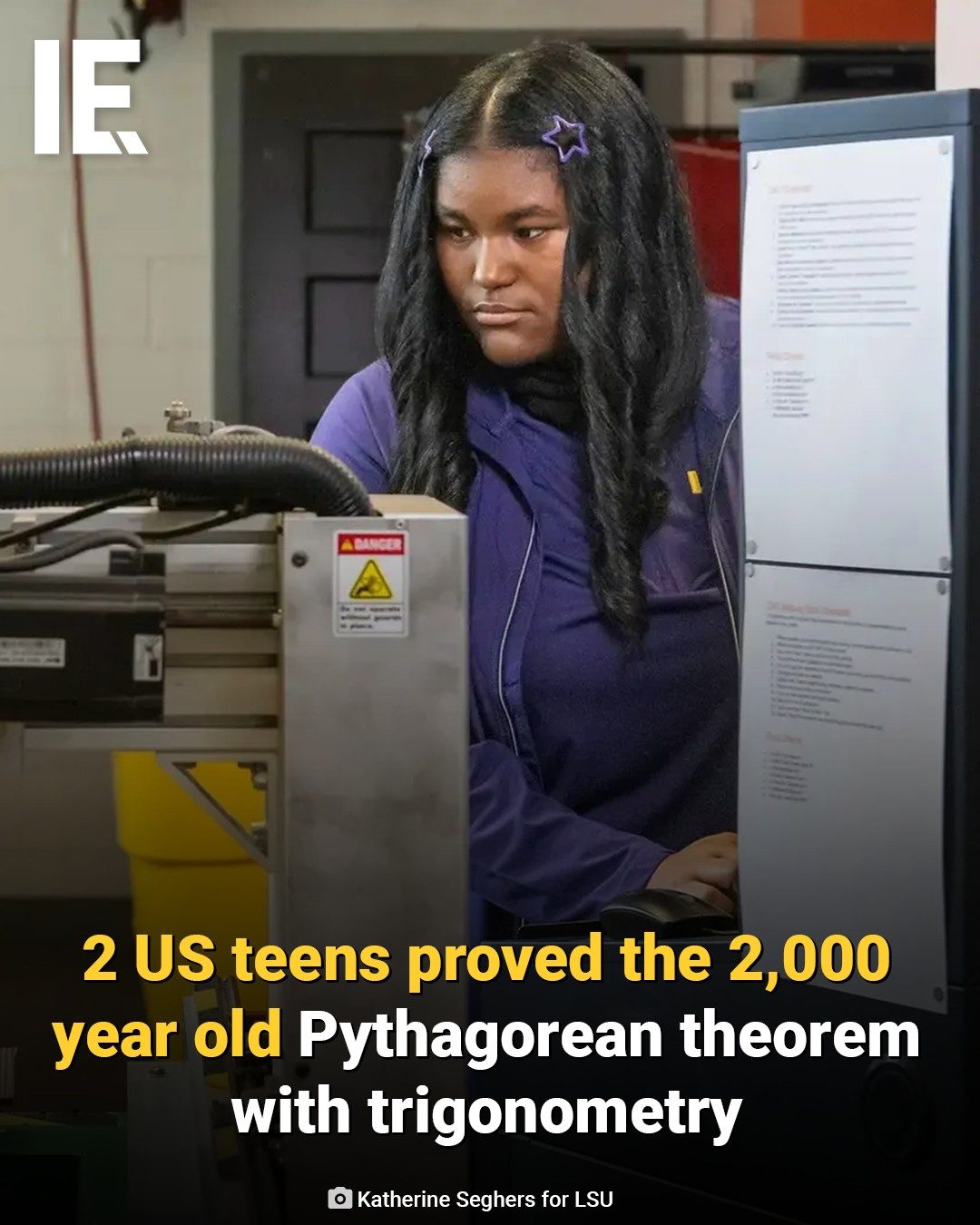
The Pythagorean theorem, a fundamental principle in geometry, has been a cornerstone of mathematical understanding for over 2,000 years. Its simplicity and elegance have made it a subject of fascination for generations of mathematicians. Recently, the theorem gained renewed attention when two high school students from New Orleans, Calcea Johnson and Ne’Kiya Jackson, found a novel trigonometry-based proof that avoids circular reasoning. This breakthrough has not only earned them global recognition but has also sparked renewed interest in the theorem and its applications.
Context / Why this matters
The Pythagorean theorem states that in a right-angled triangle, the square of the length of the hypotenuse (the side opposite the right angle) is equal to the sum of the squares of the lengths of the other two sides. This relationship, typically expressed as a² + b² = c², where a and b are the legs of the triangle and c is the hypotenuse, is widely used in various fields, including engineering, physics, and computer science.
Main discussion
The Pythagorean Theorem
The Pythagorean theorem has a rich history dating back to ancient times. Attributed to the Greek mathematician Pythagoras, the theorem has been used and studied extensively. Its applications range from constructing buildings and bridges to navigating space missions. The theorem's universality and simplicity make it a cornerstone of modern mathematics.
The Challenge of Circular Reasoning
One of the long-standing challenges in proving the Pythagorean theorem is the issue of circular reasoning. Many proofs rely on assumptions or principles that themselves depend on the theorem's validity. This circular reasoning can undermine the proof's credibility. Calcea Johnson and Ne’Kiya Jackson addressed this challenge head-on, developing a proof that avoids this logical pitfall.
The Breakthrough by Calcea Johnson and Ne’Kiya Jackson
Johnson and Jackson’s breakthrough involved using trigonometry to prove the Pythagorean theorem. Their approach was novel and avoided the pitfalls of circular reasoning that have plagued many mathematicians for decades. The clarity and ingenuity of their proof have earned them widespread acclaim and recognition.
Global Recognition
The work of Calcea Johnson and Ne’Kiya Jackson did not go unnoticed. Their proof gained global attention, and they received a shoutout from none other than Michelle Obama. This recognition underscored the significance of their contribution to the field of mathematics. The American Mathematical Monthly published their findings, which further cemented their place in the annals of mathematical history. This publication is a prestigious platform for sharing groundbreaking mathematical research, and the inclusion of their work speaks volumes about its quality and impact.
Practical tips
Understanding the Pythagorean Theorem
To appreciate the significance of Johnson and Jackson’s work, it’s essential to understand the Pythagorean theorem itself. Start by visualizing a right-angled triangle. Draw a square on each of the three sides of the triangle. The area of the square on the hypotenuse is equal to the sum of the areas of the squares on the other two sides. This visual representation can help grasp the theorem's core concept.
Exploring Trigonometry
Trigonometry is a branch of mathematics that deals with the relationships between the sides and angles of triangles. Familiarizing yourself with trigonometric functions like sine, cosine, and tangent can provide a deeper understanding of Johnson and Jackson’s proof. These functions are fundamental to their trigonometry-based approach to proving the theorem.
Avoiding Circular Reasoning
When attempting to prove the Pythagorean theorem or any other mathematical principle, it’s crucial to avoid circular reasoning. Ensure that your proof does not rely on assumptions that depend on the theorem's validity. This can be achieved by using independent principles and logical steps that lead to the desired conclusion.
Important takeaways
- The Pythagorean theorem is a fundamental principle in geometry with wide-ranging applications.
- The challenge of circular reasoning in proving the theorem has been a long-standing issue.
- Calcea Johnson and Ne’Kiya Jackson developed a novel trigonometry-based proof that avoids this issue.
- Their work has gained global recognition and has been published in the American Mathematical Monthly.
- Understanding the Pythagorean theorem and trigonometry can provide a deeper appreciation for Johnson and Jackson’s achievement.
Conclusion
The work of Calcea Johnson and Ne’Kiya Jackson is a testament to the power of curiosity and ingenuity in mathematics. Their trigonometry-based proof of the Pythagorean theorem not only addresses a long-standing challenge but also opens new avenues for exploration in the field. Their achievement serves as an inspiration for students and mathematicians alike, highlighting the potential for innovative thinking and perseverance.
Watch the Reel
Questions readers ask
How did Calcea Johnson and Ne’Kiya Jackson's proof of the Pythagorean theorem differ from traditional proofs?
Johnson and Jackson's proof is unique because it is based on trigonometry, which allows it to avoid the circular reasoning often present in traditional proofs. Traditional proofs often rely on the properties of right triangles and squares in a way that can be considered circular. Their approach brings the theorem into the realm of trigonometry, providing a fresh perspective and a more comprehensive understanding of the theorem.
What is the significance of the New Orleans students' proof in the mathematical community?
The proof by Johnson and Jackson has garnered global acclaim because it introduces a new method of proving the Pythagorean theorem, which has been studied for thousands of years. Their innovative approach demonstrates that even well-established mathematical concepts can be revisited and understood in new ways, inspiring both students and professionals in the field of mathematics.
Why is avoiding circular reasoning important in mathematical proofs?
Avoiding circular reasoning is crucial in mathematical proofs because it ensures that the proof is logically sound and that the conclusion is not assumed within the premises. Circular reasoning can undermine the validity of a proof, making it less convincing and less useful for further mathematical exploration. Johnson and Jackson’s proof stands out as it provides a clear, logical progression without relying on the theorem itself.
What is the Pythagorean theorem and why is it important in geometry?
The Pythagorean theorem is a fundamental principle in geometry that relates the three sides of a right-angled triangle. It states that the square of the length of the hypotenuse (the side opposite the right angle) is equal to the sum of the squares of the lengths of the other two sides. This theorem is important because it has wide-ranging applications in various fields, from architecture to physics, and serves as a building block for more complex mathematical concepts.
How have Calcea Johnson and Ne’Kiya Jackson's contributions influenced the field of mathematics?
Johnson and Jackson's trigonometry-based proof has sparked renewed interest in the Pythagorean theorem and has encouraged others to explore new methods and perspectives. Their work has shown that innovative thinking can lead to breakthroughs in well-established areas of mathematics, inspiring both peers and professionals to think creatively and challenge conventional approaches.
What challenges did the students face in developing their innovative proof?
Developing an innovative proof required Johnson and Jackson to delve deeply into trigonometry and geometry, navigating complex concepts and ensuring their proof was logically sound. They had to avoid the pitfalls of circular reasoning, which meant carefully crafting their proof to stand independently of the Pythagorean theorem itself. Their perseverance and creativity in tackling these challenges have resulted in a groundbreaking contribution to the field.
What inspired Calcea Johnson and Ne’Kiya Jackson to explore a new method of proving the Pythagorean theorem?
The inspiration behind Johnson and Jackson's exploration likely came from their curiosity and interest in mathematics. They recognized an opportunity to challenge conventional methods and provide a fresh perspective on a well-known theorem. Their desire to innovate and make a meaningful contribution to the field of mathematics drove them to develop a trigonometry-based proof that has since gained global recognition.
Related deep dives
Similar reads based on topic and creator.

Recent articles
Fresh deep dives from the latest Reels we unpacked.




Comments
Be the first to comment.