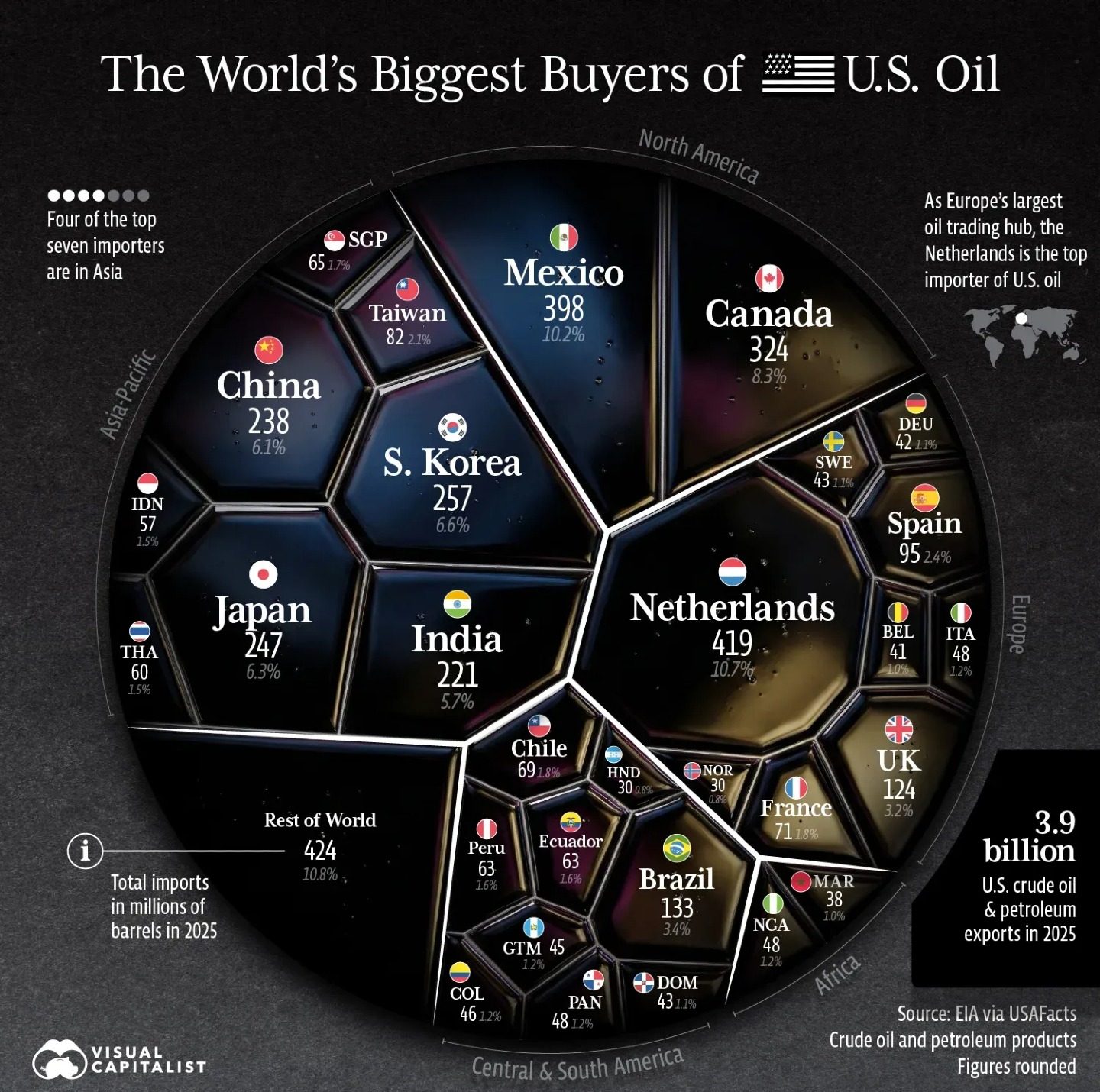
Global Oil Imports in 2025
The Netherlands leads the global demand for U.S. crude oil
U.S. oil exports continue to play a pivotal role in global energy markets, with significant volumes flowing to various regions worldwide. In 2025, the Netherlands emerged as the largest importer of U.S. crude oil, surpassing other major buyers with 419 million barrels. Following closely is Mexico, which imported 398 million barrels. Notably, global demand trends are diverging, with China's imports decreasing by 34% and India's rising by 35%. Collectively, nearly 4 billion barrels of U.S. oil were exported worldwide in 2025, highlighting the United States' influential position in the global oil market.
Context / Why This Matters
The Geopolitics of Oil Imports
Understanding the dynamics of global oil imports is crucial for several reasons. Oil is a cornerstone of the global economy, driving industrial activities, transportation, and energy production. The flow of oil from the U.S. to different countries is shaped by various factors, including economic policies, trade agreements, and geopolitical relations. The Netherlands, as the largest buyer of U.S. oil, benefits from its strategic location as Europe’s largest oil trading hub. This position allows it to efficiently distribute oil to other European countries, further solidifying its role in the global energy landscape.
Meanwhile, the divergent trends in China and India reflect their distinct economic strategies and energy needs. China's reduced imports may be attributed to its domestic energy production initiatives and efforts to diversify its energy sources. In contrast, India's surge in imports indicates a growing demand for oil to support its expanding economy and industrial sector.
Main Discussion
The global oil market is a complex web of supply and demand, influenced by numerous factors. Let’s delve into the key players and trends that shape this dynamic landscape.
Top Buyers of U.S. Crude Oil
Globally, several countries stand out as significant importers of U.S. crude oil. These countries include:
- The Netherlands: With 419 million barrels imported, the Netherlands leads the list. Its strategic location and role as Europe’s largest oil trading hub make it a crucial player in global oil distribution.
- Taiwan: Importing 398 million barrels, Taiwan is the second-largest importer. Its reliance on imported oil underscores its dependence on global energy markets.
- South Korea: South Korea imports a substantial amount of U.S. crude oil, reflecting its industrial needs and limited domestic oil reserves.
- Japan: Japan, another Asian country, is a significant buyer, driven by its energy needs and reliance on imports.
- India: India’s imports rose by 35%, totaling 264 million barrels. This surge is a testament to India’s growing energy demands as its economy expands.
These countries, along with others like Chile, Brazil, and the UK, are key players in the global oil market, contributing to the total 3.9 trillion U.S. crude oil & petroleum exports in 2025.
Regional Trends
The distribution of these imports across regions reveals interesting trends. Asia is a major consumer, with four of the seven top importers—Taiwan, South Korea, Japan, and India—located in the region. This reflects Asia’s rapid economic growth and industrialization, which drive high energy demands.
Europe, though not as dominant as Asia in terms of the number of top importers, is crucial due to the sheer volume of oil imported by the Netherlands. This highlights Europe’s reliance on imported oil to meet its energy needs.
Practical Tips
For countries aiming to optimize their oil import strategies, several practical tips can be considered:
- Diversify Energy Sources: Reduce dependence on a single source of oil by diversifying energy imports. This can help mitigate risks associated with supply disruptions and price fluctuations.
- Invest in Energy Infrastructure: Enhance energy infrastructure to improve efficiency in oil transportation, storage, and distribution. This can help in reducing costs and ensuring stable supply.
- Promote Energy Efficiency: Implement policies that promote energy efficiency in industries and households. This can lead to a reduction in overall energy consumption, thereby lowering import needs.
- Strengthen Trade Relations: Foster strong trade relations with oil-producing countries. This can help ensure stable and reliable supply, as well as favorable trade terms.
Important Takeaways
The global oil market is influenced by a myriad of factors, including economic policies, trade agreements, and geopolitical relations. Here are some key takeaways:
- The Netherlands leads the global demand for U.S. crude oil, highlighting its strategic role as Europe’s largest oil trading hub.
- Asia is a major consumer of U.S. crude oil, driven by its rapid economic growth and industrialization.
- China and India exhibit divergent trends in oil imports, reflecting their distinct economic strategies and energy needs.
- Diversifying energy sources, investing in energy infrastructure, promoting energy efficiency, and strengthening trade relations are essential strategies for countries to optimize their oil import strategies.
Conclusion
The global oil market is a dynamic and complex landscape, shaped by various factors and influenced by key players. The Netherlands, as the largest importer of U.S. crude oil, underscores the strategic importance of its location and role in global oil distribution. Meanwhile, the divergent trends in China and India highlight the need for countries to adapt their energy strategies to meet evolving needs.
Understanding these trends and dynamics is crucial for stakeholders in the global oil market. By adopting practical strategies, countries can optimize their oil import strategies, ensuring stable and reliable energy supply to support their economic growth and development.
Watch the Reel
Questions readers ask
Why did the Netherlands become the largest importer of U.S. crude oil in 2025?
The Netherlands' strategic location and infrastructure make it an ideal hub for receiving and redistributing U.S. crude oil to other European markets. This geographic advantage, combined with strong refining capacity, positions the Netherlands as a key player in global oil trends.
How much U.S. crude oil did Mexico import in 2025?
In 2025, Mexico imported 398 million barrels of U.S. crude oil, making it the second-largest importer after the Netherlands. This significant volume underscores Mexico's dependence on U.S. oil to meet its energy needs.
What are the shifting global oil demand trends in 2025?
In 2025, global oil demand trends show notable shifts. China's imports decreased by 34%, while India's imports rose by 35%. These changes reflect evolving energy policies, economic growth, and industrial developments in these countries.
Which countries are the largest buyers of U.S. crude oil in 2025?
The largest buyers of U.S. crude oil in 2025 are the Netherlands and Mexico. The Netherlands leads with 419 million barrels, followed by Mexico with 398 million barrels. Together, they highlight the significant role that these countries play in the global oil market.
What is the total volume of U.S. crude oil exported worldwide in 2025?
In 2025, nearly 4 billion barrels of U.S. crude oil were exported worldwide. This substantial volume underscores the United States' prominent role as a major supplier in the global oil market, influencing energy trends and geopolitical dynamics.
How do oil imports in Taiwan and Korea compare to other major importers in 2025?
While the article does not provide specific figures for Taiwan and Korea, it is implied that their imports are less than those of the Netherlands and Mexico. To get a precise comparison, one would need to review comprehensive oil import statistics for 2025.
What role do U.S. crude oil imports play in global energy markets?
U.S. crude oil imports play a pivotal role in global energy markets by supplying significant volumes to various regions. The Netherlands, Mexico, and other major buyers rely on these imports to meet their energy needs, making the U.S. a key player in shaping global energy trends and market dynamics.
Recent articles
Fresh deep dives from the latest Reels we unpacked.




Comments
Be the first to comment.