NATO Defense Spending
NATO defense spending has seen a significant shift in recent years, with a notable increase in the number of member countries meeting the 2% of GDP defense spending requirement. This trend is driven by various geopolitical factors, including ongoing conflicts in Ukraine and Israel. Let's explore the data and implications of this shift in defense expenditure.
Context
NATO's 2% Spending Requirement
The 2% of GDP defense spending target is a guideline set by NATO for its member countries. This benchmark is intended to ensure that all member states contribute adequately to the collective defense of the alliance. Historically, only a small number of countries have met this target, but recent data shows a growing number of nations are increasing their defense budgets to meet this requirement.
The Impact of Conflict
The ongoing conflicts in Ukraine and Israel have had a significant impact on defense spending within NATO. These geopolitical tensions have prompted many member countries to re-evaluate their defense priorities, leading to increased investment in military capabilities. This trend is evident in the data, which shows a steady rise in defense spending over the past decade.
Annual Percentage Change in Defense Spending
2012-2024 Overview
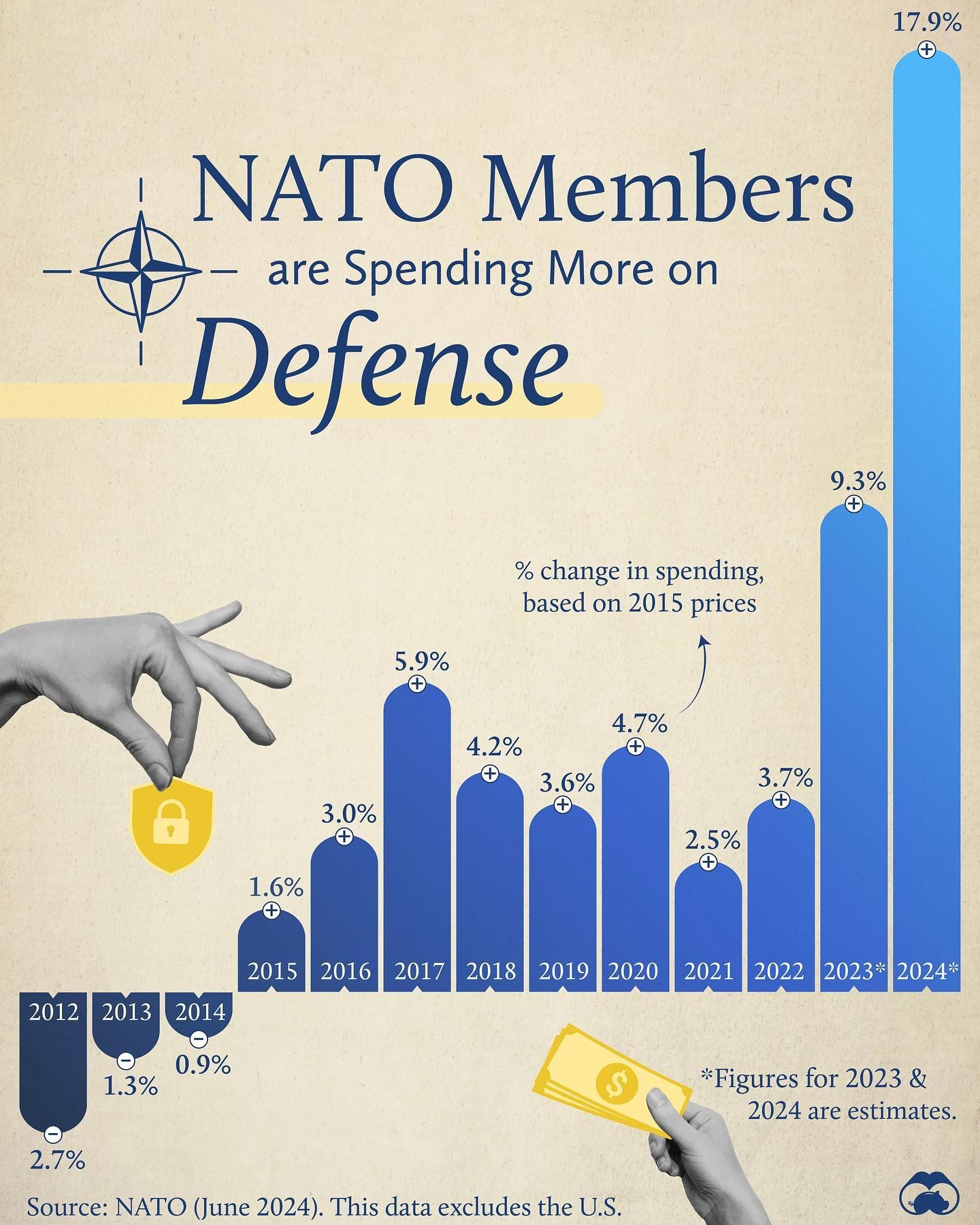
The data from 2012 to 2024 (with estimates for 2023 and 2024) provides a clear picture of how NATO members have been adjusting their defense budgets. Let's break down the key years and their corresponding percentage changes in spending, based on 2015 prices:
- 2012: 1.3%
- 2013: 0.9%
- 2014: 5.9%
- 2015: 3.0%
- 2016: 4.2%
- 2017: 4.7%
- 2018: 3.7%
- 2019: 2.5%
- 2020: 1.6%
- 2021: 2.7%
Significant Trends and Milestones
The data shows a significant spike in 2014, with a 5.9% increase in defense spending. This rise can be attributed to the escalating tensions in Ukraine, which began in 2014. The subsequent years show varying levels of increase, reflecting the ongoing geopolitical landscape and the evolving defense needs of NATO members.
Recent Years and Estimates
- 2022: 2.7%
- 2023: 2.7%
- 2024 (Estimated): 2.7%
The estimates for 2023 and 2024 suggest that the trend of increased defense spending is likely to continue. This is particularly relevant in the context of the ongoing conflicts in Ukraine and Israel, which have driven many countries to prioritize defense spending.
Practical Tips for Understanding Defense Spending Data
Interpreting Annual Percentage Changes
To fully understand the data, it's important to consider the annual percentage changes in the context of broader geopolitical events. For example, the significant increase in 2014 can be directly linked to the escalation of tensions in Ukraine. Similarly, the sustained spending increases in recent years reflect the ongoing conflicts and the need for enhanced military preparedness.
Evaluating Estimates
Given that figures for 2023 and 2024 are estimates, it's crucial to approach them with caution. These estimates are based on current trends and projections, but actual spending can vary based on unexpected geopolitical developments. It's essential to stay informed about ongoing events and their potential impact on defense budgets.
Important Takeaways
The Role of Conflict in Driving Defense Spending
The data clearly illustrates the role of conflict in driving defense spending. Ongoing conflicts in Ukraine and Israel have prompted NATO members to increase their defense budgets, reflecting their commitment to collective defense and military preparedness. This trend is likely to continue as long as these conflicts persist.
The Significance of the 2% Spending Target
The 2% of GDP defense spending target is a critical benchmark for NATO members. Meeting this target indicates a commitment to the collective defense of the alliance. The increasing number of countries meeting this benchmark is a positive development, signaling a stronger and more unified NATO.
NATO's defense spending trends are indicative of a broader shift in global geopolitics. The data highlights the importance of collective defense and the role of conflict in driving defense expenditures. As geopolitical tensions continue to evolve, it will be essential to monitor defense spending trends and their implications for global security.
Conclusion
NATO defense spending has seen a notable increase in recent years, driven by ongoing conflicts and a commitment to collective defense. The data provides valuable insights into the factors influencing defense budgets and the role of geopolitical tensions in shaping defense priorities. As the world continues to face new challenges, understanding these trends will be crucial for maintaining global security and stability.
Watch the Reel
Questions readers ask
Which NATO countries have recently increased their defense spending to meet the 2% of GDP target?
Several NATO countries have recently accelerated their defense spending to meet the 2% of GDP target. While the article does not specify each country, notable examples include the United Kingdom, Poland, and the Baltic states. These countries have shown significant increases in their defense budgets in response to geopolitical tensions and conflicts, particularly those in Ukraine and Israel.
What are the primary geopolitical factors driving the increase in NATO defense spending?
The primary geopolitical factors driving the increase in NATO defense spending are the ongoing conflicts in Ukraine and Israel. These conflicts have heightened concerns about regional security and stability, prompting NATO members to invest more in their militaries. Additionally, broader global tensions and evolving security threats have contributed to this trend.
What is the significance of the 2% of GDP defense spending target for NATO members?
The 2% of GDP defense spending target is a benchmark set by NATO to ensure that all member countries contribute adequately to the collective defense of the alliance. Meeting this target is seen as a commitment to maintaining a strong and effective military capability. Although the guidelines are not a hard requirement, many countries view it as an expectation.
Why has the number of NATO countries meeting the 2% of GDP target increased in recent years?
The number of NATO countries meeting the 2% of GDP target has increased in recent years due to a combination of heightened geopolitical tensions, conflicts in Ukraine and Israel, and a shift in defense priorities. Countries are recognizing the need for greater military investment to address emerging security challenges and to fulfill their obligations within the alliance.
How do geopolitical tensions in Ukraine and Israel impact NATO defense spending?
Geopolitical tensions in Ukraine and Israel have significantly impacted NATO defense spending by heightening the perceived threat to European security. These conflicts have led to increased military investment and a re-evaluation of defense priorities. NATO members are bolstering their military capabilities to deter potential aggressors and to support allies in regions facing heightened security risks.
What changes can we expect in NATO's 2023 and 2024 defense spending?
For 2023 and 2024, NATO's defense spending is expected to continue its upward trajectory. This trend is driven by the ongoing need to address geopolitical tensions and conflicts, with a particular focus on the situations in Ukraine and Israel. Member countries are likely to allocate more resources to military capabilities, training, and equipment to enhance their collective defense posture.
What shifts in defense priorities are NATO members implementing in response to recent geopolitical tensions?
In response to recent geopolitical tensions, NATO members are implementing several shifts in defense priorities. These include enhancing cybersecurity measures, increasing investments in advanced military technologies, and strengthening rapid response capabilities. Additionally, there is a greater focus on interoperability and joint training exercises to ensure effective collaboration among member countries.
Related deep dives
Similar reads based on topic and creator.


Recent articles
Fresh deep dives from the latest Reels we unpacked.




Comments
Be the first to comment.