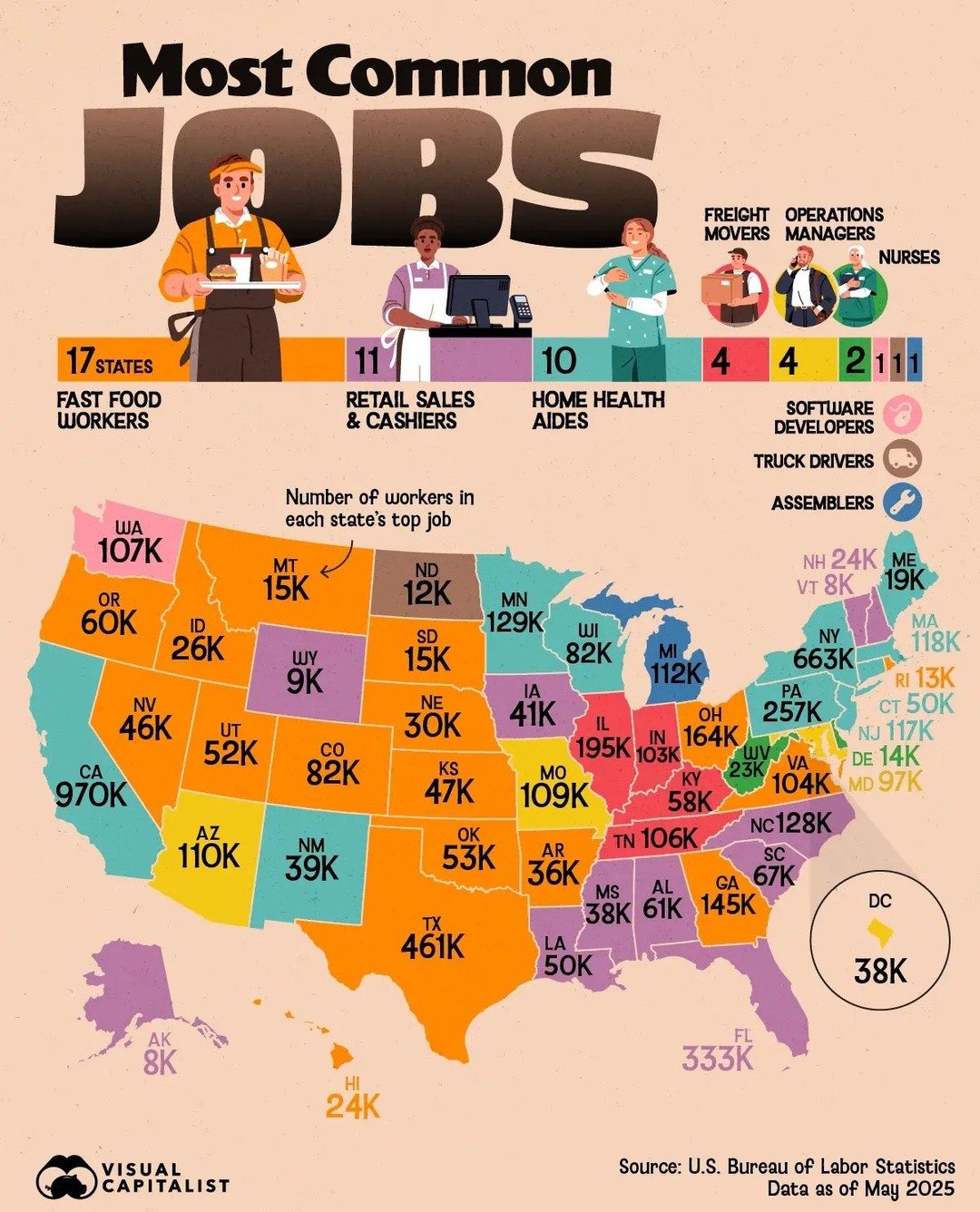
Fast Food Workers: The Most Common Job in 17 U.S. States
The landscape of employment in the United States reveals an intriguing shift, with fast food workers now holding the title of the most common job in 17 states. This trend underscores the changing dynamics of the job market and the influence of various economic factors on employment trends. The data, sourced from the U.S. Bureau of Labor Statistics and visualized in an informative infographic, presents a clear picture of the most prevalent occupations across different states.
Why This Matters
Understanding the most common jobs in each state provides valuable insights into the economic health and labor trends of different regions. It highlights the sectors that are driving employment and offers a glimpse into the types of jobs that are most in demand. This information is crucial for policymakers, job seekers, and employers alike, as it helps in making informed decisions about workforce development, educational programs, and economic policies.
The Most Common Jobs by State
The infographic reveals a diverse range of top occupations, each reflecting the unique economic landscape of their respective states. Here are some of the key findings:
Fast Food and Retail Dominate
Fast food workers and retail salespersons are the most common jobs in many states. This prevalence can be attributed to several factors, including:
- Job Accessibility: These positions often require minimal formal education and training, making them accessible to a wide range of job seekers.
- Growing Demand: The ever-expanding food and retail sectors continue to create new job opportunities, driven by consumer demand and economic growth.
- Economic Factors: In some states, the presence of fast food and retail chains as major employers significantly contributes to their prominence in the job market.
Software Developers in Washington
In Washington, software developers hold the top position, reflecting the state's robust tech industry. This trend is driven by:
- Tech Hubs: The presence of major tech companies and startups in Washington creates a high demand for skilled software developers.
- Educational Infrastructure: Strong educational programs and a tech-savvy workforce contribute to the high number of software developers in the state.
Healthcare and Transportation
Healthcare and transportation sectors also see significant representation, with home health aides and truck drivers being among the most common jobs in various states. These jobs are vital due to:
- Aging Population: The growing demand for home health services reflects an aging population that requires more healthcare support.
- Supply Chain Needs: The logistics and transportation sectors are crucial for maintaining the supply chain, ensuring that goods and services reach consumers efficiently.
The Role of Economic Factors
The prevalence of certain jobs in different states can be attributed to various economic factors. Understanding these factors is essential for a comprehensive view of the job market. Some key economic drivers include:
Economic Growth
States with strong economic growth often see a rise in job opportunities across various sectors. This growth is driven by factors such as:
- Investment and Infrastructure: States that invest in infrastructure and attract business investments create more job opportunities.
- Consumer Demand: Higher consumer spending and economic activity contribute to the demand for goods and services, leading to more jobs.
Industry Trends
Changes in industry trends can also influence the most common jobs in a state. For example:
- Tech Booms: States like Washington benefit from the tech boom, leading to a high concentration of software developers.
- Healthcare Advancements: Improvements in healthcare services and technology create more job opportunities in the healthcare sector.
Educational Attainment
The level of educational attainment in a region can also impact the most common jobs. For instance:
- Skills and Certification: Jobs in the software development and healthcare sectors often require specialized skills and certifications, which are more prevalent in regions with strong educational programs.
- Vocational Training: The availability of vocational training programs can lead to a higher number of workers in fields like fast food and retail, which often require on-the-job training.
Practical Tips for Job Seekers
Whether you're a job seeker or an employer, understanding the most common jobs in your state can provide valuable insights. Here are some practical tips to navigate the job market effectively:
Identifying High-Demand Sectors
Knowing the most common jobs in your state can help you identify high-demand sectors. For example, if you're in a state where fast food and retail jobs are prevalent, you might consider:
- Vocational Training: Enrolling in vocational training programs can enhance your skills and make you more competitive in the job market.
- Networking: Building a network within the industry can provide access to job opportunities and industry insights.
Leveraging Economic Trends
Understanding the economic trends in your state can help you make informed decisions. For instance, if your state has a growing tech sector, you might consider:
- Upskilling: Investing in relevant skills and certifications can make you more attractive to employers in the tech industry.
- Relocation: If the tech sector isn't strong in your current state, you might consider relocating to a state where it is.
Evaluating Educational Requirements
Different jobs have varying educational requirements. For example, software development often requires a bachelor's degree or specialized certifications, while fast food and retail jobs may require only on-the-job training. Consider:
- Educational Pathways: Choosing the right educational pathway can help you secure a job in a high-demand sector.
- Continuous Learning: Keeping your skills up-to-date through continuous learning and development can enhance your career prospects.
Important Takeaways
The latest data from the U.S. Bureau of Labor Statistics highlights several important takeaways about the job market in the United States:
- Fast food and retail jobs are prevalent in many states, reflecting their accessibility and growing demand.
- Tech hubs like Washington have a high concentration of software developers, driven by a robust tech industry and strong educational programs.
- Healthcare and transportation sectors are crucial for meeting the needs of an aging population and maintaining the supply chain.
- Economic factors such as growth, industry trends, and educational attainment significantly influence the job market.
Conclusion
The landscape of employment in the United States presents a diverse and dynamic picture, with various sectors driving job opportunities in different regions. From fast food and retail to software development and healthcare, each state has its unique job trends that reflect its economic and industrial landscape. Understanding these trends is essential for job seekers, employers, and policymakers, as it helps in making informed decisions about workforce development, educational programs, and economic strategies. By leveraging insights from the most common jobs data, individuals and organizations can navigate the job market more effectively and contribute to a thriving economy.
Watch the Reel
Questions readers ask
Which jobs are most prevalent in the U.S. in 2025, and how do they vary by state?
The most common jobs in the U.S. in 2025 vary significantly by state. Fast food workers are the most prevalent in 17 states, highlighting the prominence of the service industry in many regions. In contrast, software developers dominate in states like Washington, reflecting the tech industry's strong presence. Other states have unique top jobs, such as retail salespersons and health care practitioners, illustrating the diverse economic landscapes across the country.
What insights can be gained from understanding the most common jobs by state?
Examining the most common jobs by state offers a window into each region's economic health and labor trends. It helps identify the sectors driving employment and can inform decisions for job seekers, policymakers, and businesses. For instance, if a state's most common job is in healthcare, it might indicate a strong demand for medical services, while a prevalence of software developers could signal a thriving tech industry.
What are the top jobs in each state expected to be in 2025, based on current trends?
Based on current trends, the top jobs in each state for 2025 are projected to span various sectors. Fast food and retail jobs are predicted to remain common in many states, while professional occupations like software developers and healthcare practitioners are anticipated to be prevalent in others. Detailed state-by-state job data, such as that provided by the U.S. Bureau of Labor Statistics, will offer more specific insights as 2025 approaches.
How do job trends in 2025 compare to previous years, and which jobs are on the rise?
Job trends in 2025 are expected to show a continued shift towards service and technology sectors. While fast food and retail jobs have historically been common, the rise of remote work and automation may influence these trends. In contrast, jobs such as software developers and healthcare practitioners are expected to experience growth, driven by advancements in technology and an aging population.
Which states are likely to have the most tech-oriented job markets in 2025?
States like Washington, California, and Massachusetts are likely to have the most tech-oriented job markets in 2025, with software developers being among the most common jobs. These states have established themselves as hubs for technology and innovation, attracting both established tech companies and startups.
How can job seekers use this information to their advantage in 2025?
Job seekers can leverage this information to target their job searches more effectively. By identifying the most in-demand jobs in their state or a desired location, they can tailor their skills and qualifications to meet the specific needs of the local job market. Additionally, understanding the prevalent job trends can help job seekers make informed decisions about career paths, training, and relocation.
Recent articles
Fresh deep dives from the latest Reels we unpacked.




Comments
Be the first to comment.