U.S. Import Dependence on Canada and Mexico
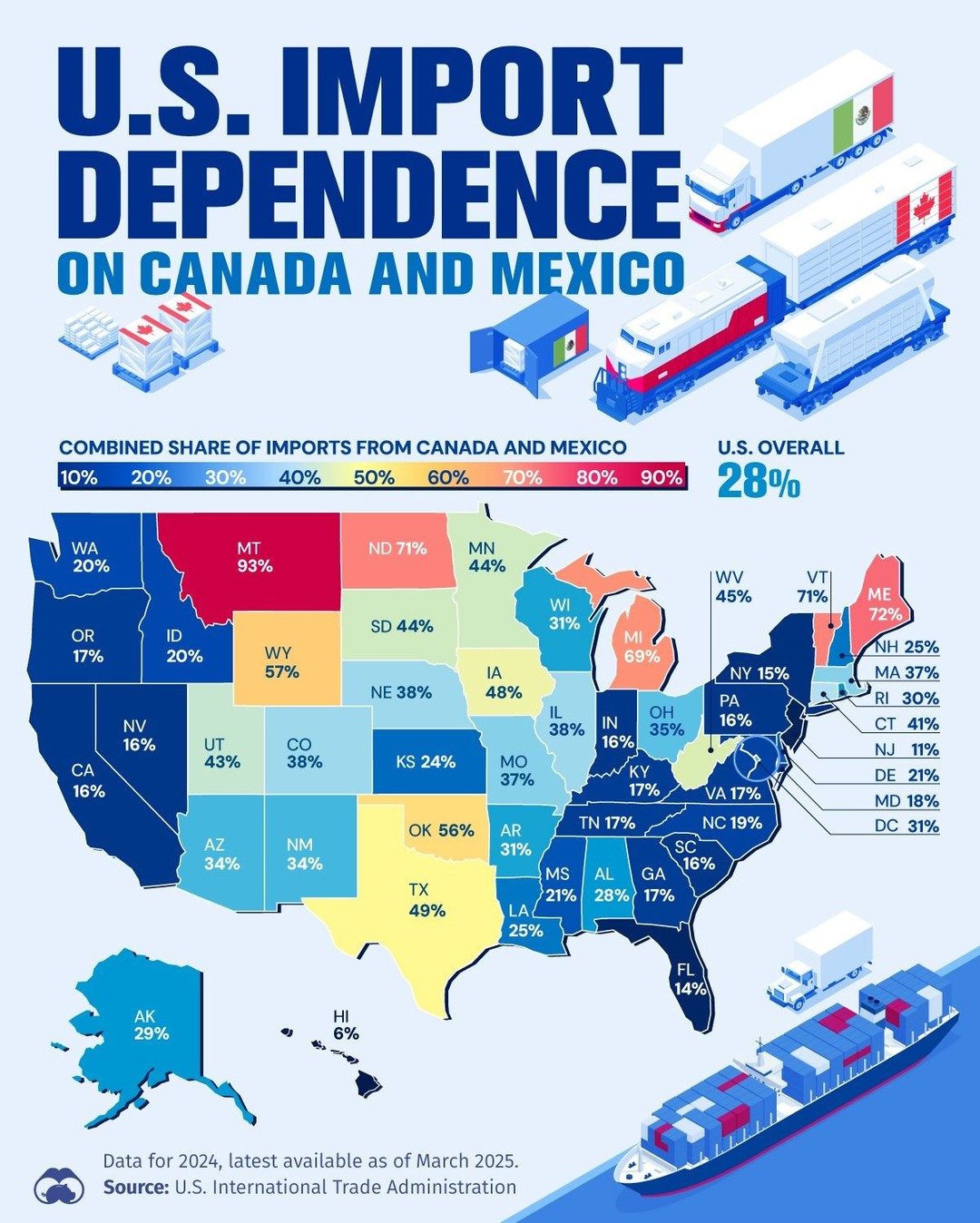
The United States relies heavily on imports from its neighboring countries, Canada and Mexico, with a significant portion of its imports coming from these two trade partners. This dependence is particularly notable in certain states, where the combined share of imports from Canada and Mexico exceeds 50% in some cases. The high level of dependency is driven by various factors, particularly the import of crude oil for refinery operations.
Why This Matters
Understanding the U.S.'s import dependence on Canada and Mexico is crucial for several reasons. It provides insights into the country's trade dynamics, highlights the importance of these trade relationships, and underscores the potential impact of trade policies and disruptions in supply chains. This information can be valuable for policymakers, businesses, and consumers alike, as it affects the availability and cost of goods and services.
State-by-State Breakdown
The combined share of imports from Canada and Mexico varies significantly among U.S. states. Here's a closer look at the states with the highest and lowest dependency:
Top States for Import Dependence
Montana (93%): Montana tops the list with an astonishing 93% of its imports coming from Canada and Mexico. This high dependence is largely due to the state's oil refinery operations, which rely heavily on crude oil imports from Canada.
Wisconsin (69%): Wisconsin follows closely with 69% of its imports originating from these two countries. The state's manufacturing sector, which includes the production of machinery, vehicles, and food products has a high import dependence.
North Dakota (71%): North Dakota's 71% import share is driven by its energy sector, which includes the import of crude oil and natural gas. Its geopolitical position as a northern state also makes it more reliant on Canadian imports.
Minnesota (57%): Minnesota's 57% import share is influenced by its diverse economy, which includes agriculture, manufacturing, and mining. The state's proximity to Canada plays a significant role in its import dependence.
States with Lower Import Dependence
Florida (14%): Florida has a relatively low import dependence, with only 14% of its imports coming from Canada and Mexico. This is likely due to its geographical location and its strong trade relationships with other countries, particularly in Latin America.
Hawaii (6%): Hawaii has the lowest import dependence from Canada and Mexico, with only 6% of its imports coming from these countries. This is primarily because of Hawaii's unique geographical location and its strong reliance on imports from Asia.
Industry-Specific Dependence
Oil and Gas
The oil and gas sector is one of the most impacted by the U.S.'s import dependence on Canada and Mexico. States like Montana, North Dakota, and Oklahoma rely heavily on crude oil imports from Canada for their refinery operations. This dependence can have significant implications for energy prices and supply chain stability.
Manufacturing
The manufacturing sector is another key area of import dependence. States with robust manufacturing industries, such as Wisconsin and Minnesota, import a substantial amount of raw materials and components from Canada and Mexico. This trend highlights the interconnected nature of North American manufacturing supply chains.
Agriculture
The agricultural sector also shows significant import dependence. States like Minnesota and North Dakota import various agricultural inputs, including fertilizers and machinery, from Canada and Mexico.
The Role of Trade Policies
Trade policies, including tariffs and trade agreements, play a crucial role in shaping the U.S.'s import dependence on Canada and Mexico. Policies that promote free trade can enhance the flow of goods and reduce dependence, while protectionist measures can have the opposite effect. For instance, tariffs imposed on Canadian steel and aluminum have the potential to disrupt supply chains and increase production costs in certain states.
Practical Tips
For businesses and policymakers, understanding the nuances of import dependence can offer several practical benefits:
Diversify Supply Chains
Businesses that rely heavily on imports from Canada and Mexico should consider diversifying their supply chains. This can help mitigate risks associated with trade disruptions and geopolitical tensions. Exploring alternative sourcing options can also potentially lower costs and improve supply chain resilience.
Monitor Trade Policies
Keeping a close eye on trade policies and negotiations is essential. Changes in tariffs, trade agreements, and other regulatory measures can significantly impact import dependence and supply chain stability. Staying informed can help businesses and policymakers make strategic decisions.
Foster Domestic Production
Encouraging domestic production can reduce reliance on imports. This can be achieved through incentives for local manufacturing, research and development, and investment in infrastructure. While this may not eliminate import dependence, it can certainly mitigate its impact.
Important Takeaways
The U.S.'s reliance on imports from Canada and Mexico is a complex issue with significant implications for various sectors, including oil and gas, manufacturing, and agriculture. Key takeaways include:
- State Variation: Import dependence varies widely among states, with Montana, Wisconsin, and North Dakota showing the highest levels of reliance.
- Industry-Specific Dependence: Certain industries, such as oil and gas, manufacturing, and agriculture, are particularly impacted by this dependence.
- Trade Policy Impact: Trade policies significantly influence import dependence and supply chain stability.
- Import Dependence Mitigation: Diversifying supply chains, monitoring trade policies, and fostering domestic production are effective strategies to mitigate the impacts of import dependence.
Conclusion
The U.S.'s import dependence on Canada and Mexico is a multifaceted issue that affects various sectors and states. Understanding the nuances of this dependence and its implications is crucial for policymakers, businesses, and consumers. By adopting strategic approaches and staying informed about trade policies, stakeholders can manage this dependence more effectively, ensuring supply chain stability and economic growth.
Watch the Reel
Questions readers ask
Why is Montana the most import-dependent state on Canada and Mexico?
Montana's high dependence on imports from Canada and Mexico is primarily due to its substantial oil refinery operations. The state's geographical proximity to Canada also plays a significant role, making it convenient and cost-effective to import goods from these neighboring countries.
What percentage of Montana's imports come from Canada and Mexico?
Montana sources 93% of its imports from Canada and Mexico, making it the most import-dependent state on these two countries. This high percentage underscores the state's heavy reliance on its northern and southern neighbors for goods and materials.
Which other U.S. states show significant import dependence on Canada and Mexico?
While Montana leads in import dependence, other states also show significant reliance on Canada and Mexico. Several states have more than 50% of their imports coming from these countries, illustrating a broader trend of dependence on northern and southern neighbors for various goods, including oil.
Why are Canada and Mexico important U.S. trade partners?
Canada and Mexico are crucial trade partners for the U.S. due to their geographical proximity and the extensive trade agreements in place. These countries supply a significant portion of U.S. imports, influencing trade dynamics and supply chains, particularly in states like Montana.
How does Montana's oil industry contribute to its import dependence on Canada and Mexico?
Montana's oil industry heavily relies on crude oil imports from Canada. The state's refineries process this imported oil, making Canada a vital source for oil imports. This dependence is a key factor in Montana's overall import reliance on Canada.
What are some of the implications of the U.S. import dependence on Canada and Mexico?
The U.S.'s import dependence on Canada and Mexico influences trade policies, supply chains, and the overall economy. Trade disruptions, policy changes, or shifts in supply can have significant impacts on states like Montana, highlighting the importance of maintaining robust trade relationships.
Recent articles
Fresh deep dives from the latest Reels we unpacked.




Comments
Be the first to comment.