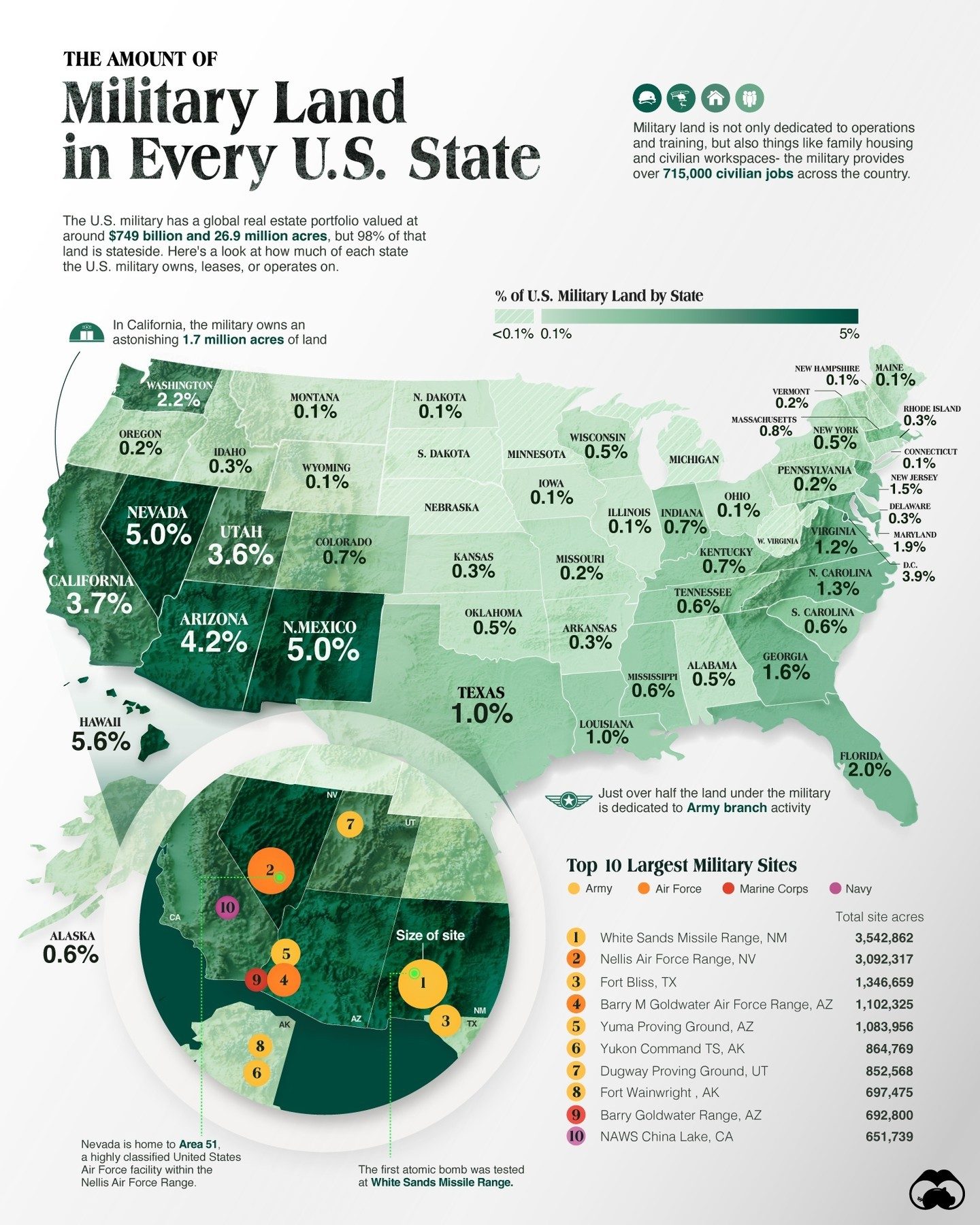
Military Land Ownership
The United States military owns, leases, or operates a staggering amount of land and property, a fact rarely explored in depth. The military's real estate portfolio is vast, encompassing 26.9 million acres of land and buildings valued at $749 billion. Of this extensive portfolio, a significant 98% is located within the United States, making it a substantial landowner in nearly every state.
Context / Why this matters
Understanding the extent of military land ownership is crucial for several reasons. It provides insights into the military's operational capabilities, economic impact, and influence on local communities. The military's land holdings are not just for training and operations; they also include family housing and civilian workspaces. This vast infrastructure supports over 715,000 civilian jobs across the country, highlighting the military's role in the national economy.
Main discussion
The Scope of Military Land
The United States military's real estate portfolio is not just about land; it includes a wide array of buildings and facilities. The total value of these properties is estimated at $749 billion, a figure that underscores the military's significant investment in infrastructure. The land itself covers 26.9 million acres, an area roughly the size of Ohio and Virginia combined.
State-by-State Breakdown
The military's land holdings are not evenly distributed across the country. Some states have significantly more military-owned land than others. California leads with 1,717,000 acres, followed by Texas with 965,843 acres and Florida with 786,583 acres. Virginia and Arizona follow with substantial holdings, 585,318 acres and 568,845 acres, respectively.
Other states with notable amounts of military land include:
- Alaska
- Hawaii
- Colorado
- Alabama
- Georgia
- Kentucky
- Mississippi
- Louisiana
- Oklahoma
- New Mexico
- New York
- Washington
- Illinois
- Massachusetts
Uses of Military Land
Military land is not solely dedicated to training and operations. It serves a variety of purposes, including:
- Family Housing: Military families need housing, and the military provides it. This includes both on-base housing and privately owned homes in military communities.
- Civilian Workspaces: The military employs a large number of civilians, and these workers need places to work. Military bases often include administrative buildings, research facilities, and other civilian workspaces.
- Training and Testing: Over half of the military's land is dedicated to training and testing. This includes ranges, training areas, and testing grounds for new equipment and technologies.
Practical tips
Staying Informed
For those interested in understanding the military's impact on local communities, it's essential to stay informed about military land holdings. This information can be found through various government resources, including the Department of Defense (DoD) and local military bases.
Engaging with Local Authorities
Engaging with local authorities and military representatives can provide more detailed information about military land in specific areas. This is particularly important for residents who live near military installations, as changes in military operations can impact local communities.
Important takeaways
The military's extensive land holdings have a significant impact on the national economy and local communities. Understanding the extent and uses of this land can provide valuable insights into the military's operations and its role in society. Here are some key points:
- The U.S. military owns a vast real estate portfolio, valued at $749 billion, with 98% of this land located within the United States.
- The military's land holdings are distributed across all 50 states, with California, Texas, and Florida having the largest amounts.
- Over half of the military's land is dedicated to training and testing, but it also includes family housing and civilian workspaces.
- Military land holdings support over 715,000 civilian jobs across the country, highlighting the military's economic impact.
Conclusion
The military's land ownership is a critical aspect of its operations and has far-reaching implications for the economy and local communities. By understanding the extent and uses of military land, individuals and communities can better navigate the impacts of military presence in their areas. Whether it's through government resources, local authorities, or community engagement, staying informed about military land holdings is essential for a comprehensive understanding of the military's role in the United States.
Watch the Reel
Questions readers ask
What is the total amount of land owned or controlled by the U.S. military, and how is it distributed across the states?
The U.S. military owns or controls approximately 26.9 million acres of land, with 98% of this vast portfolio located within the United States. This means that military land can be found in nearly every state, making the military a significant landowner nationwide.
Which state has the most military land and what is the significance of this?
While the article does not specify the exact amount of military land in each state, it is known that states like Texas have substantial military holdings. The significance of these holdings lies in their support for military operations, infrastructure, and their broader economic impact on local communities.
What types of properties are included in the military's real estate portfolio?
The military's real estate portfolio includes a variety of properties such as training grounds, operational facilities, family housing, and civilian workspaces. This diverse range of properties underscores the military's multifaceted role in both defense and community support.
How does the military's land ownership impact the broader economy?
The military's extensive land ownership supports a wide range of economic activities, including jobs, infrastructure development, and local business opportunities. By leasing or operating these lands, the military contributes to the economic health of the communities in which it is present.
What is the valuation of the military's land and property holdings, and why is it important to know this?
The military's land and property holdings are valued at approximately $749 billion. Knowing this valuation is important for understanding the scale of the military's investment in infrastructure, as well as its potential influence on real estate markets and local economies.
Can the military land be used for civilian purposes, and if so, how is this managed?
While the primary use of military land is for defense and operational purposes, some military-owned or operated lands can be used for civilian purposes through leasing or partnerships. This is managed through various agreements that ensure the land continues to serve both military and public needs.
How does the military's land ownership vary by state, and where can I find a map of it?
The amount of military-owned land varies by state, with some states having more extensive holdings than others. To understand the distribution, you can refer to a military land state map, which provides a visual representation of where military lands are located across the U.S. Unfortunately, this is not provided in the article but can be sought from additional resources.
Related deep dives
Similar reads based on topic and creator.


Recent articles
Fresh deep dives from the latest Reels we unpacked.




Comments
Be the first to comment.