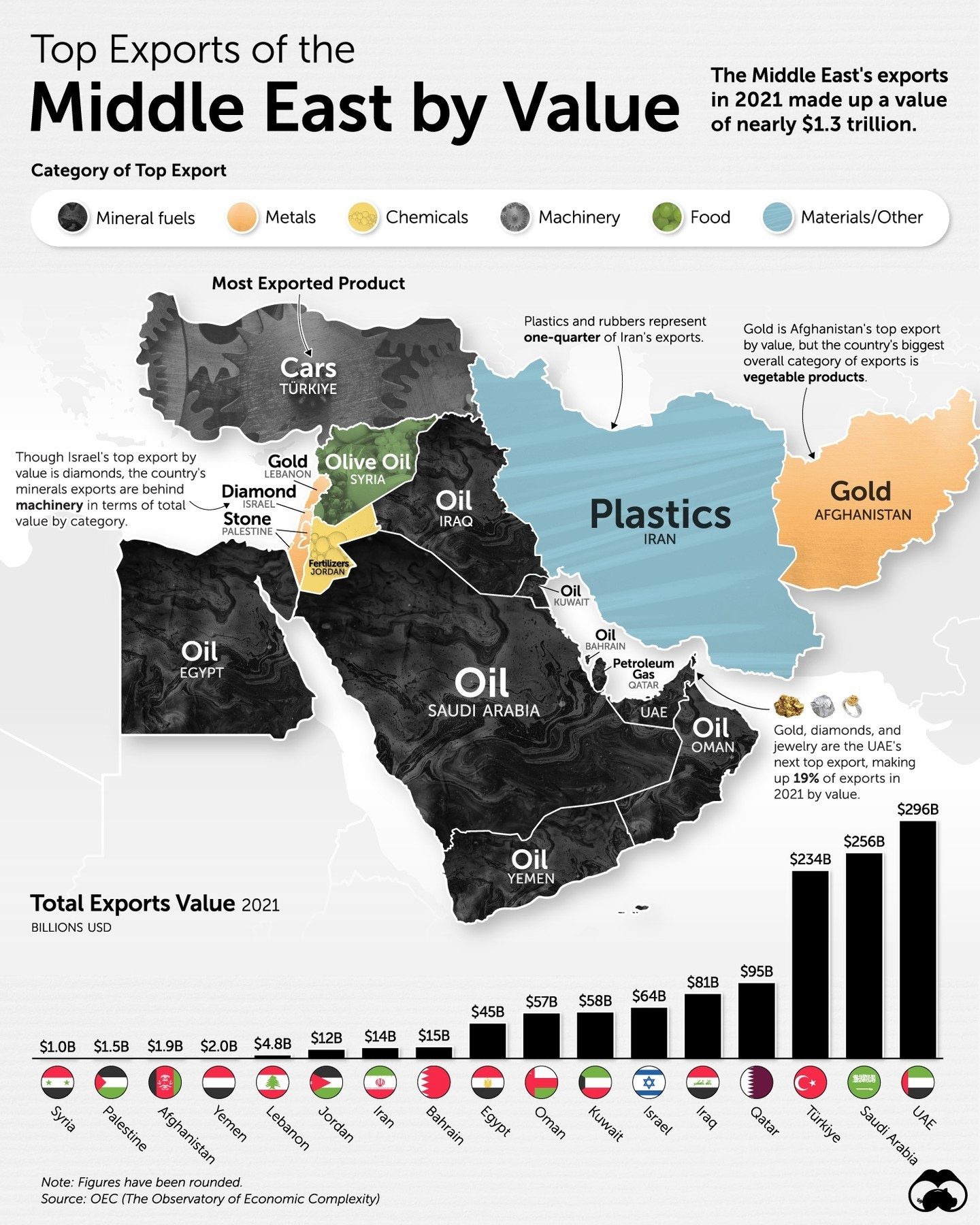
The Middle East's economy is a powerhouse in the global market, particularly in the energy sector. However, the region's economic influence extends far beyond oil. Let’s delve into the diverse array of exports that contribute to the Middle East's robust economy, using 2021 data from The Observatory of Economic Complexity.
Context / Why this matters
The Middle East's economic landscape is deeply rooted in its rich natural resources, but the region's export portfolio is surprisingly diverse. Understanding the full spectrum of the Middle East's exports provides valuable insights into the region's economic health, strategic importance, and global trade dynamics.
Main Discussion
The Big Picture: Regional Exports
The Middle East’s exports in 2021 were valued at nearly $1.3 trillion. While mineral fuels, including oil and petroleum, dominate the export landscape, other sectors such as metals, chemicals, machinery, food, and materials play a crucial role in the region's economic diversity.
Oil and Mineral Fuels
Oil remains the backbone of the Middle East's export economy. Countries like Saudi Arabia, Iraq, and Egypt are major exporters of petroleum products. For instance, Saudi Arabia is well-known for its substantial oil exports, contributing significantly to its economic prowess and global influence. The UAE, another key player, also relies heavily on oil exports, although it is diversifying its economic base.
The significance of oil in the region can be seen in countries such as Yemen and Oman, where mineral fuels are crucial exports. This sector not only fuels the local economies but also plays a pivotal role in global energy markets.
Metals and Precious Resources
Metals and precious resources are another significant sector in the Middle East's export economy. For instance, Turkiye stands out with gold as one of its top exports. Afghanistan, although not traditionally part of the Middle East, is included in the region by some organizations and is known for its gold exports. Gold is a significant contributor to Afghanistan’s export value, showcasing the country’s rich mineral resources.
Chemicals and Plastics
The Middle East is also a significant player in the global chemical and plastic industries. Plastics and rubbers represent one quarter of Iran’s exports, highlighting the country's strong manufacturing capabilities. Similarly, chemical exports from countries like Lebanon and Syria contribute to the region's economic diversity. These exports not only support local industries but also meet global demand for these essential materials.
Machinery and Food
Machinery and food exports are other notable sectors. Machinery exports from countries like Jordan and Israel reflect the region's advanced industrial capabilities. The food sector, including olive oil from Lebanon and Syria, showcases the region's agricultural prowess. These exports not only support local economies but also contribute to global food security and industrial development.
Practical Tips
For businesses looking to engage with the Middle East's export market, understanding the regional dynamics is crucial. Here are a few practical tips for navigating this complex landscape:
- Identify Key Exports: Understand which countries excel in specific export sectors. For example, Saudi Arabia for oil, Turkiye for gold, and Iran for plastics.
- Leverage Trade Agreements: Many Middle Eastern countries have established trade agreements with global partners. Leverage these agreements to facilitate smoother trade relations.
- Diversify Partnerships: While oil remains a significant export, diversifying partnerships across sectors such as metals, chemicals, and machinery can provide strategic advantages.
- Stay Updated on Economic Trends: Economic policies and market dynamics evolve. Staying updated on the latest trends and regulatory changes can help in making informed business decisions.
Important Takeaways
The Middle East's export economy is a multifaceted mosaic of industries, each contributing significantly to the region's economic strength and global influence. Here are the key takeaways:
- Oil Dominates: Mineral fuels remain the cornerstone of the Middle East's export economy, with oil being the primary contributor.
- Diversified Exports: Beyond oil, the region exports a wide range of products including metals, chemicals, machinery, and food.
- Strategic Exports: Countries like Saudi Arabia, UAE, and Turkiye leverage their strategic exports to maintain economic stability and global influence.
- Economic Diversity: The Middle East’s diverse export portfolio supports local economies and meets global demand, showcasing the region's economic resilience and adaptability.
Conclusion
The Middle East's export economy is a testament to the region's rich resources and strategic significance. While oil remains the dominant export, the diversity of other sectors such as metals, chemicals, machinery, and food highlights the region's economic resilience and adaptability. Understanding the Middle East's export economy provides valuable insights into the region's global trade dynamics and economic prowess.
Watch the Reel
Questions readers ask
What were the top exports of the Middle East in 2021 besides oil?
In 2021, the Middle East exported a variety of goods including metals, chemicals, machinery, food, and various materials. Metals like gold and aluminum were particularly notable, contributing significantly to the region's export revenue.
How does the Middle East's export diversity impact its global influence?
The Middle East's export diversity enhances its global influence by reducing its reliance on a single commodity. This diversification allows the region to maintain economic stability and engage in a broader range of international trade partnerships.
Which countries in the Middle East are the leading exporters?
The leading export countries in the Middle East include the United Arab Emirates, Saudi Arabia, and Qatar. These countries have robust export sectors that span across multiple industries, contributing significantly to the region's overall export value.
How has the Middle East's export complexity evolved in recent years?
The Middle East's export complexity has evolved significantly, with a growing emphasis on high-value, processed goods. This shift reflects the region's efforts to move away from a sole dependence on raw materials and towards more sophisticated, value-added products.
What role do food and agricultural exports play in the Middle East's economy?
Food and agricultural exports are a crucial component of the Middle East's economy, providing essential revenue and contributing to the region's food security. Countries like Egypt and Syria are significant exporters of food products, showcasing the region's agricultural capabilities.
In what ways do the Middle East's chemical and machinery exports contribute to its economic diversity?
The chemical and machinery exports from the Middle East contribute to its economic diversity by tapping into high-demand global markets. These sectors require advanced technology and skilled labor, further enhancing the region's industrial capabilities and export portfolio.
What trends in the Middle East's export data from 2021 are particularly noteworthy?
Noteworthy trends from 2021 include a rise in the export of metals like gold and aluminum, as well as an increase in the export of sophisticated machinery and chemicals. These trends indicate a growing sophistication in the region's industrial capabilities and export offerings.
Related deep dives
Similar reads based on topic and creator.


Recent articles
Fresh deep dives from the latest Reels we unpacked.




Comments
Be the first to comment.