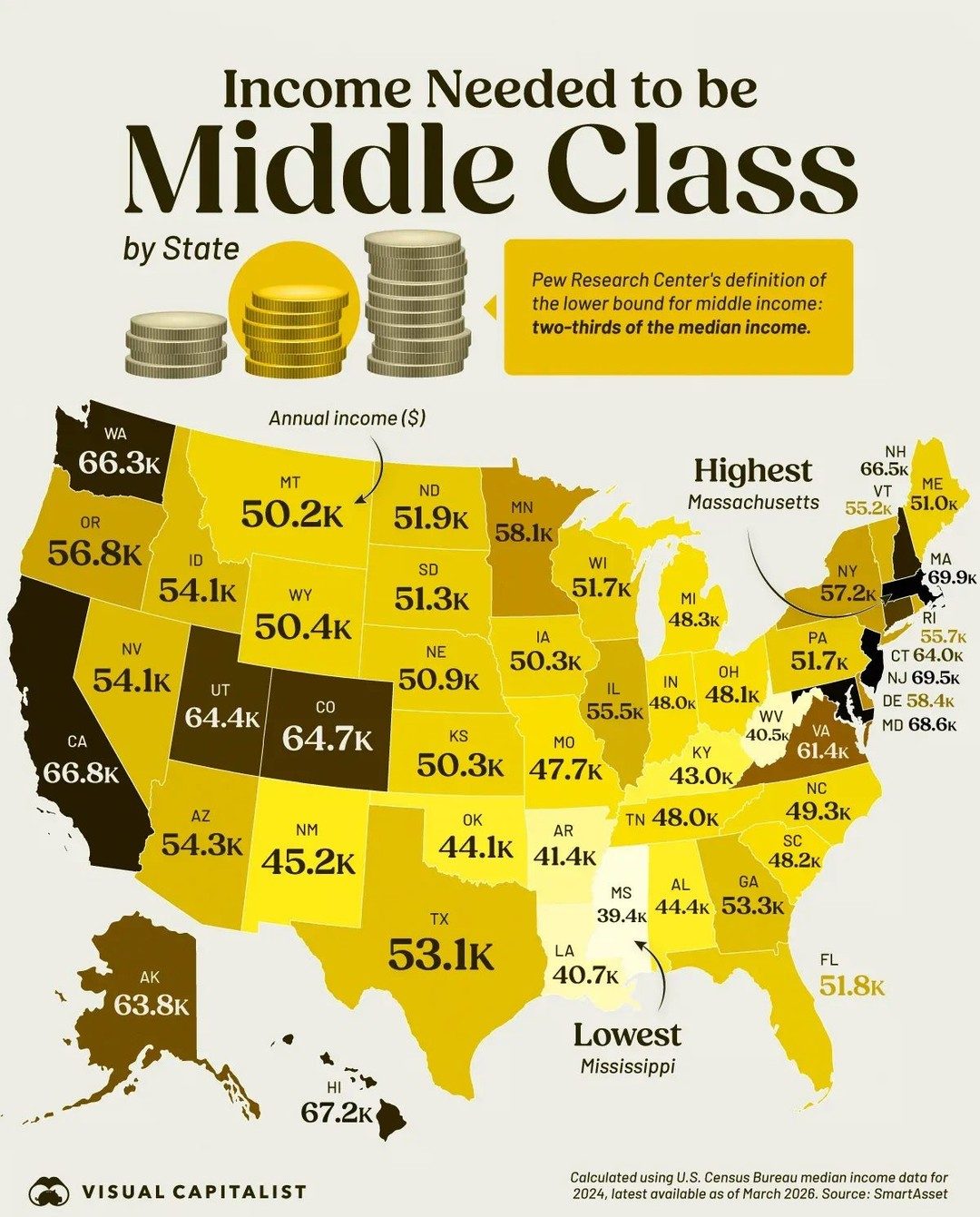
Income Needed for Middle Class by State
Determining the financial threshold for middle-class status varies significantly across the United States. The minimum annual income required to be considered middle class ranges from $39.4K in Mississippi to $69.9K in Massachusetts. This disparity highlights the economic differences between regions, with Northeastern and coastal states generally demanding higher incomes for middle-class status, while many Southern states have lower income requirements.
Why This Matters
Understanding the income needed to be middle class in each state is crucial for several reasons. It provides insight into the cost of living, economic opportunities, and financial stability in different regions. For individuals and families planning to move, it offers a clear picture of what to expect in terms of earning potential and expenses. For policymakers, it can guide decisions on minimum wage, tax policies, and social services.
The Data Behind the Middle-Class Income
The data used to map the minimum income required for middle-class status comes from reputable sources, including SmartAsset, the U.S. Census Bureau, and the Pew Research Center. These organizations define the lower bound of the middle class as two-thirds of the median income in each state.
Highest and Lowest Income Requirements
The highest income requirement for middle-class status is in Massachusetts, where households need at least $69.9K annually. Massachusetts is followed by New Hampshire ($69.9K) and Connecticut ($64.0K). These states are known for their high cost of living, particularly in areas like housing, healthcare, and education.
On the other hand, Mississippi has the lowest income requirement for middle-class status at $39.4K. Other states with relatively low requirements include Arkansas ($43.0K), Alabama ($44.4K), and Oklahoma ($44.1K). These states generally have a lower cost of living, making it easier for households to achieve middle-class status with lower incomes.
State-by-State Breakdown
Here is a breakdown of the annual income needed to be considered middle class in each state, according to the data:
- Alabama ($44.4K)
- Alaska ($63.8K)
- Arizona ($45.2K)
- Arkansas ($43.0K)
- California ($66.8K)
- Colorado ($50.3K)
- Connecticut ($64.0K)
- Delaware ($58.4K)
- Florida ($51.8K)
- Georgia ($48.2K)
- Hawaii ($66.5K)
- Idaho ($54.1K)
- Illinois ($51.7K)
- Indiana ($51.7K)
- Iowa ($51.3K)
- Kansas ($47.7K)
- Kentucky ($47.8K)
- Louisiana ($40.7K)
- Maine ($66.5K)
- Maryland ($68.6K)
- Massachusetts ($69.9K)
- Michigan ($51.7K)
- Minnesota ($51.3K)
- Mississippi ($39.4K)
- Missouri ($47.9K)
- Montana ($57.2K)
- Nebraska ($50.3K)
- Nevada ($54.1K)
- New Hampshire ($69.9K)
- New Jersey ($61.4K)
- New Mexico ($45.6K)
- New York ($61.4K)
- North Carolina ($48.2K)
- North Dakota ($55.5K)
- Ohio ($48.1K)
- Oklahoma ($44.1K)
- Oregon ($57.2K)
- Pennsylvania ($51.7K)
- Rhode Island ($55.7K)
- South Carolina ($48.2K)
- South Dakota ($50.9K)
- Tennessee ($48.0K)
- Texas ($51.5K)
- Utah ($64.4K)
- Virginia ($61.4K)
- Washington ($66.3K)
- West Virginia ($50.3K)
- Wisconsin ($55.5K)
- Wyoming ($50.4K)
Practical Tips to Navigate Middle-Class Income
For those aiming to achieve or maintain a middle-class lifestyle, here are some practical tips:
Adjust Your Cost of Living
Consider relocating to a state with a lower cost of living if your income is nearer to the high end of the middle-class range. This can help stretch your budget further and improve your financial stability.
Plan for Expenses
Budgeting is key to financial stability. Use financial planning tools to understand your monthly expenses and allocate your income accordingly. This includes savings for emergencies, retirement, and other long-term goals.
Increase Your Earning Potential
Invest in education, skills, and certifications that can boost your earning potential. Higher qualifications can lead to better job opportunities and salaries, helping you maintain a middle-class lifestyle.
Take Advantage of Local Resources
Many states offer resources and programs to support middle-class households. Research local initiatives, tax breaks, and other benefits that can help you manage your finances more effectively.
Important Takeaways
- Variability Across States: The income needed to be middle class varies significantly by state, with Northeastern and coastal states generally requiring higher incomes.
- Cost of Living: Understanding the cost of living in different regions can help you plan your finances better and make informed decisions about relocation.
- Economic Opportunities: States with higher income requirements for the middle class often offer more economic opportunities and a higher standard of living.
Conclusion
The income needed to be considered middle class in the United States varies widely from state to state. By understanding these variations, individuals and families can make informed decisions about their financial future, whether it's planning a move, budgeting more effectively, or investing in their earning potential. This knowledge is essential for navigating the economic landscape and achieving financial stability.
Watch the Reel
Questions readers ask
What is the minimum annual income to be considered middle class in Mississippi?
The minimum annual income to be considered middle class in Mississippi is $39,400. This is the lowest threshold in the U.S., reflecting the state's relatively lower cost of living compared to other states.
Which state has the highest minimum annual income for middle class status?
Massachusetts has the highest minimum annual income for middle class status, set at $69,900. This high threshold is largely due to the state's elevated cost of living and housing expenses.
Why do middle class income thresholds vary by state?
Middle class income thresholds vary by state due to differences in cost of living, economic opportunities, and financial stability. States with higher living costs, such as those in the Northeast and on the coasts, typically have higher income requirements for middle class status.
How can knowing state-specific middle class income thresholds be beneficial?
Knowing state-specific middle class income thresholds can be beneficial for individuals and families planning to move, as it provides insight into the cost of living and economic opportunities in different regions. This information can help in financial planning and setting realistic expectations for a comfortable lifestyle.
What are some key factors that influence the cost of living in a state?
Key factors that influence the cost of living in a state include housing prices, taxes, transportation costs, and the availability of jobs. States with high housing costs and taxes, like Massachusetts, often have higher middle class income thresholds, while states with lower living expenses, like Mississippi, have lower thresholds.
Where can I find a middle class income map for the U.S.?
For an overview of middle class income thresholds across the U.S., you can look for resources that provide visual representations, such as maps or interactive graphs. These tools often use data from reliable sources like the Pew Research Center to illustrate income disparities by state. Many blogs and financial websites offer these visuals to help compare middle class income thresholds across different regions.
Recent articles
Fresh deep dives from the latest Reels we unpacked.




Comments
Be the first to comment.