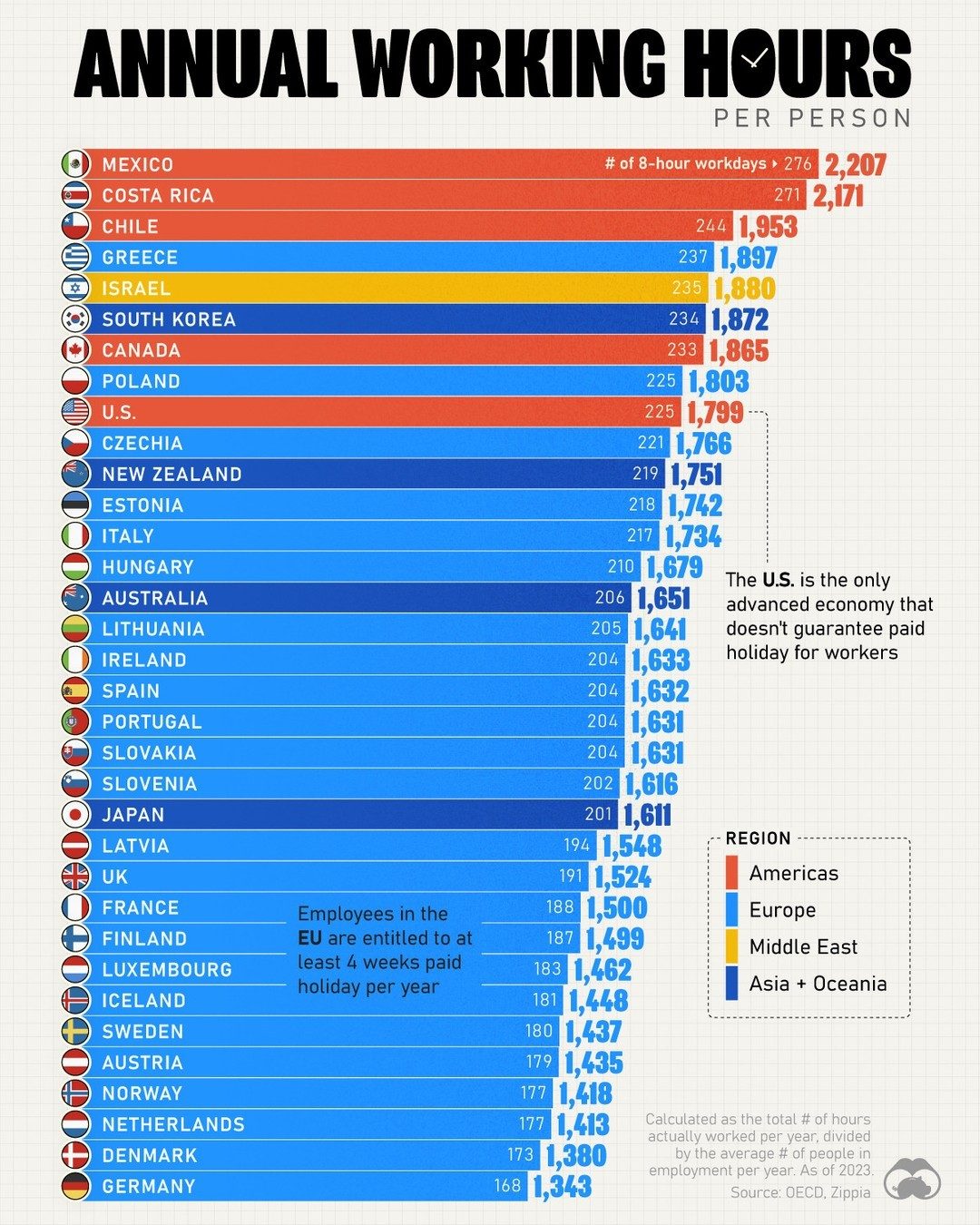
Annual Working Hours by Country
Annual working hours by country vary significantly, with Mexico leading the list among OECD countries. In contrast, Germans work about 40% fewer hours annually. This disparity is influenced by several factors, including mandatory paid holidays and cultural differences in work culture. Understanding these variations can provide insight into labor policies, economic structures, and work-life balance across different nations.
Why This Matters
Annual working hours are a crucial indicator of a country's labor policies, economic productivity, and overall work-life balance. Countries with higher annual working hours may face challenges related to employee burnout and reduced productivity, while those with fewer hours often prioritize leisure time and quality of life for their workforce. This balance is essential for fostering a healthy and productive workforce, contributing to economic growth and social well-being.
Main Discussion
Regional Comparisons
According to recent data, countries in the Americas and Asia + Oceania generally have higher annual working hours. Mexico tops the list with 2,207 hours per year, followed by Costa Rica at 2,171 hours. Conversely, European countries like Germany and the Netherlands have the lowest working hours, with Germany ranking the lowest at 1,343 hours annually. This significant difference highlights the varying labor policies and work cultures between regions.
Key Countries
Mexico
Mexico stands out with the highest annual working hours among OECD countries, at 2,207 hours per year. This high number of working hours can be attributed to various factors, including a strong work ethic, fewer regulations on working hours, and a high demand for labor in certain sectors. However, this high number of working hours could lead to potential issues such as employee burnout, reduced productivity, and a lower quality of life.
Germany
Germany, on the other hand, has the lowest annual working hours at 1,343 hours per year. This is partly due to the EU's 4-week paid holiday mandate, which ensures that employees have a substantial amount of time off. Additionally, Germany's strong labor unions and policies prioritize work-life balance, contributing to a healthier and more productive workforce.
United States
The United States is one of the few countries that do not guarantee paid holiday for workers. As a result, Americans work an average of 1,766 hours per year, which is significantly higher than some European countries but lower than several countries in the Americas and Asia. This discrepancy can be attributed to the U.S. labor policies, which generally favor employer flexibility and productivity.
EU Mandate on Paid Holidays
One of the key factors influencing lower working hours in countries like Germany is the EU's 4-week paid holiday mandate. This regulation ensures that employees have at least 20 days of paid leave per year, contributing to a healthier and more productive workforce. Countries like the U.S. that do not mandates paid holidays can often see higher working hours and potential issues related to employee burnout and reduced productivity.
Calculating Annual Working Hours
Annual working hours are calculated as the total number of hours actually worked per year, divided by the average number of people in employment. This calculation provides a more accurate representation of the work distribution within a country and helps in comparing different countries. The data for this ranking is sourced from the OECD and Zippia, ensuring reliable and up-to-date information.
Practical Tips
For individuals and organizations looking to understand and adapt to varying annual working hours, here are some practical tips:
-
Employer Perspective: Employers should consider offering competitive paid leave policies to attract and retain talent. This can also lead to a healthier and more productive workforce.
-
Employee Perspective: Employees should be aware of their entitlements and seek to maintain a healthy work-life balance. This may involve negotiating work hours, taking full advantage of paid leave, and prioritizing self-care.
-
Government Perspective: Policymakers should consider the impact of labor laws on working hours and work-life balance. Implementing regulations that support a healthy work environment can lead to long-term economic and social benefits.
Important Takeaways
-
Regional Differences: Annual working hours vary significantly by region, with countries like Mexico having the highest and Germany the lowest.
-
Work-Life Balance: Policies that prioritize work-life balance, such as the EU's 4-week paid holiday mandate, contribute to a healthier and more productive workforce.
-
Labor Policies: Different labor policies and regulations significantly impact the number of working hours and overall work culture.
Conclusion
Understanding the variations in annual working hours by country provides valuable insights into labor policies, economic structures, and work-life balance. Countries with higher working hours, such as Mexico, may face challenges related to burnout and reduced productivity, while those with lower working hours, like Germany, prioritize leisure time and quality of life. Employers, employees, and policymakers can all benefit from considering these factors and implementing practices that support a healthy and productive workforce.
Watch the Reel
Questions readers ask
How many hours per year does the average worker in Mexico put in, compared to Germany?
Mexico has the highest number of annual working hours among OECD countries. The average Mexican worker clocks in around 2,124 hours per year, while the average German worker puts in about 1,408 hours, which is around 40% less.
What factors contribute to the differences in annual working hours between Mexico and Germany?
Several factors contribute to the difference in annual working hours including mandatory holidays, labor regulations, and cultural norms. Mexico has fewer mandatory holidays and shorter vacations, while Germany has more generous paid holidays and a strong cultural emphasis on leisure time.
How do OECD annual working hours compare between countries, and why is it important to look at these figures?
Annual working hours vary significantly across OECD countries. For instance, Mexico leads with the most annual working hours, while Germany has the least. This comparison is important to understand labor policies, economic productivity, and work-life balance across different countries.
What are some of the challenges faced by countries with higher annual working hours, such as Mexico?
Countries with higher annual working hours, like Mexico, may face challenges related to employee burnout, reduced productivity, and potential health issues stemming from overwork. These factors can impact overall well-being and economic productivity.
How do mandatory holidays and labor regulations impact annual working hours in OECD countries?
Mandatory holidays and labor regulations significantly impact annual working hours. For example, countries with more mandatory holidays and stricter labor regulations, like Germany, tend to have fewer annual working hours compared to countries with less generous holidays, such as Mexico.
What can other countries learn from the comparison of annual working hours between Mexico and Germany?
Other countries can gain insights into the benefits and drawbacks of different work-hour policies. For instance, Germany's approach might highlight the importance of balancing work and leisure, while Mexico's approach could illustrate the potential economic trade-offs of longer working hours.
How do cultural norms influence the number of annual working hours in a country?
Cultural norms play a significant role in shaping work-hour policies. In some countries, there is a cultural emphasis on leisure and work-life balance, which results in fewer annual working hours. In contrast, other countries may prioritize work and productivity, leading to longer working hours.
Recent articles
Fresh deep dives from the latest Reels we unpacked.




Comments
Be the first to comment.