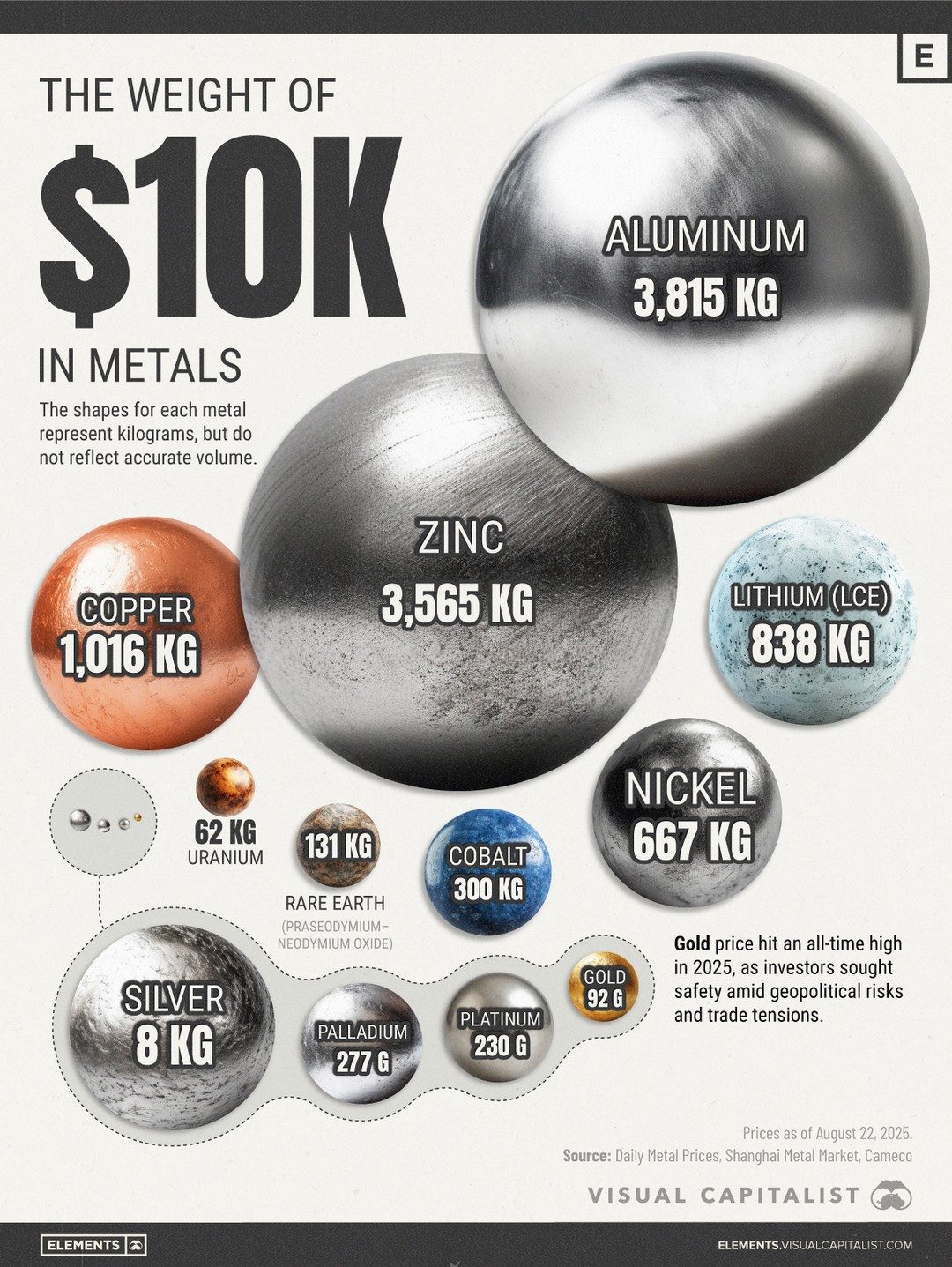
The Dramatic Difference in Metal Weights for $10,000
The metals market presents a stark contrast when considering the weights of various materials that can be purchased for $10,000. This visual exploration highlights how 92 grams of gold contrasts with over 3,800 kilograms of aluminum. The significant difference underscores the gap between rare, high-value precious metals and more abundant industrial materials.
Why This Matters
Understanding the weight and value of different metals is crucial for investors, industrialists, and anyone interested in the commodities market. The price fluctuations and the significant differences in the quantities of metals that $10,000 can buy reflect broader economic trends and geopolitical risks.
The Weight of $10,000 in Various Metals
Precious Metals
Gold sits at the top of the list of precious metals. For $10,000, you can acquire just 92 grams. Gold's rarity and enduring value make it a preferred choice for investors seeking stability and a hedge against economic uncertainties. This precious metal often peaks during times of geopolitical instability and trade tensions, as evidenced by its all-time high in 2025.
Platinum and palladium are also precious metals, with $10,000 buying 230 grams and 277 grams, respectively. These metals are essential in various industrial applications, including automotive catalysts and jewelry. Their supply is limited, which contributes to their high value and scarcity.
Silver, another precious metal, is more abundant than gold, platinum, and palladium. $10,000 can procure 8 kilograms of silver. Silver's dual role as an industrial metal and a store of value makes it a versatile investment option.
Industrial Metals
Aluminum is the most abundant metal in this comparison, with $10,000 yielding 3,815 kilograms. Aluminum's widespread use in construction, transportation, and packaging drives its industrial demand. Its lightweight and durability make it an essential material in modern manufacturing.
Copper also stands out as a key industrial metal. For $10,000, you can obtain 1,016 kilograms. Copper's excellent conductivity makes it indispensable in electrical and electronic applications. Its price reflects its critical role in infrastructure and technological development.
Zinc and nickel are also significant industrial metals. $10,000 will get you 3,565 kilograms of zinc and 667 kilograms of nickel. Both metals are essential in various industrial processes, including galvanization and stainless steel production. Their prices are influenced by supply and demand dynamics in these industries.
Specialty Metals
Lithium and rare earth elements are pivotal in the modern technological landscape. Lithium, particularly in its lithium carbonate equivalent (LCE) form, is crucial for batteries in electric vehicles and renewable energy storage. $10,000 can purchase 838 kilograms of lithium (LCE).
On the other hand, rare earth elements such as praseodymium and neodymium are vital in magnets used in electric motors, wind turbines, and other high-tech applications. The infographic does not specify the exact weight of rare earth elements for $10,000, but their scarcity and critical applications underscore their value.
Uranium and Cobalt
Uranium is essential for nuclear energy, with $10,000 buying 62 kilograms. Its price is influenced by global energy policies and the demand for nuclear power. Cobalt, crucial in batteries for electric vehicles and electronic devices, can be procured at 300 kilograms for $10,000. Cobalt's price is subject to supply chain disruptions and geopolitical factors, particularly in regions like the Democratic Republic of Congo, which supplies a significant portion of the world's cobalt.
Practical Tips for Investing in Metals
When investing in metals, consider the following:
1. Diversification
Diversifying your portfolio with a mix of precious, industrial, and specialty metals can mitigate risks associated with price volatility in any single metal. For example, combining gold (for stability) with copper (for industrial demand) and lithium (for technological growth) can provide a balanced investment strategy.
2. Understanding Market Drivers
Stay informed about global economic trends, geopolitical risks, and industrial demand. These factors significantly impact metal prices. For instance, geopolitical tensions and trade wars can drive up the price of gold, while technological advancements can boost demand for lithium and rare earth elements.
3. Long-Term Perspective
Metals are often considered long-term investments. Prices can fluctuate in the short term, but historical data shows that metals like gold and copper have maintained their value over extended periods. Consider your investment horizon and long-term goals when choosing metals for your portfolio.
4. Storage and Insurance
If you opt for physical metals, ensure they are stored securely and insured against theft and damage. For industrial metals, consider the logistics and costs associated with storage and transportation.
5. ESG Considerations
Incorporating Environmental, Social, and Governance (ESG) factors into your investment decisions can enhance the sustainability and ethical integrity of your portfolio. Metals sourced from environmentally responsible mines and companies with strong governance practices can offer a more sustainable investment.
Important Takeaways
The significant disparities in the weights of metals that $10,000 can buy reflect the diverse uses, supply, and demand dynamics of various metals. Precious metals like gold and platinum are rare and highly valued, while industrial metals like aluminum and copper are abundant and essential for modern manufacturing.
Metals as Investment Assets
Metals serve as valuable investment assets due to their roles in various industries and their responsiveness to global economic trends. Gold and silver, for example, are often seen as safe havens during economic uncertainty, while copper and lithium are crucial for technological advancement and industrial growth.
Supply and Demand Dynamics
Supply and demand dynamics play a critical role in determining metal prices. Industrial metals like copper and zinc are driven by industrial demand, while specialty metals like lithium and rare earth elements are influenced by technological advancements. Understanding these dynamics can help investors make informed decisions.
Geopolitical Factors
Geopolitical risks and trade tensions significantly impact metal prices. For instance, gold prices surge during geopolitical instability, while metals like cobalt are influenced by supply chain disruptions in regions like the Democratic Republic of Congo. Investors should stay informed about global events that could affect metal prices.
Future Trends
Looking ahead, the demand for metals like lithium and rare earth elements is expected to rise with the growth of electric vehicles and renewable energy technologies. Investors who anticipate these trends can position themselves to benefit from the increasing demand for these critical metals.
Conclusion
The stark contrast in weights of various metals for $10,000 highlights the diverse roles and values of metals in the global economy. From the rare and precious metals to the abundant industrial materials, each metal plays a unique and essential part in various industries. Understanding the weight, value, and market dynamics of these metals can provide valuable insights for investors and industry professionals. As you navigate the metals market, consider the long-term trends, market drivers, and the ever-evolving landscape of global demand and supply. This knowledge will help you make informed decisions and capitalize on the opportunities presented by this dynamic market.
Watch the Reel
Questions readers ask
How does the weight of gold compare to aluminum when considering $10,000 worth of each metal?
For $10,000, you would acquire approximately 92 grams of gold, while you could get over 3,800 kilograms of aluminum. This stark contrast illustrates the significant difference in density and value between precious and industrial metals.
Why is there such a large discrepancy in the amount of metal for the same dollar value?
The vast difference in weight is due to the rarity and intrinsic value of gold compared to aluminum. Gold is a precious metal with high market demand and limited supply, making it much more expensive per gram than aluminum, which is abundant and commonly used in industrial applications.
How can investors benefit from comparing the weight of gold and aluminum for $10,000?
Investors can gain insights into market trends and potential risks by comparing the weight and value of these metals. Gold's weight for $10,000 is indicative of its stability and value retention, whereas aluminum’s weight reflects its industrial utility and price volatility.
What are the daily metal price trends for gold and aluminum?
Daily metal price trends for gold and aluminum can fluctuate based on various factors, including economic indicators, geopolitical events, and market demand. Gold prices are often influenced by investor sentiment and global economic conditions, while aluminum prices respond to industrial demand and supply dynamics.
Should I invest in gold or aluminum based on weight and value differences?
The decision to invest in gold or aluminum depends on your investment goals. Gold is often chosen for its stability and value preservation, making it a popular choice for long-term investors. Conversely, aluminum may be more appealing for those looking to capitalize on industrial demand and potential price appreciation in the commodities market.
How does the weight per dollar of metal help industry professionals in their decision-making?
Understanding the weight per dollar of metals like gold and aluminum helps industry professionals in assessing costs and potential profits. For instance, knowing how much aluminum can be acquired for a given investment aids in production planning and cost management, while gold's weight per dollar reflects its role as a store of value and hedge against inflation.
What are the implications of buying a rare metal like gold versus a more abundant metal like aluminum?
Buying a rare metal like gold versus a more abundant metal like aluminum has different implications. Gold, being rare, is often seen as a safe haven and a hedge against economic uncertainty. Aluminum, being abundant, is more suited for industrial applications and may offer greater potential for price volatility and short-term gains.
Recent articles
Fresh deep dives from the latest Reels we unpacked.




Comments
Be the first to comment.