Salaries by Age: A Deep Dive into U.S. Earnings Across Generations
Salary trends across different age groups in the United States provide a fascinating look into the economic landscape and the earning potential of workers at various stages of their careers. The data from the Bureau of Labor Statistics offers valuable insights into how earnings evolve with age. This article will delve into the median annual salaries of full-time wage and salaried workers across different age groups, exploring the trends and implications of these figures.
Context / Why This Matters
Understanding the earning potential at different stages of one's career is crucial for financial planning, career development, and economic policy. The data reveals how age correlates with income, highlighting the peaks and troughs in earnings across a person's working life. This information can guide individuals in making informed decisions about their careers, such as when to pursue further education, change jobs, or plan for retirement. Additionally, policymakers can use this data to address income disparities and ensure that workers are fairly compensated throughout their careers.
Main Discussion
Age 16–19: The Entry-Level Earners
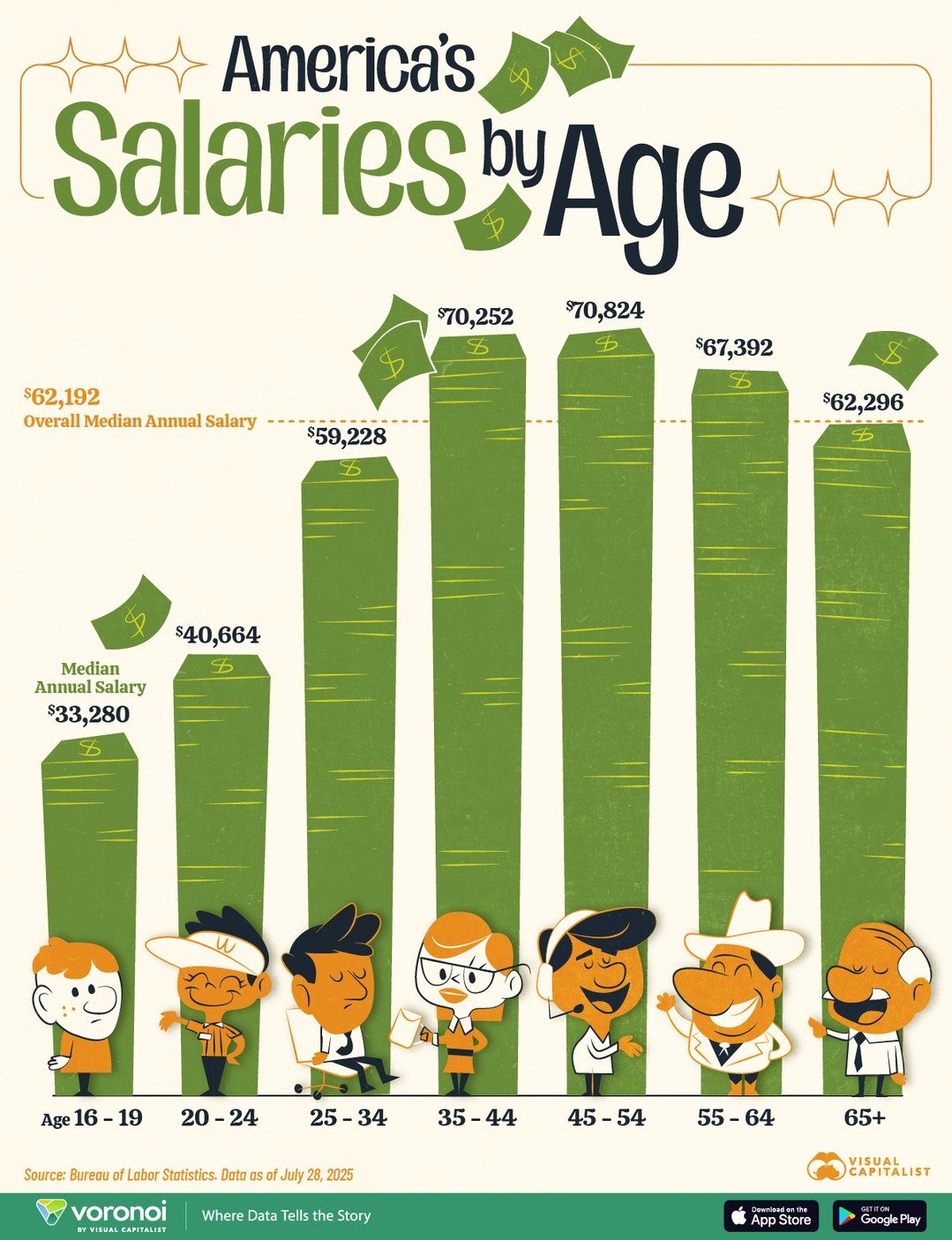
Workers aged 16–19 are typically at the beginning of their careers, and their median annual salary reflects this. At $33,280, this age group earns the least among all the cohorts. The relatively low salary is understandable as many in this group are part-time workers, students, or in entry-level positions. This period is often characterized by learning and gaining initial work experience, which is crucial for future career advancement.
Age 20–24: Early Career Gains
The median annual salary for those aged 20–24 is $40,664. This represents a significant increase from the previous age group, demonstrating the value of early career experience. Workers in this age range are likely to have completed some form of post-secondary education or training and are beginning to climb the career ladder. They may be in roles that require more responsibility and higher skill levels, which translates to increased earnings.
Age 25–34: The Mid-Career Peak
By the age of 25-34, workers typically reach a higher level of expertise and career stability. The median annual salary for this group is $62,296, showing a substantial jump from the previous age group. This period often coincides with peak productivity and the accumulation of valuable work experience. Many individuals in this age range may also be advancing in their careers, taking on leadership roles, or specializing in their fields, all of which contribute to higher earnings.
Age 35–44: Established Professionals
Workers aged 35–44 have a median annual salary of $59,228. This age group is characterized by established careers and significant work experience. Many in this cohort are likely to hold mid to senior-level positions, which comes with higher salaries and greater responsibilities. This period often sees individuals at the height of their earning potential, balancing career and family responsibilities.
Age 45–54: The Highest Earning Years
American workers aged 45–54 earn the highest median salaries at $70,824 per year, making this the peak earning age group. These workers are typically at the apex of their careers, holding senior-level positions, and enjoying the benefits of decades of experience and expertise. This age range often sees individuals in executive or leadership roles, commanding higher salaries due to their extensive knowledge and contributions to their respective fields.
Age 55–64: Late-Career Stability
The median annual salary for workers aged 55–64 is $62,192. While this is lower than the peak earning years of 45-54, it still reflects a stable income. This age group often includes individuals who are nearing retirement or transitioning into less demanding roles. Some may choose to downshift or pursue part-time work, which can affect their earnings.
Age 65 and Above: The Golden Years
For those aged 65 and above, the median annual salary is $67,392. This is still a respectable figure, reflecting the continuing value of their skills and experience. Many individuals in this age group may choose to work part-time or consult, balancing work with retirement or leisure activities. Some may also be in higher-paying roles that they held before retirement.
Overall Median Annual Salary
The overall median annual salary for full-time wage and salaried workers in the U.S. is $62,192. This figure provides a broad perspective on the earning potential of the American workforce. It highlights the importance of gaining experience, advancing in one's career, and making strategic decisions that can maximize earning potential over a lifetime.
Practical Tips
Investing in Education and Training
One of the best ways to increase earning potential is through continuous education and skill development. Whether through formal degrees, certifications, or on-the-job training, investing in one's knowledge and skills can lead to higher-paying roles and career advancement.
Career Planning and Goal Setting
Developing a clear career plan and setting achievable goals can help individuals navigate their career paths more effectively. This includes identifying key milestones, such as promotions, skill acquisitions, or job changes, and working towards them systematically.
Financial Planning
Understanding how earnings evolve over time can help in financial planning. This includes saving for retirement, managing debt, and investing wisely. Individuals can use the salary trends by age to plan their financial goals more effectively, ensuring they are on track to achieve financial stability and security.
Important Takeaways
Age as a Key Factor
Age is a critical factor in determining earning potential. Younger workers typically start with lower salaries, which increase as they gain experience and advance in their careers. The peak earning years are in the middle age groups, reflecting the value of experience and expertise.
The Importance of Continuous Learning
Continuous learning and skill development are essential for career advancement and higher earnings. Investing in education and training can lead to better job opportunities and increased earning potential.
Financial Planning
Effective financial planning is crucial for long-term financial stability. Understanding salary trends by age can help individuals make informed decisions about saving, investing, and retirement planning.
Conclusion
Salary trends by age in the United States provide a valuable lens into the economic landscape and how earning potential evolves over a person's career. From the early entry-level earnings of those aged 16–19 to the peak earnings of the 45–54 age group, the data highlights the importance of experience, skill development, and career planning. By understanding these trends, individuals can make informed decisions about their careers, financial planning, and overall economic well-being.
Watch the Reel
Questions readers ask
At what age do workers typically earn the highest median salary in the U.S.?
According to the Bureau of Labor Statistics, workers generally earn the highest median salaries in their late 40s to early 50s. This period often coincides with peak career experience and seniority, leading to higher earning potential.
How does the median salary for entry-level workers compare to that of more experienced workers?
Entry-level workers, typically in their early 20s, earn significantly less than more experienced workers. For instance, the median salary for workers aged 20-24 is notably lower than for those in their 30s, 40s, or 50s, reflecting the impact of experience and career progression on earnings.
What trends can be observed in the annual salary by age according to the BLS data?
The BLS data shows a steady increase in median annual salaries from the early 20s through the mid-50s, with a peak in the late 40s to early 50s. After this peak, salaries tend to plateau or slightly decline, reflecting changes in career stages and work patterns.
Why is understanding median salaries by age group important for career development?
Knowing median salaries by age group helps individuals set realistic financial goals and career expectations. It can guide decisions about career advancement, job changes, and negotiating salaries, providing a benchmark for what to expect at different career stages.
How do salaries evolve by age for full-time workers in the U.S.?
For full-time workers, salaries typically start lower in the early 20s and increase steadily with age, reaching their peak in the late 40s to early 50s. This evolution reflects the accumulation of skills, experience, and seniority over time.
What insights can be gained from the Bureau of Labor Statistics earnings data by age?
The BLS earnings data by age provides a comprehensive view of how income changes with age, highlighting key stages such as entry-level, mid-career, and peak earning years. This information is useful for understanding economic trends, career planning, and policy-making.
At what age do workers typically see their median salaries plateau or decline?
Workers typically see their median salaries plateau or slightly decline in their late 50s to early 60s. This can be attributed to factors such as retirement planning, reduced work hours, or transitions to less demanding roles.
Recent articles
Fresh deep dives from the latest Reels we unpacked.




Comments
Be the first to comment.