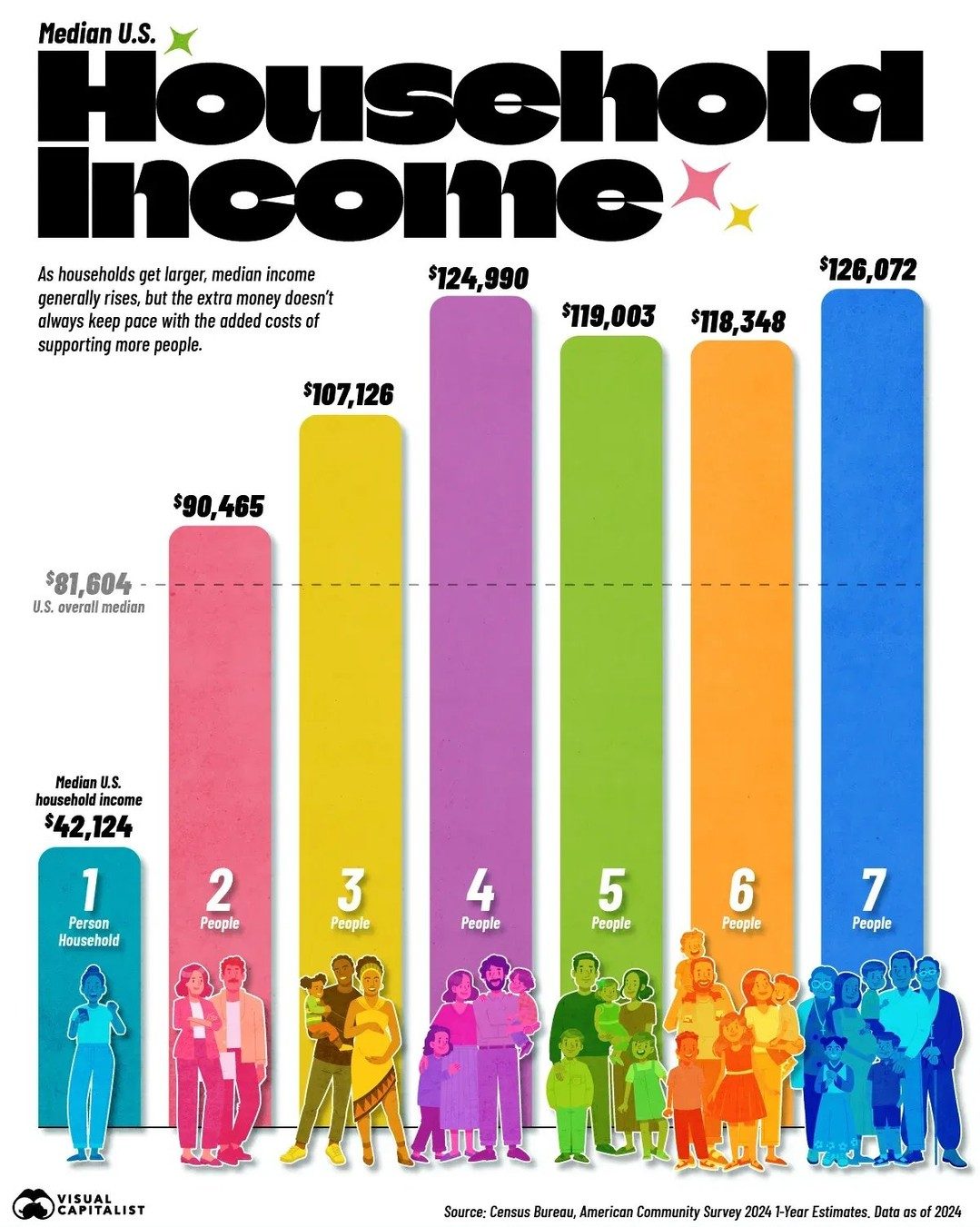
Median U.S. household income is a critical indicator of economic well-being, and it varies significantly based on household size. The latest data from the U.S. Census Bureau's American Community Survey (2024 1-Year Estimates) shows that the median household income in the U.S. is $81,604. This figure, however, masks a wide range of income levels when broken down by household size.
Context / Why This Matters
Understanding how household income varies by size is essential for policymakers, economists, and individuals alike. It provides insights into economic disparities, helps in planning social welfare programs, and informs personal financial decisions. For example, households with seven or more people earn the highest median income, roughly $126,072, while single-person households earn significantly less, with a median income of $42,124.
Household Income by Size
Single-Person Households
Single-person households are the most common type, and they have the lowest median income. At $42,124, this figure is less than half of what a two-person household earns. This disparity highlights the economic challenges faced by individuals living alone, who often lack the benefits of shared income and expenses.
Two-Person Households
Two-person households see a significant jump in median income to $90,465. This increase can be attributed to the combined earning power of two adults, as well as potential economies of scale in living expenses. This income level is roughly 2.15 times higher than that of single-person households.
Medium-Sized Households (3-6 People)
Medium-sized households, ranging from three to six people, continue to show an incremental increase in median income:
- Three-Person Households: $107,126
- Four-Person Households: $124,990
- Five-Person Households: $119,003
- Six-Person Households: $118,348
These figures illustrate that as household size grows, so does the median income. This trend can be explained by the additional earning potential of more family members entering the workforce, as well as shared living costs.
Large Households (7+ People)
Households with seven or more people earn the highest median income at $126,072. This is likely due to multiple breadwinners and shared expenses, allowing for greater financial stability and higher disposable income.
Factors Influencing Household Income
Several factors contribute to the variation in household income by size. These include:
- Earning Potential: Larger households often have more earners, which can significantly boost the overall income.
- Shared Expenses: Living costs, such as housing, utilities, and groceries, can be distributed among more people, reducing the financial burden per individual.
- Economies of Scale: Larger households may benefit from bulk purchases and other cost-saving measures, further enhancing their financial stability.
- Social and Community Support: Larger households may have more extensive social networks and community support, which can provide additional economic benefits, such as shared resources and mutual aid.
Practical Tips
If you're looking to improve your household's financial situation, consider the following tips:
- Increase Earning Potential: Encourage all able members of the household to engage in earning activities, whether through employment, freelancing, or entrepreneurship.
- Optimize Expenses: Look for ways to reduce living costs, such as shared housing, carpooling, and bulk purchasing.
- Budgeting and Saving: Create a comprehensive budget that accounts for all household expenses and savings goals. Regularly review and adjust the budget as needed.
- Invest Wisely: Consider investing in assets that can generate passive income, such as real estate, stocks, and bonds. This can help to grow your wealth over time.
- Seek Financial Advice: Consult with financial advisors or planners who can provide personalized strategies tailored to your household's unique needs and goals.
Important Takeaways
The data from the Census Bureau highlights several key points about household income in the U.S.:
- Median household income increases with the size of the household, with the highest incomes found in households with seven or more people.
- Single-person households face significant economic challenges, earning less than half of what two-person households earn.
- Medium-sized households benefit from shared expenses and multiple earners, leading to higher median incomes.
- Larger households often have more earning potential and can take advantage of economies of scale, further enhancing their financial stability.
Conclusion
Median U.S. household income by size provides a nuanced look at economic well-being across different household structures. The data underscores the importance of understanding how household size influences income and offers practical insights for improving financial situations. By leveraging shared resources, increasing earning potential, and optimizing expenses, households of all sizes can work towards greater economic stability and prosperity.
Watch the Reel
Questions readers ask
What is the median household income in the U.S. for 2024?
The median household income in the U.S. for 2024 is $81,604, according to the latest data from the U.S. Census Bureau's American Community Survey (2024 1-Year Estimates).
How does the median income vary among different household sizes in 2024?
The median income varies significantly among different household sizes. For instance, single-person households have a median income of $42,124, while households with seven or more people have a median income of $126,072.
What are the economic benefits of larger household sizes as indicated by the 2024 data?
Larger households tend to benefit from shared living expenses and combined incomes, which results in a higher median income. This is evident in the 2024 data, where households with seven or more people have the highest median income.
Why is understanding median household income by size important for policymakers?
Understanding median household income by size is crucial for policymakers as it provides insights into economic disparities and helps in planning social welfare programs. This information can guide decisions on resource allocation and policy interventions.
What is the median income for single-person households in 2024?
The median income for single-person households in 2024 is $42,124, according to the latest data. This figure highlights the economic challenges that single-person households may face compared to larger households.
How does the 2024 data from the U.S. Census Bureau's American Community Survey help individuals with financial planning?
The 2024 data from the U.S. Census Bureau's American Community Survey helps individuals with financial planning by providing a clear picture of how income varies by household size. This information can guide decisions on budgeting, saving, and planning for future financial needs.
What is the significance of the data on household income by size for economists?
The data on household income by size is significant for economists as it offers a detailed view of income distribution and economic trends. This information is vital for analyzing economic policies, understanding economic disparities, and forecasting future economic conditions.
Related deep dives
Similar reads based on topic and creator.


Recent articles
Fresh deep dives from the latest Reels we unpacked.




Comments
Be the first to comment.