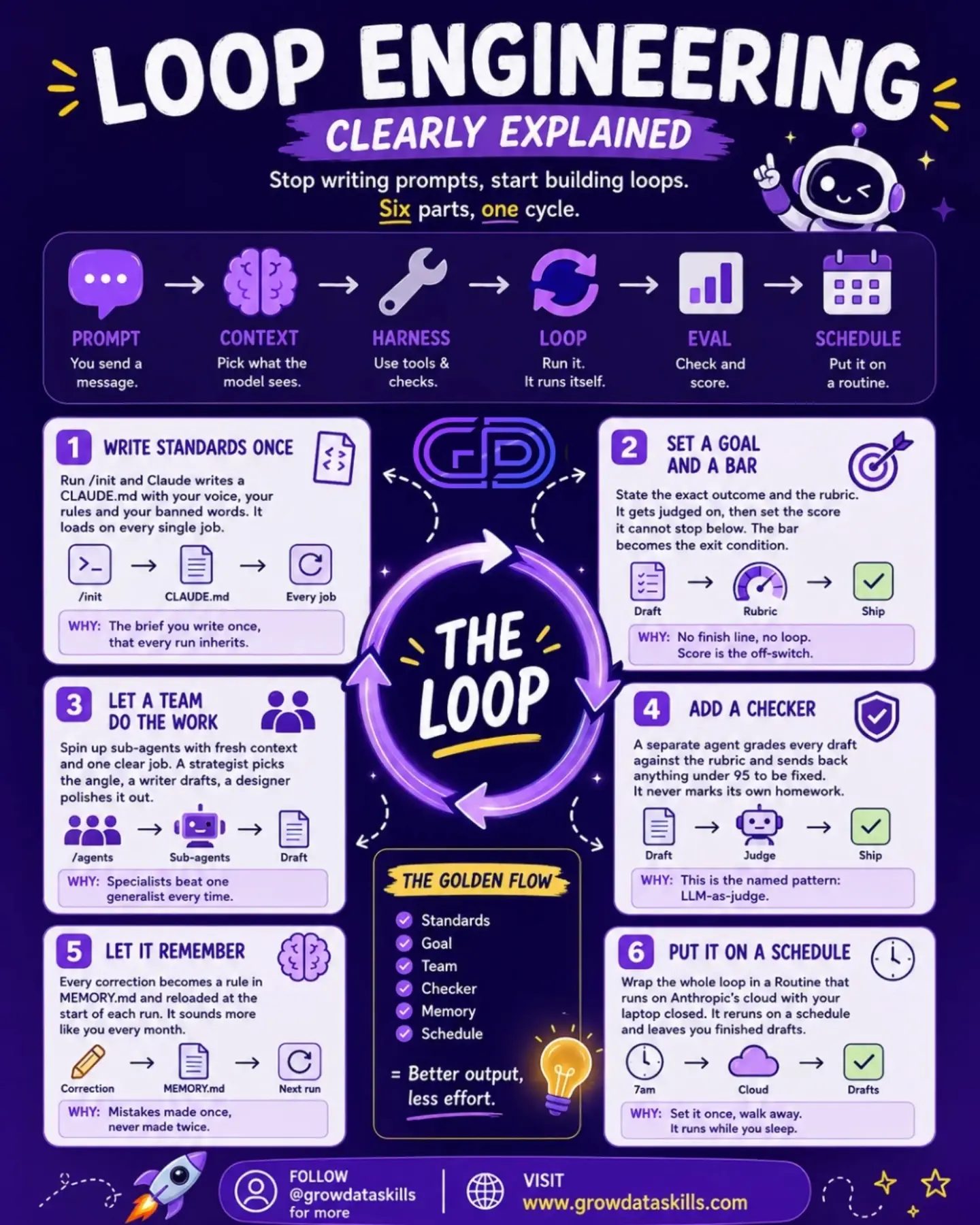
Loop engineering is a systematic approach to transforming a one-time prompt into an automated, self-improving workflow. This process involves creating loops that can plan, execute, evaluate, and run automatically, ensuring continuous improvement. Instead of manually prompting every day, loop engineering allows you to build systems that can handle tasks more efficiently.
Context / Why this matters
In the rapidly evolving field of AI and data engineering, the ability to create self-improving systems is crucial. Loop engineering represents a shift from merely getting answers to generating workflows that can adapt and optimize over time. This approach is particularly relevant for professionals in AI data engineering, agentic AI, and related fields, as it provides a framework for building and deploying modern AI systems in production environments.
Main discussion
The Six Parts of Loop Engineering
Loop engineering is composed of six key components, each playing a vital role in the process. These components include context, tools and checks, sub-agents, evaluation, memory, and scheduling. Understanding and implementing each of these parts can help create a robust and efficient loop.
1. Context
Context refers to the information and parameters that define the scope and boundaries of the loop. It includes the goals, constraints, and any relevant data that the loop will use to execute its tasks. Clear context ensures that the loop operates within the desired parameters and avoids unnecessary deviations.
2. Tools and Checks
Tools and checks are the mechanisms that perform the actual work within the loop. These can include software tools, algorithms, and other resources that help execute the tasks. Checks ensure that the outputs meet the specified standards and criteria. By integrating these elements, the loop can perform tasks accurately and efficiently.
3. Sub-Agents
Sub-agents are smaller, specialized components within the loop that handle specific aspects of the task. They can be thought of as automations that can be orchestrated for tasks. Each sub-agent focuses on a particular function, such as data collection, analysis, or reporting. Together, these sub-agents work collaboratively to achieve the overall goal of the loop.
4. Evaluation
Evaluation involves assessing the performance and effectiveness of the loop. It includes metrics and criteria that determine whether the loop is meeting its objectives and making progress. Regular evaluation allows for adjustments and improvements, ensuring that the loop continues to operate optimally.
5. Memory
Memory refers to the storage and retrieval of information within the loop. It enables the loop to learn from past experiences and use that knowledge to improve future performance. By maintaining a record of previous actions and outcomes, the loop can adapt and optimize its processes over time.
6. Scheduling
Scheduling ensures that the loop runs at the appropriate times and intervals. It involves setting up a timeline for the execution of tasks, including any recurring or periodic activities. Effective scheduling helps maintain the loop's efficiency and ensures that tasks are completed on time.
The Loop Engineering Cycle
The loop engineering cycle consists of setting a goal, writing standards, team collaboration, integrating a checker, and putting it on a schedule. Each of these steps contributes to the overall efficiency and effectiveness of the loop.
Step 1: Set a Goal
The first step in the loop engineering cycle is to set a clear and specific goal. This goal defines the desired outcome and provides a benchmark for evaluating the loop's performance. A well-defined goal ensures that the loop is aligned with the overall objectives and can be measured against specific criteria.
Step 2: Write Standards
Writing standards involves establishing the guidelines and criteria that the loop will follow. These standards ensure consistency and quality in the execution of tasks. By defining clear standards, the loop can operate reliably and achieve the desired outcomes.
Step 3: Let a Team Do the Work
Team collaboration is essential in the loop engineering process. A team of specialists or sub-agents can handle different aspects of the task, ensuring that the loop operates efficiently. Each team member or sub-agent focuses on their specific area of expertise, contributing to the overall success of the loop.
Step 4: Add a Checker
Integrating a checker involves setting up checks and balances to ensure that the loop is performing as expected. This step includes verifying that the outputs meet the specified standards and criteria. By incorporating a checker, the loop can maintain its accuracy and reliability, ensuring that the desired outcomes are achieved.
Step 5: Put It on a Schedule
Finally, putting the loop on a schedule ensures that tasks are executed at the appropriate times and intervals. This step involves setting up a timeline for the execution of tasks, including any recurring or periodic activities. Effective scheduling helps maintain the loop's efficiency and ensures that tasks are completed on time.
Automation and Continuous Improvement
One of the key benefits of loop engineering is the ability to automate tasks and achieve continuous improvement. By creating loops that can plan, execute, evaluate, and run automatically, professionals can focus on higher-level tasks and strategic decision-making. This approach not only saves time and resources but also enhances the overall performance and efficiency of the system.
Loop engineering also allows for continuous improvement through the use of feedback loops and iterative processes. By regularly evaluating the performance of the loop and making necessary adjustments, professionals can ensure that the system remains effective and efficient over time.
Practical tips
To effectively implement loop engineering, consider the following practical tips:
- Define Clear Goals and Standards: Ensure that the goals and standards for the loop are well-defined and clearly communicated. This will provide a solid foundation for the loop and help maintain its effectiveness.
- Utilize Specialized Tools and Checks: Integrate specialized tools and checks to perform the tasks accurately and efficiently. This will help ensure that the loop meets the specified standards and criteria.
- Encourage Team Collaboration: Foster collaboration among team members or sub-agents to handle different aspects of the task. This will enhance the loop's efficiency and ensure that all tasks are completed to a high standard.
- Implement Effective Scheduling: Set up a timeline for the execution of tasks, including any recurring or periodic activities. This will help maintain the loop's efficiency and ensure that tasks are completed on time.
- Regularly Evaluate and Improve: Continuously evaluate the performance of the loop and make necessary adjustments. This will help ensure that the system remains effective and efficient over time.
Important takeaways
Loop engineering is a powerful approach to transforming one-time prompts into repeatable, self-improving workflows. By incorporating context, tools and checks, sub-agents, evaluation, memory, and scheduling, professionals can create efficient and effective systems.
- Loop engineering involves six key components: context, tools and checks, sub-agents, evaluation, memory, and scheduling.
- The loop engineering cycle consists of setting a goal, writing standards, team collaboration, integrating a checker, and putting it on a schedule.
- Automation and continuous improvement are essential for maintaining the efficiency and effectiveness of the loop.
- Defining clear goals and standards, utilizing specialized tools and checks, encouraging team collaboration, implementing effective scheduling, and regularly evaluating and improving are practical tips for successful loop engineering.
Conclusion
Loop engineering represents a significant advancement in AI and data engineering. By creating loops that can plan, execute, evaluate, and run automatically, professionals can build systems that improve over time. This approach not only enhances efficiency and effectiveness but also enables continuous improvement and adaptation.
Watch the Reel
Questions readers ask
What is loop engineering in the context of AI?
Loop engineering is a method that transforms static AI prompts into dynamic, self-improving workflows. It involves creating loops that plan, execute, evaluate, and optimize tasks automatically, reducing the need for manual intervention and enhancing efficiency.
How does loop engineering improve AI workflows?
Loop engineering improves AI workflows by enabling continuous process improvement. Systems built with this approach can adapt and optimize over time, leading to more efficient and effective task execution.
What are the key components of an AI loop in loop engineering?
The key components of an AI loop in loop engineering include planning, execution, evaluation, and automation. These components work together to create a system that can handle tasks more efficiently and improve over time.
Why is automating AI workflows beneficial?
Automating AI workflows through loop engineering benefits professionals by reducing manual effort, minimizing errors, and enabling systems to adapt to new data and requirements. This leads to more efficient and reliable AI processes.
Can loop engineering be applied to all AI systems?
While loop engineering can be applied to many AI systems, its applicability depends on the specific use case and the system's ability to integrate the planning, execution, evaluation, and automation components effectively.
How does loop engineering enhance data engineering in AI?
By automating and optimizing data workflows, loop engineering enhances data engineering in AI. It ensures that data processes are continuously improved, leading to better data management, and more reliable AI outcomes.
What role does system memory play in loop engineering?
In loop engineering, system memory retains the knowledge gained from previous iterations, enabling the system to learn and improve over time. This memory component is crucial for creating self-improving systems that can adapt to changes and optimize their performance.
Related deep dives
Similar reads based on topic and creator.

Recent articles
Fresh deep dives from the latest Reels we unpacked.




Comments
Be the first to comment.