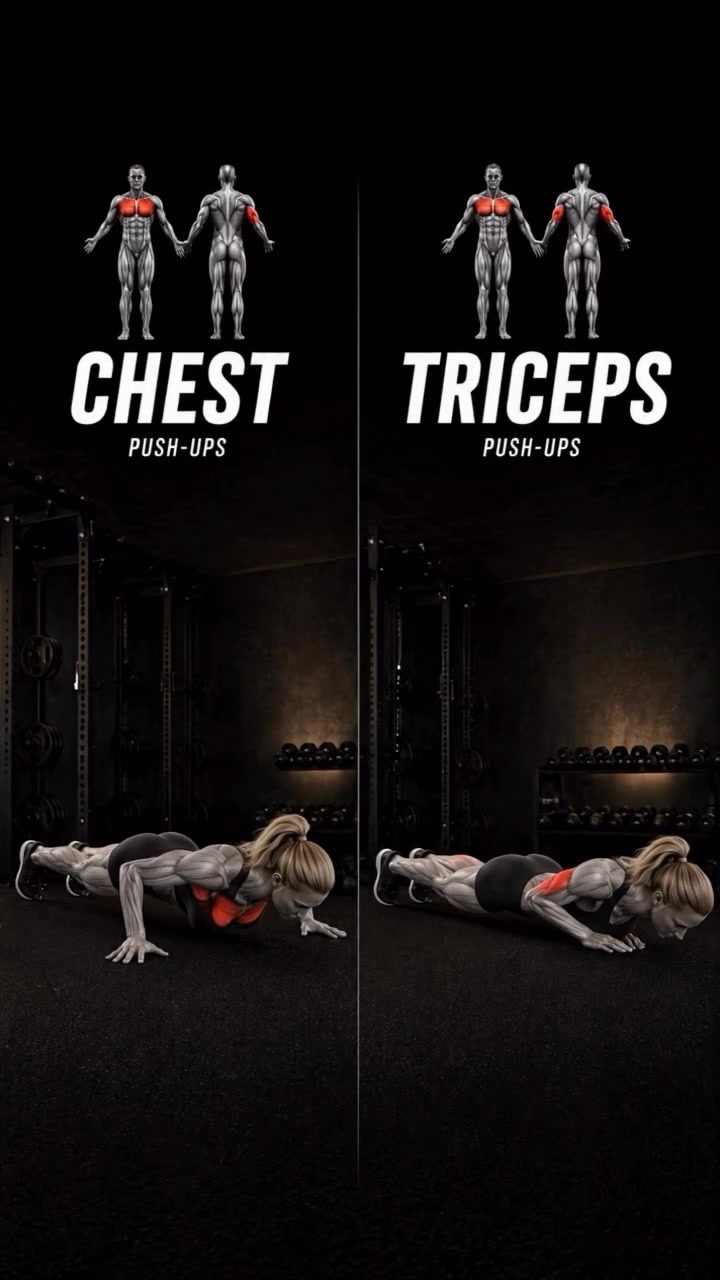
Push-Ups: Mastering Chest and Triceps Focus
Push-ups are a staple in any fitness routine, targeting multiple muscle groups effectively. The key to maximizing their benefits lies in adjusting your hand position to shift the emphasis between your chest and triceps. This approach allows you to tailor your workouts to your specific goals, whether you're aiming to build strength in your chest or tone your triceps.
Why This Matters
Understanding how to modify push-ups is crucial for anyone looking to get the most out of their bodyweight training. By simply changing your hand placement, you can target different muscle groups more effectively, leading to better overall results and reduced risk of injury.
Main Discussion
Anatomy of a Push-Up
Push-ups engage several major muscle groups, including the chest, triceps, shoulders, and core. However, the primary muscles worked can shift significantly based on hand position. This is particularly useful for those who want to emphasize specific areas without adding extra equipment or exercises to their routines.
Chest-Focused Push-Ups
To emphasize your chest muscles, place your hands slightly wider than shoulder width. This position allows your elbows to flare out at a comfortable angle, increasing the demand on your chest muscles, especially when you lower your body with control and reach a full, pain-free depth. Keeping your elbows at a slight angle helps distribute the load more evenly across your chest, making this variation ideal for those looking to build chest strength and definition.
Avoiding extreme angles will help prevent shoulder strain and ensure that you're getting the most out of the exercise. Always keep a straight line from your head to your heels, brace your core, and squeeze your glutes to maintain proper form.
Triceps-Focused Push-Ups
For a triceps focus, bring your hands closer together and keep your elbows tucked nearer to your sides. This narrower position increases elbow extension, making your triceps work harder. You do not need to position your hands in a perfect diamond shape; choose a position that feels comfortable on your wrists and shoulders. This variation is particularly effective for targeting the triceps, as it forces your elbows to stay close to your body, isolating the triceps more effectively.
Maintain a straight line from your head to your heels, brace your core, and keep your glutes tight to ensure proper form. The narrower hand position also helps engage your core more effectively, providing a full-body workout.
Proper Form and Technique
Regardless of the variation, maintaining proper form is crucial for both safety and effectiveness. Keep your head, hips, and heels in a straight line, brace your core, and squeeze your glutes. Lower your chest under control, avoid letting your elbows flare straight out, and push the floor away, fully extending your arms without losing position.
Progression and Adaptation
If full push-ups are too challenging, try using an elevated surface to reduce the range of motion. Conversely, if you need more challenge, you can slow the lowering phase to increase the time your muscles spend under tension. Starting with the variation you want to improve the most, and then finishing with the other, allows you to target specific muscle groups more effectively.
Practical Tips
- Hand Positioning: Experiment with different hand positions to find what works best for you. Small adjustments can make a significant difference in which muscles are being targeted.
- Controlled Movements: Focus on controlled movements, especially during the lowering phase. This helps increase muscle engagement and reduces the risk of injury.
- Proper Alignment: Ensure your head, hips, and heels are in a straight line. This alignment helps distribute the load evenly and protects your spine.
- Bracing Your Core: Keep your core engaged and your glutes squeezed. This not only helps with stability but also engages your core muscles more effectively.
- Progressive Overload: Gradually increase the challenge by adjusting the speed or range of motion. This helps in building strength and endurance over time.
Important Takeaways
- Chest-Focused Push-Ups: Wider hand placement and a slight elbow flare emphasize chest muscles.
- Triceps-Focused Push-Ups: Narrower hand placement and tucked elbows target the triceps more effectively.
- Consistent Technique: Proper form and alignment are crucial for both safety and maximum muscle engagement.
- Progressive Overload: Gradually increasing the challenge helps in building strength and endurance.
Conclusion
Push-ups are a versatile exercise that can be adapted to target different muscle groups effectively. By adjusting your hand position, you can shift the focus between your chest and triceps, allowing you to tailor your workouts to your specific goals. Whether you're aiming to build strength in your chest or tone your triceps, mastering these variations will help you get the most out of your push-up routine.
Watch the Reel
Questions readers ask
How do I perform chest push-ups with proper form and technique?
To focus on your chest, position your hands slightly wider than shoulder-width apart. Keep your body in a straight line, and as you lower yourself, let your chest touch the ground. Keep your elbows tucked in at a 45-degree angle. This variation emphasizes your chest muscles.
What is the best hand position for tricep push-ups?
For targeting your triceps, place your hands closer together, directly under your chest. Keep your elbows close to your body as you lower down, this will ensure that your triceps do most of the work. This variation is effective for toning and strengthening your triceps.
Can push-ups help improve my shoulder strength?
Yes, push-ups are excellent for shoulder development. To emphasize your shoulders, position your hands in a reverse triangle shape, with your fingers pointing towards your toes. This variation targets your anterior deltoid muscles, which are essential for shoulder strength and stability.
How can I engage my core during push-ups?
To engage your core, maintain a straight body position, with your core muscles tightened and your spine aligned. You can also try variations like decline push-ups, where your feet are elevated, or pike push-ups. These variations increase the demand on your core muscles and help improve stability and strength.
What are some push-up variations to prevent injury?
To prevent injury, focus on maintaining proper form and gradually increasing the difficulty of your push-ups. Variations like knee push-ups, incline push-ups, or push-ups on a stable surface can help build strength without straining your muscles. Listen to your body and avoid pushing through pain.
How does hand width affect push-up muscle emphasis?
Hand width significantly affects which muscles are emphasized. Wider hand positions shift the focus to the chest and shoulders, while narrower positions target the triceps. Experimenting with different hand widths allows you to tailor your workouts to your specific goals and avoid muscular imbalances.
Can push-ups be part of a full-body workout?
Absolutely, push-ups can be a key part of a full-body workout. They engage multiple muscle groups, including the chest, triceps, shoulders, core, and even the legs. By incorporating various push-up variations, you can create a comprehensive workout that strengthens and tones your entire body.
Recent articles
Fresh deep dives from the latest Reels we unpacked.




Comments
Be the first to comment.