World Religions Comparison
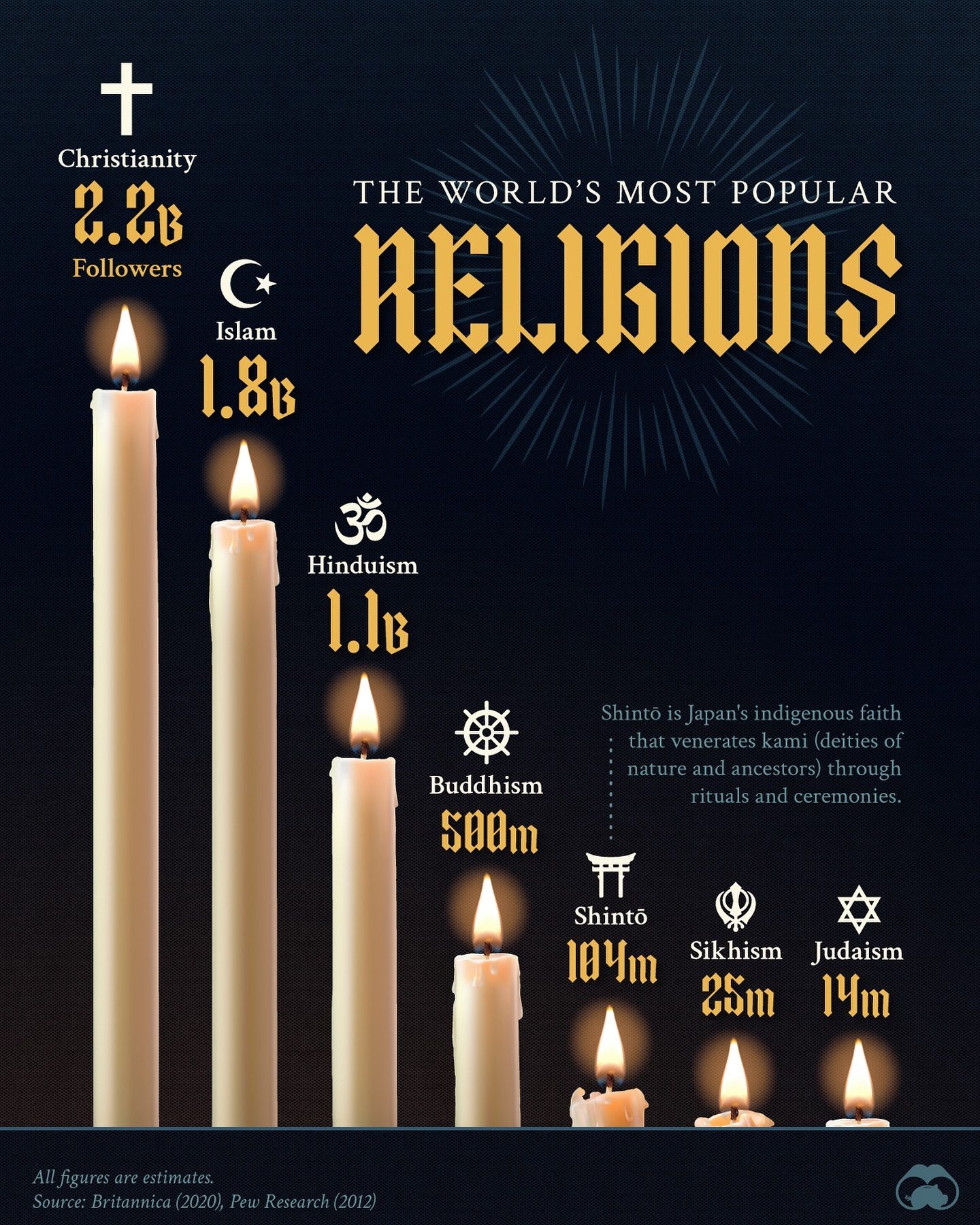
In the United States, the religious landscape has been evolving, with Christianity seeing a gradual decline. For instance, in 1990, 90% of U.S. adults were raised as Christians, a figure that dropped to 65% by 2020. Understanding the global religious landscape requires looking beyond Christianity and examining other major religions. Here, we provide a comparison of global followers of major religions, as estimated by Britannica and Pew Research.
Why This Matters
Religion plays a crucial role in shaping cultures, societies, and individual worldviews. Understanding the number of followers of various religions can provide insights into the global distribution of beliefs. This comparison highlights not only the diversity of religious practices but also the significant influence each religion has on its followers and the world at large.
Main Discussion
Christianity
Christianity stands as the most followed religion globally, with an estimated 2.2 billion adherents. This religion encompasses a wide range of denominations, including Catholicism, Protestantism, and Orthodox Christianity. Each denomination has its unique traditions, practices, and beliefs, contributing to the rich tapestry of global Christianity. Christianity’s influence spans continents, with significant populations in Europe, the Americas, and Africa.
Islam
Islam is the second-largest religion, with approximately 1.8 billion followers. Like Christianity, Islam is diverse, with two primary branches: Sunni and Shia. These branches share core beliefs but have distinct practices and interpretations of Islamic law. Islam is prevalent in the Middle East, North Africa, and parts of Asia, playing a central role in the cultural and political landscapes of these regions.
Hinduism
Hinduism, with around 1.1 billion followers, is predominantly practiced in India and Nepal. This ancient religion is characterized by its polytheistic beliefs, intricate rituals, and a rich philosophical tradition. Hinduism’s influence extends beyond religious practices, shaping art, literature, and social structures in the regions where it is practiced.
Buddhism
Buddhism has around 500 million adherents, primarily in Asia. Founded by Siddhartha Gautama, Buddhism emphasizes meditation, ethical living, and the pursuit of enlightenment. The religion is divided into several branches, including Theravada, Mahayana, and Vajrayana, each with its unique interpretations and practices.
Shintō
Shintō, Japan’s indigenous faith, has a relatively smaller following, with around 10 million adherents. Shintō involves the veneration of kami, or deities of nature and ancestors, through rituals and ceremonies. It is deeply intertwined with Japanese culture, influencing festivals, traditions, and family practices.
Sikhism
Sikhism, with approximately 25 million followers, is predominantly practiced in the Punjab region of India and Pakistan. Founded by Guru Nanak, Sikhism combines elements of Hinduism and Islam, emphasizing equality, service, and devotion to one God. Sikhism is known for its communal practices, including the langar, a free community kitchen that serves food to all, regardless of faith.
Judaism
Judaism has around 14 million followers, primarily in Israel and the United States. This monotheistic religion is rooted in the covenants between God and the Israelites, as described in the Torah. Judaism encompasses a variety of denominations, including Orthodox, Conservative, and Reform, each offering different interpretations of Jewish law and practice.
Practical Tips
When exploring different religions, it is essential to approach the subject with an open mind and respect for diverse beliefs. Here are some practical tips for understanding and appreciating the world’s major religions:
- Engage in Dialogue: Participate in interfaith dialogues and discussions. This can provide a deeper understanding of different religious practices and beliefs.
- Read Sacred Texts: Explore the foundational texts of various religions. Whether it’s the Bible, the Quran, the Bhagavad Gita, or the Tripitaka, these texts offer profound insights into religious teachings.
- Visit Places of Worship: Experience the beauty and diversity of religious architecture and rituals by visiting temples, mosques, synagogues, and churches. This can offer a unique perspective on how people practice their faith.
- Attend Cultural Events: Participate in festivals and celebrations from different religions. Events like Diwali, Eid, Passover, and Christmas provide a rich cultural experience and a deeper understanding of religious traditions.
Important Takeaways
- Christianity is the largest religion globally, followed by Islam, Hinduism, and Buddhism.
- Each major religion has a unique history, set of beliefs, and practices that influence its followers and the broader society.
- Understanding the global distribution of religions helps in appreciating the diversity of human beliefs and practices.
- Engaging with different religious communities through dialogues, reading, and cultural events can foster a deeper understanding and respect for various faiths.
Conclusion
The global religious landscape is vast and diverse, with each religion contributing uniquely to the cultural and social fabric of the world. Christianity, Islam, Hinduism, Buddhism, Shintō, Sikhism, and Judaism are just a few of the many religions that shape the beliefs and practices of billions of people. By exploring and understanding these religions, we gain a greater appreciation for the rich tapestry of human spirituality and the profound impact it has on our world.
Watch the Reel
Questions readers ask
Which religion has the most followers worldwide?
Christianity has the most followers worldwide, with approximately 2.2 billion adherents. This makes it the largest religion globally, with a significant presence across many countries and cultures.
How many followers does Islam have globally?
Islam is the second-largest religion worldwide, with around 1.8 billion followers. The majority of Muslims are concentrated in the Middle East and Asia, making it a major religious force in these regions.
What are the current trends in religious demographics in the United States?
In the United States, Christianity has been experiencing a gradual decline. In 1990, 90% of U.S. adults were raised as Christians, but by 2020, this figure had dropped to 65%. The religious landscape in the U.S. is becoming increasingly diverse, reflecting broader changes in society's religious beliefs.
How many followers do Hinduism and Buddhism have respectively?
Hinduism has an estimated 1.16 billion followers, making it the third-largest religion worldwide. Buddhism, on the other hand, has around 520 million adherents, with significant populations in countries such as Thailand, Myanmar, and Sri Lanka.
Which other major world religions have a significant global presence?
In addition to Christianity, Islam, Hinduism, and Buddhism, other major world religions with significant global followings include Sikhism, Judaism, and Shinto. Sikhism has approximately 30 million followers, primarily in India and Pakistan. Judaism has around 14.5 million adherents, with significant communities in the United States and Israel. Shinto, which is native to Japan, has around 4 million followers.
What insights can be gained from understanding the number of followers of various religions?
Understanding the number of followers of various religions provides valuable insights into the global distribution of beliefs and the influence of different religions. It highlights the diversity of religious practices and helps explain cultural and societal dynamics that are shaped by these beliefs.
How does the global religious landscape compare to the U.S. religious landscape?
The global religious landscape is more diverse than the religious landscape of the U.S. The U.S. has seen a decline in Christianity, while the global landscape shows a broader distribution of major world religions. This comparison underscores the unique religious dynamics in the U.S. compared to the rest of the world.
Related deep dives
Similar reads based on topic and creator.




Recent articles
Fresh deep dives from the latest Reels we unpacked.




Comments
Be the first to comment.