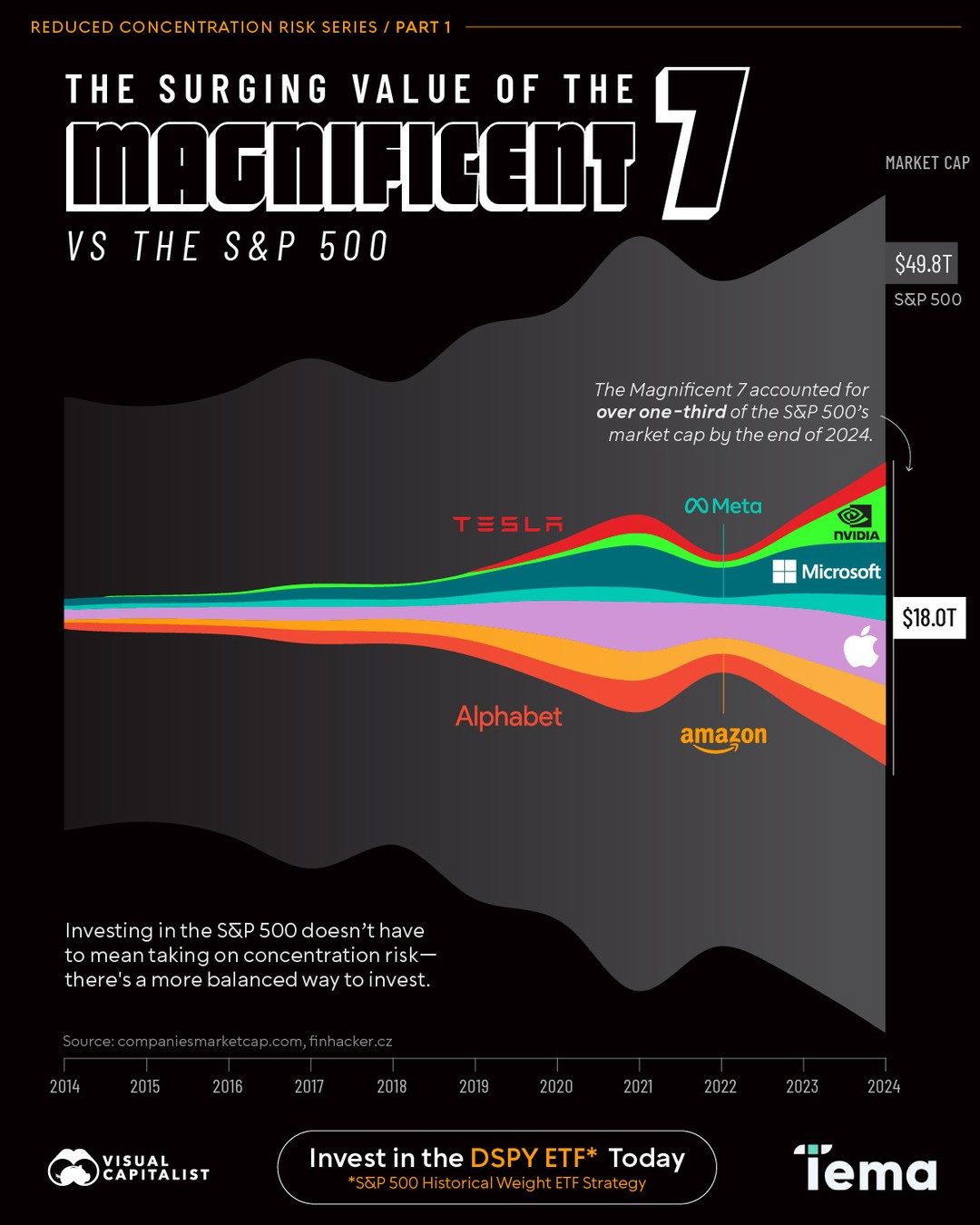
The Magnificent 7 and the Surging Market Capitalization
The "Magnificent 7"—comprising some of the world's most influential tech giants, including NVIDIA, Meta, Tesla, Microsoft, Alphabet, and Amazon—have seen their market capitalization soar from $1.8 trillion in 2014 to over $18 trillion by 2024. This dramatic growth has sparked significant debate and concern about concentration risk in the stock market, particularly within the S&P 500. This group of companies has exerted an outsized influence on the S&P 500's performance, accounting for over one-third of its market capitalization by the end of 2024. This shift in market dynamics raises important questions about investment strategies and the broader implications for the stock market.
The Concentration of Wealth in Tech Giants
The rise of the Magnificent 7 has been nothing short of phenomenal. These seven companies have not only grown in size but have also become the cornerstone of the tech industry, influencing global markets and economies. The concentration of wealth in these tech giants is a clear sign of the market's shift towards technology-driven solutions and innovation.
Market Dominance
By 2024, the Magnificent 7 accounted for a staggering portion of the S&P 500's market capitalization. This concentration has led to discussions about market risk and the potential for overreliance on a small number of companies. The influence of these giants extends beyond their financial performance; they shape consumer behavior, drive technological advancements, and set industry standards.
Historical Context
The journey of the Magnificent 7 from 2014 to 2024 is a story of monumental growth and market dominance. In 2014, their combined market capitalization stood at $1.8 trillion. By 2024, this figure had skyrocketed to over $18 trillion. This exponential growth reflects the rapid adoption of technology in various sectors, from entertainment and communication to artificial intelligence and cloud computing.
The Impact on the S&P 500
The outsized influence of the Magnificent 7 on the S&P 500 has significant implications for investors and the broader economy. The S&P 500, a widely followed stock market index, is often used as a benchmark for the overall performance of the U.S. stock market. The concentration risk associated with these seven companies means that fluctuations in their performance can have a disproportionate impact on the index's performance.
Market Volatility
Investors have grown wary of the concentration risk posed by the Magnificent 7. If these companies were to face significant downturns, the S&P 500 could experience substantial volatility. This risk highlights the need for diversified investment strategies that mitigate the potential impact of any single company or sector on the overall portfolio.
Diversification Strategies
Given the concentration risk, many investors are turning to more balanced investment options. One such option is the DSPY ETF, which provides a more diversified approach to investing in the S&P 500. By reducing the concentration risk, investors can achieve a more balanced portfolio that is less susceptible to the volatility associated with the performance of a few key companies.
The DSPY ETF
The DSPY ETF (or any similar fund) offers investors a way to gain exposure to the broader market without being overly reliant on a handful of tech giants. By distributing investments across a wider range of companies, investors can build a more resilient portfolio. This approach can help mitigate the risks associated with market concentration and provide greater stability during market fluctuations.
Diversification is a fundamental principle of modern portfolio management, and the DSPY ETF embodies this principle by offering a more balanced investment strategy. While the Magnificent 7 continue to dominate the market, diversifying investments can help investors navigate the complexities and potential risks of a concentrated market.
Practical Tips
For investors looking to navigate the current market landscape, here are some practical tips:
1. Assess Your Risk Tolerance
Understand your risk tolerance before making investment decisions. Are you comfortable with the potential volatility associated with a concentrated market, or would you prefer a more diversified approach?
2. Consider Alternative Investment Options
Explore diversified investment options like the DSPY ETF. These funds can provide a more balanced approach to investing in the S&P 500, reducing the concentration risk associated with the Magnificent 7.
3. Stay Informed
Stay updated on market trends and developments. Keeping an eye on market movements can help you make informed investment decisions and adjust your portfolio as needed.
Important Takeaways
The rise of the Magnificent 7 has transformed the market landscape, with these companies now accounting for over one-third of the S&P 500's market capitalization. This concentration risk poses significant challenges and opportunities for investors. Diversification strategies, such as investing in the DSPY ETF, offer a more balanced approach to mitigating these risks.
Understanding the implications of market concentration is crucial for investors. By assessing your risk tolerance, considering alternative investment options, and staying informed, you can navigate the complexities of the current market landscape and build a resilient investment portfolio.
Conclusion
The Magnificent 7's surge in market capitalization from $1.8 trillion in 2014 to over $18 trillion by 2024 has reshaped the stock market. While this growth reflects the dominance of tech giants, it also raises concerns about concentration risk. Investors can mitigate these risks by exploring diversified investment options and staying informed about market trends. As the market evolves, a balanced approach to investing will be key to navigating the challenges and opportunities ahead.
Watch the Reel
Questions readers ask
Which companies make up the 'Magnificent 7' stocks?
The 'Magnificent 7' refers to seven prominent tech companies: NVIDIA, Meta, Tesla, Microsoft, Alphabet, and Amazon. These companies have seen remarkable growth in their market capitalization over the past decade, significantly impacting the S&P 500.
How has the market capitalization of the 'Magnificent 7' changed over time?
The combined market capitalization of the 'Magnificent 7' has surged from $1.8 trillion in 2014 to over $18 trillion by 2024, marking a tenfold increase. This rapid growth has contributed to their dominant position in the S&P 500 and the broader stock market.
What is market concentration, and why is it a concern with the 'Magnificent 7'?
Market concentration refers to the proportion of a market controlled by the largest firms. The 'Magnificent 7' stocks have grown to account for over one-third of the S&P 500's market capitalization, raising concerns about market risks, such as heightened volatility and reduced diversification benefits.
Which of these companies has shown the most significant growth in market capitalization in recent years?
Several companies have shown remarkable growth, but Tesla stands out with a particularly impressive increase in market capitalization. Its value has surged dramatically, contributing significantly to the overall growth of the 'Magnificent 7'.
What impact do the 'Magnificent 7' have on the broader economy beyond finance?
Beyond their financial influence, the 'Magnificent 7' set industry standards and drive innovation in various sectors. Their dominance shapes global economies by influencing technological advancements, employment trends, and consumer behaviors.
How has the performance of the 'Magnificent 7' affected investment strategies?
The outsize influence of the 'Magnificent 7' on the S&P 500 has led many investors to reassess their strategies. Some have chosen to overweight these stocks to capitalize on their growth, while others have sought to diversify away from them to mitigate concentration risks.
What are the potential risks associated with the dominance of these tech giants in the S&P 500?
The high concentration of these tech giants in the S&P 500 can pose several risks. These include increased market volatility, as the performance of a few stocks can significantly impact the broader market. Additionally, there are concerns about reduced diversification and potential regulatory backlash.
Related deep dives
Similar reads based on topic and creator.



Recent articles
Fresh deep dives from the latest Reels we unpacked.




Comments
Be the first to comment.