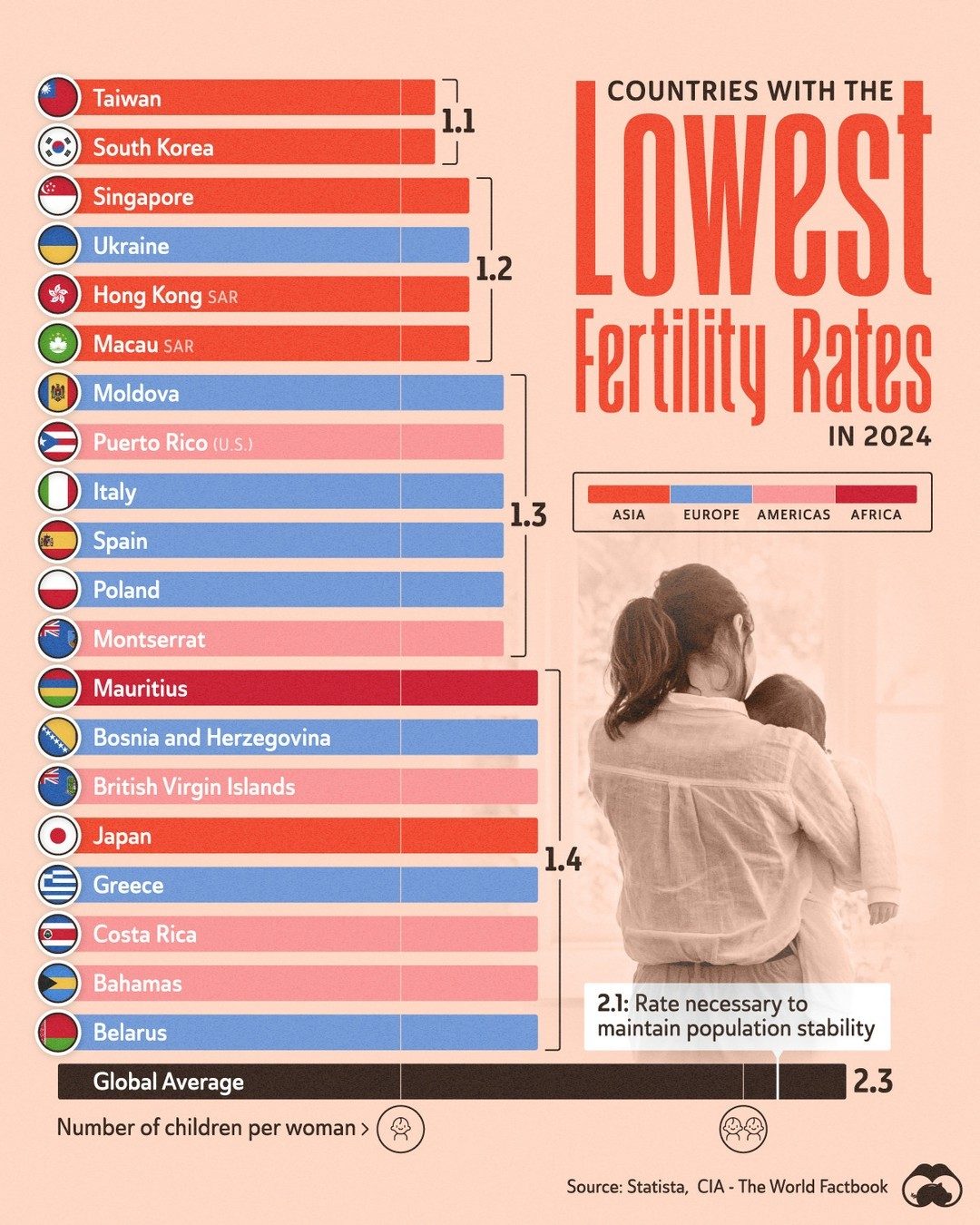
Fertility Rates in 2024: A Global Overview
Europe is home to several countries with fertility rates below the global average, which is 2.3 births per woman. These rates have significant implications, as the region is the only one projected to see an overall population decline in the near term. Understanding these trends is crucial for policy-making and societal planning.
Context / Why This Matters
Fertility rates are a key indicator of a country's population dynamics and future growth. A fertility rate of 2.1 births per woman is generally considered necessary to maintain population stability. Falling below this rate can lead to population decline over time, which has wide-ranging effects on a nation's economy, healthcare, and social services.
Main Discussion
Europe's Declining Fertility Rates
Europe is at the forefront of this demographic shift. Eight countries in Europe have fertility rates below the global average of 2.3 births per woman. This includes nations like Italy and Spain, which are experiencing some of the lowest fertility rates in the world. The decline in fertility rates poses significant challenges for these countries, as they face an aging population and reduced workforce.
Asia's Lowest Rates
Asia also has several countries with very low fertility rates. Taiwan and South Korea are notable examples, with their fertility rates significantly below the replacement level of 2.1. These countries are grappling with the consequences of a declining population, including labor shortages and increased pressure on pension systems.
The Americas and Africa
In the Americas, some countries are also experiencing lower fertility rates, although the trend is not as pronounced as in Europe and Asia. Africa, on the other hand, generally has higher fertility rates. However, even in Africa, there are variations, with some countries showing a decline in fertility rates as they develop economically.
The Impact of Low Fertility Rates
Declining fertility rates can lead to a shrinking population, which has several implications. Firstly, there is a reduction in the workforce, which can slow economic growth and strain social services. Secondly, an aging population increases the demand for healthcare and pension services, putting additional pressure on resources. Lastly, a smaller population can also lead to a decrease in innovation and entrepreneurship.
Practical Tips for Policy Makers
Encourage Family-Friendly Policies
Encouraging family-friendly policies is one way to address declining fertility rates. These policies can include generous parental leave, flexible working hours, and affordable childcare. Such measures can make it easier for individuals to balance work and family life, potentially encouraging them to have more children.
Invest in Healthcare and Education
Investing in healthcare and education can also have a positive impact on fertility rates. Access to quality healthcare ensures that children are born and raised in a healthy environment. Education, particularly for women, can empower individuals and lead to more informed decisions about family planning.
Promote Economic Growth
Promoting economic growth can create a more stable and secure environment for families. Economic stability can reduce financial stressors and make individuals more likely to consider having children. Policies aimed at boosting job creation, improving wages, and reducing inequality can all contribute to a more favorable economic climate.
Important Takeaways
The trends in fertility rates around the world highlight the need for proactive policy-making. Countries with declining fertility rates must address the challenges they face in order to maintain economic stability and social cohesion. By implementing family-friendly policies, investing in healthcare and education, and promoting economic growth, nations can mitigate the negative impacts of low fertility rates.
Conclusion
Fertility rates are a critical aspect of a country's demographic landscape, with significant implications for its future. As Europe and other regions grapple with declining fertility rates, it is essential to understand the underlying causes and take proactive measures to address the challenges. By doing so, countries can ensure a sustainable future for their populations and economies.
Watch the Reel
Questions readers ask
What are the lowest fertility rates in 2024?
The lowest fertility rates in 2024 are found in several countries, primarily in Europe and Asia. These countries have fertility rates well below the global average of 2.3 births per woman. For specific rates, referring to sources like the CIA World Factbook can provide up-to-date figures.
Which countries are facing population decline in 2024?
European countries are expected to experience an overall population decline, as they have some of the lowest fertility rates in 2024. Asian countries are also experiencing significant population decline challenges due to low fertility rates.
Why is a fertility rate of 2.1 births per woman considered important?
A fertility rate of 2.1 births per woman is generally considered the replacement rate, which means that each generation is replacing itself. Falling below this rate can lead to long-term population decline, impacting a nation's economy, healthcare, and social services.
What are the implications of population decline in Europe and Asia?
Population decline in Europe and Asia can lead to labor shortages, strain on social services, and challenges in maintaining economic growth. These demographic shifts require careful policy-making and societal planning to address the resulting issues.
Recent articles
Fresh deep dives from the latest Reels we unpacked.




Comments
Be the first to comment.