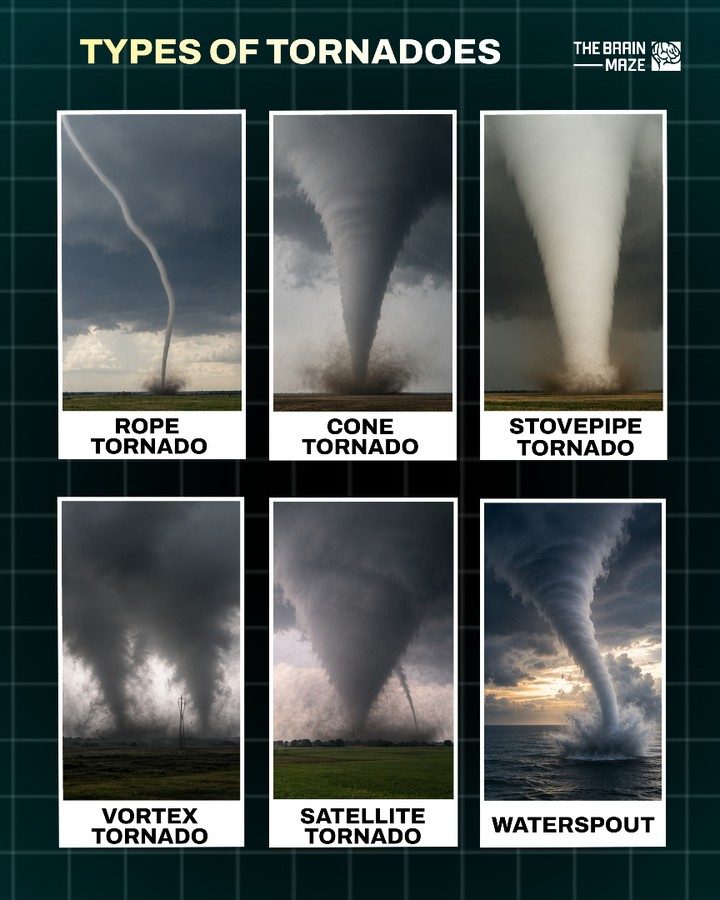
Tornadoes come in several shapes and sizes
Tornadoes, powerful and destructive weather phenomena, can take on a variety of shapes and sizes. Understanding these different forms is crucial for recognizing the varied ways in which tornadoes can impact the environment. Each type of tornado has unique characteristics that set it apart from the others. Let's explore the six main types of tornadoes: rope, cone, stovepipe, vortex, satellite, and waterspouts.
Why this matters
Knowing the different types of tornadoes can help in identifying potential hazards and responding appropriately during severe weather events. Each type of tornado has distinct features that can affect its behavior and impact. By recognizing these differences, individuals can better prepare and stay safe.
Rope tornadoes
Rope tornadoes are characterized by their long, thin, and rope-like appearance. They typically have a narrow funnel cloud that extends from the base of a thunderstorm to the ground. These tornadoes are often associated with weaker tornadoes on the Enhanced Fujita (EF) scale, usually rated as EF-0 or EF-1. Despite their relatively small size, rope tornadoes can still cause damage, especially to trees and smaller structures.
Cone tornadoes
Cone tornadoes have a classic funnel shape that tapers toward the ground. These tornadoes are wider at the top and narrower at the base, resembling a cone. Cone tornadoes can vary in intensity and are often classified as EF-1 to EF-3 on the EF scale. The wider funnel can make them more visible from a distance, providing more time for people to seek shelter.
Stovepipe tornadoes
Stovepipe tornadoes are known for their tall, cylindrical shape. They appear very powerful and are often wider than rope or cone tornadoes. These tornadoes are typically associated with stronger winds and can cause significant damage. Stovepipe tornadoes are usually classified as EF-2 to EF-5, making them particularly dangerous. Their robust structure can cause extensive destruction to buildings and infrastructure.
Vortex tornadoes
Vortex tornadoes are characterized by a swirling motion that is often more pronounced than in other types. These tornadoes can have a wide range of shapes, from narrow to wide, and their swirling motion can make them appear more chaotic. Vortex tornadoes can vary in intensity and are often classified as EF-1 to EF-4. The swirling motion can cause debris to be thrown in all directions, increasing the risk of injury and damage.
Satellite tornadoes
Satellite tornadoes are unique because they form near a larger, parent tornado. These smaller tornadoes orbit around the main tornado, creating a complex and dangerous weather system. Satellite tornadoes can be difficult to predict and are often classified as EF-0 to EF-2. Their proximity to the parent tornado can make the overall weather event more hazardous, as they can cause additional damage and confusion.
Waterspouts
Waterspouts are tornadoes that form over water. They can be as dangerous as land-based tornadoes, especially to boats and coastal areas. Waterspouts can take on various shapes, including rope, cone, and stovepipe forms, and are often classified as EF-0 to EF-2. While they typically dissipate when they reach land, they can still cause significant damage to marine vessels and coastal structures.
Practical tips
When encountering any type of tornado, it's essential to prioritize safety. Here are some practical tips to keep in mind:
- Stay Informed: Keep an eye on weather forecasts and be aware of tornado warnings in your area.
- Seek Shelter: If a tornado is approaching, seek shelter immediately. The safest place is typically an underground shelter or a reinforced basement. If these are not available, go to the lowest level of a sturdy building and stay away from windows.
- Protect Yourself: Cover your head and neck with your arms or a sturdy object to protect against flying debris.
- Stay Calm: Staying calm and focused can help you make the best decisions during an emergency.
Important takeaways
- Tornadoes come in various shapes and sizes, each with unique characteristics.
- Rope, cone, and stovepipe tornadoes are visually distinct and can vary in intensity.
- Vortex tornadoes are characterized by a swirling motion, adding to their chaotic nature.
- Satellite tornadoes form near a larger, parent tornado, creating a more complex weather event.
- Waterspouts, while occurring over water, can still be dangerous to boats and coastal areas.
Conclusion
Understanding the different types of tornadoes is essential for recognizing potential hazards and responding appropriately during severe weather events. By being aware of the unique features of each type, individuals can better prepare and stay safe. Whether it's a rope, cone, stovepipe, vortex, satellite, or waterspout, each type of tornado presents its own set of challenges and dangers. Stay informed, seek shelter when necessary, and prioritize safety to protect yourself and your loved ones.
Watch the Reel
Questions readers ask
What are the six main types of tornadoes?
The six main types of tornadoes are rope, cone, stovepipe, vortex, satellite, and waterspouts. Each type has unique characteristics that differentiate them from one another, including size, shape, and potential impact.
How do rope tornadoes differ from other types?
Rope tornadoes are characterized by their narrow, rope-like appearance. They are typically the smallest and least destructive type of tornado, often forming at the end of a tornado's lifecycle or as a result of a larger tornado splitting into smaller vortices.
What is a stovepipe tornado and why is it significant?
A stovepipe tornado is wide and cylindrical, resembling a stovepipe. These tornadoes are significant due to their large size and potential for causing substantial damage. They are often associated with powerful storms and can be particularly destructive.
What are vortex tornadoes, and how do they form?
Vortex tornadoes are defined by their rapidly rotating column of air, which can be visible as a funnel cloud. They form when warm, moist air meets cool, dry air, creating instability in the atmosphere. This type of tornado can vary greatly in size and intensity.
What are satellite tornadoes, and how do they form?
Satellite tornadoes are smaller tornadoes that form in the vicinity of a larger, primary tornado. They often appear to orbit the main vortex, contributing to the overall damage and impact of the storm. Satellite tornadoes are relatively rare and can be challenging to predict.
What are waterspout tornadoes, and how do they form?
Waterspouts are tornadoes that form over bodies of water. They are similar to land-based tornadoes but can be less intense. Waterspouts can occur when water vapor condenses in the air, forming a funnel cloud that extends from the water surface to a storm cloud.
What are the key tornado warning signs to look out for?
Key warning signs include a dark, often greenish sky, large hail without rain, a loud roar similar to a freight train, and a visible rotating funnel cloud. Recognizing these signs can help individuals take immediate action to ensure their safety during severe weather events.
Related deep dives
Similar reads based on topic and creator.

Recent articles
Fresh deep dives from the latest Reels we unpacked.




Comments
Be the first to comment.