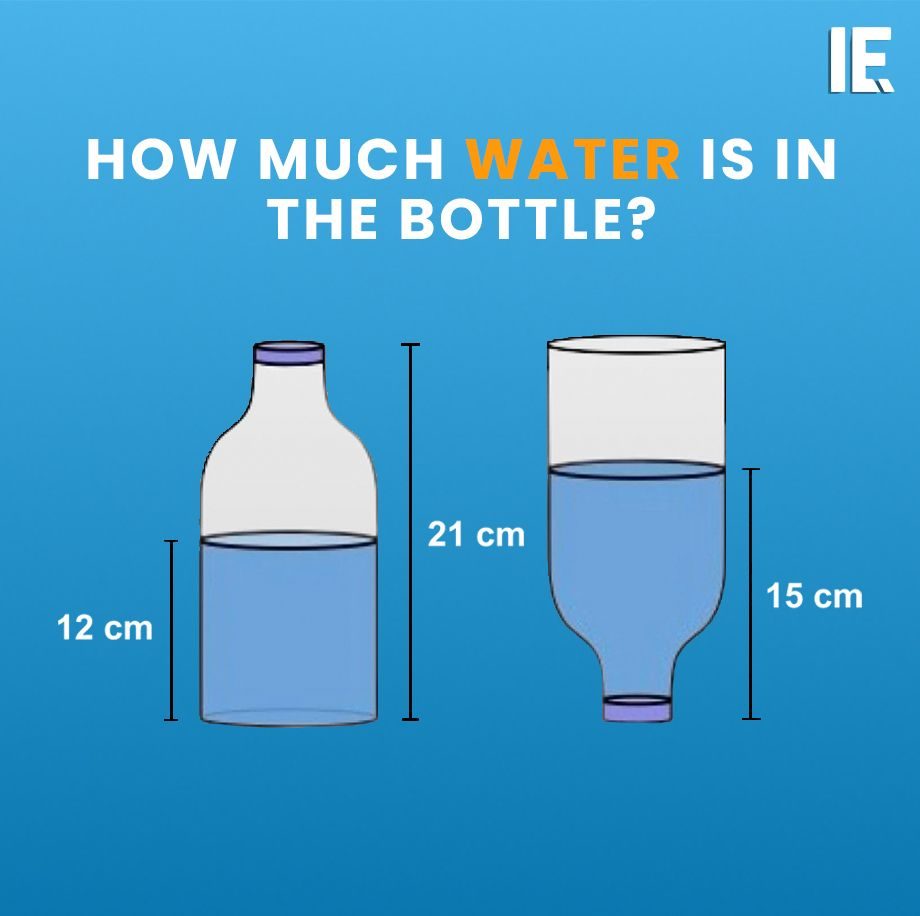
Bottle Water Volume Calculation: A Step-by-Step Guide
Ever wondered how to calculate the exact amount of water in a bottle? This guide will walk you through the process of determining the water volume in a bottle, using the heights provided. This method is useful for understanding how much water you can carry or use in various situations.
Context / Why This Matters
Accurately measuring the volume of water in a bottle is important for many reasons. Whether you're a hiker planning a long trek, a scientist conducting an experiment, or simply curious about your daily water intake, knowing how to calculate water volume can be incredibly useful. This method can be applied to various types of bottles, regardless of their shape or size.
Main discussion
Understanding Volume in Bottles
The volume of water in a bottle depends on the bottle's capacity and the height of the water level. To calculate the volume, you need to know the bottle's total height and the height of the water inside. This method assumes the bottle has a consistent cross-sectional shape.
Bottle Dimensions and Measurements
Bottle 1
- Total Height (H): 21 cm
- Water Height (h): 12 cm
Bottle 2
- Total Height (H): 15 cm
- Water Height (h): 12 cm
Calculating the Volume
Step 1: Determine the Proportion of Water in the Bottle
First, find the proportion of the bottle that is filled with water. This is done by dividing the water height (h) by the total height (H) of the bottle.
For Bottle 1: [ \text{Proportion}_1 = \frac{h}{H} = \frac{12 \text{ cm}}{21 \text{ cm}} \approx 0.5714 ]
For Bottle 2: [ \text{Proportion}_2 = \frac{h}{H} = \frac{12 \text{ cm}}{15 \text{ cm}} = 0.8 ]
Step 2: Calculate the Volume
With the proportion of water in the bottle, you can calculate the volume. This requires knowing the total volume capacity of the bottle. However, for simplicity, let's assume both bottles have the same volume capacity, which can be calculated by the formula for the volume of a cylinder.
Volume of a Cylinder: [ V = \pi r^2 h ]
Assuming both bottles have the same base radius and height, the total volume (V_total) can be approximated.
Bottle 1 Volume: [ V_1 = \text{Proportion}1 \times V{\text{total}} \approx 0.5714 \times V_{\text{total}} ]
Bottle 2 Volume: [ V_2 = \text{Proportion}2 \times V{\text{total}} \approx 0.8 \times V_{\text{total}} ]
Use the proportion to calculate the exact volume of water in each bottle. The steps are simplified here for clarity. The actual calculation may require specific measurements of the bottle's shape and dimensions.
Practical Tips
Ensure Accuracy
- Measure Precisely: Always use a precise measuring tool to get the exact height of the water and the bottle.
- Consistent Units: Use the same units for all measurements (e.g., centimeters).
- Check Bottle Shape: Ensure the bottle has a consistent cross-sectional shape for accurate volume calculations.
Simplify the Process
- Use a Calculator: For more complex shapes, a calculator or software can help with volume calculations.
- Pre-Marked Levels: Some bottles come with pre-marked levels for easier volume estimation. Look for these markings or create your own by filling the bottle with known volumes.
Important Takeaways
- Understanding Proportions: The proportion of water in the bottle is crucial for volume calculation.
- Consistent Shape: The method works best with bottles that have a consistent cross-sectional shape.
- Practical Application: This method can be used in various scenarios, from daily life to scientific experiments.
- Accurate Measurements: Precision in measurements leads to accurate volume calculations.
Conclusion
Calculating the volume of water in a bottle is a straightforward process once you understand the basic principles. By knowing the total height of the bottle and the height of the water inside, you can determine the volume with ease. This method is not only practical for everyday use but also valuable for scientific and experimental purposes.
Watch the Reel
Questions readers ask
How can I determine the volume of water in a bottle without any special tools?
To measure the volume of water in a bottle using simple tools, you can use a ruler or measuring tape to determine the height of the water level. Then, you can use a formula that takes into account the bottle's dimensions and the water's height.
What formula should I use to calculate the volume of water in a cylindrical bottle?
For a cylindrical bottle, you can use the formula V = πr²h, where 'r' is the radius of the base of the cylinder, and 'h' is the height of the water. First, measure the diameter, divide by 2 to get the radius, then plug it into the formula with the water height to get the volume.
Can this method be applied to non-cylindrical bottles, like sports bottles or wider-mouthed containers?
Yes, this method can be adapted for non-cylindrical bottles. You will need to measure the dimensions of the bottle at various heights and create a profile of bottle. Then calculate the volume at each segment and sum them up to get the total volume of water in the bottle.
Why is it important for hikers to know how to measure water in a bottle?
For hikers, knowing how to measure water in a bottle is crucial for planning and safety. It helps in determining how much water to carry for a trek, ensuring hydration, and avoiding the risk of dehydration. It also aids in monitoring water intake during the hike.
How can this method be beneficial for scientific experiments?
Scientists can use this method to accurately measure water volumes in various containers, ensuring precise results in experiments. This is particularly useful in fields like chemistry or biology, where exact measurements are critical for reproducible, reliable and accurate results.
What should I do if my bottle has an irregular shape?
For irregularly shaped bottles, you can divide the bottle into smaller, more manageable sections, measure the dimensions of each section, and then calculate the volume for each section. Summing up the volumes of all sections will give you the total volume of water in the bottle.
How can I track my daily water intake using this method?
To track daily water intake, measure the volume of water in your bottle at the start and end of each day. Subtract the volume at the end from the volume at the start to determine how much water you have consumed. Repeat this process daily to monitor your water intake.
Related deep dives
Similar reads based on topic and creator.


Recent articles
Fresh deep dives from the latest Reels we unpacked.




Comments
Be the first to comment.