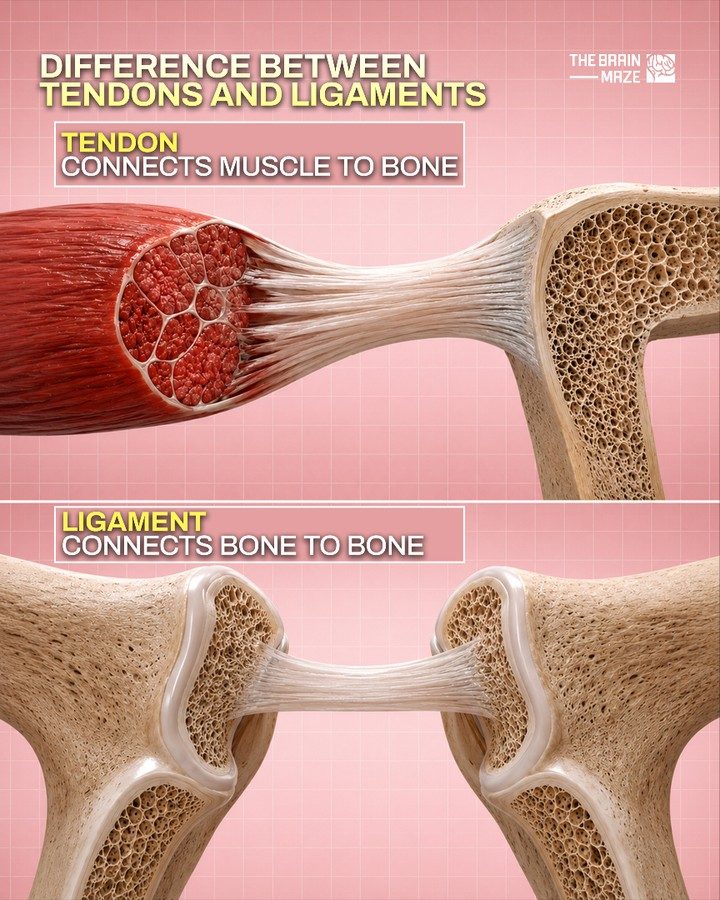
Tendon vs. Ligament
Tendons and ligaments are both crucial components of the human body, made primarily of collagen, and play vital roles in movement and stability. However, they serve distinct functions and have different structural properties.
Why This Matters
Understanding the differences between tendons and ligaments is essential for appreciating how the body moves and stabilizes itself. This knowledge is particularly useful for athletes, physical therapists, and anyone interested in anatomy and physiology. By grasping the unique roles and characteristics of these connective tissues, individuals can better prevent injuries, optimize performance, and maintain overall joint health.
Anatomy and Function
Tendons: Connecting Muscle to Bone
Tendons are strong, fibrous connective tissues that attach muscles to bones. Their primary function is to transmit the force generated by muscle contractions, enabling movement. Tendons are generally stiffer, which allows them to effectively convey the mechanical power from muscles to the skeletal system. This stiffness is crucial for actions that require precision and control, such as lifting weights or performing delicate tasks with the hands.
Key points about tendons:
- Location: Tendons are found at the ends of muscles, anchoring them to bones.
- Composition: They are primarily made of collagen fibers, which provide tensile strength.
- Function: Tendons transmit the force of muscle contractions to bones, facilitating movement.
Ligaments: Stabilizing Joints
Ligaments, on the other hand, connect bones to other bones, providing stability to joints while allowing for controlled motion. They are slightly more flexible than tendons, which helps prevent excessive joint movement and potential injury. This flexibility is essential for activities that involve a range of motion, such as running, jumping, or dancing. Ligaments work in conjunction with other structures, like cartilage and synovial fluid, to maintain joint integrity and mobility.
Key points about ligaments:
- Location: Ligaments are found around joints, connecting bones to each other.
- Composition: Like tendons, ligaments are primarily made of collagen fibers, but with a slightly different structure that allows for more flexibility.
- Function: Ligaments stabilize joints and control the range of motion, preventing hyperextension and dislocation.
Structural Differences
Collagen Content and Organization
Both tendons and ligaments are composed mainly of collagen, but the organization and type of collagen fibers differ. Tendons contain more parallel, densely packed collagen fibers, which contribute to their high tensile strength and stiffness. This structure is ideal for transmitting force from muscles to bones efficiently.
In contrast, ligaments have a more elongated and wavy arrangement of collagen fibers. This structure allows ligaments to stretch and recoil, providing the flexibility needed to stabilize joints and control movement. The specific arrangement of collagen fibers in ligaments also helps dissipate energy, reducing the risk of joint damage during impact.
Flexibility and Elasticity
Tendons are generally stiffer and less elastic than ligaments. This stiffness is essential for precise movements and the transfer of mechanical power. For example, when a weightlifter performs a bicep curl, the tendons in the arm efficiently transmit the force from the bicep muscle to the forearm, allowing for controlled lifting.
Ligaments, being slightly more flexible, can stretch to a certain extent and then return to their original shape. This property is crucial for joints that undergo a wide range of motion, such as the knee and shoulder. The ligaments in these joints allow for smooth, controlled movement while preventing excessive motion that could lead to injury.
Injury and Healing
Common Injuries
Tendon and ligament injuries are common among athletes and individuals who engage in physical activities. Understanding the types of injuries that can affect these tissues is important for prevention and effective treatment.
-
Tendon Injuries: Common tendon injuries include tendinitis (inflammation of the tendon) and tendon tears. Tendinitis often occurs due to overuse or repetitive strain, commonly affecting areas like the Achilles tendon, elbow (tennis elbow), and shoulder (rotator cuff tendinitis). Tendon tears can be partial or complete and are often caused by sudden, forceful movements or trauma. Surgical intervention may be necessary for severe tendon tears.
-
Ligament Injuries: Ligament injuries typically involve sprains, which occur when the ligament is stretched or torn. Sprains are graded based on their severity:
- Grade 1: Mild sprain with minor stretching and microscopic tearing of the ligament fibers.
- Grade 2: Moderate sprain with partial tearing of the ligament.
- Grade 3: Severe sprain with complete tearing of the ligament.
Sprains frequently affect the knees (ACL, MCL), ankles, and wrists. Treatment for ligament injuries often involves rest, ice, compression, and elevation (RICE), followed by physical therapy to restore strength and flexibility.
Healing and Rehabilitation
Healing times and rehabilitation protocols for tendon and ligament injuries can vary significantly. Proper treatment and rehabilitation are crucial for a full recovery and the prevention of future injuries.
-
Tendon Healing: Tendons have a limited blood supply, which can slow down the healing process. Rehabilitation for tendon injuries often focuses on controlled loading and progressive strengthening exercises. For example, eccentric exercises, where the muscle lengthens under load, have been shown to be effective in promoting tendon healing and improving tendon strength.
-
Ligament Healing: Ligaments generally have a better blood supply than tendons, which can facilitate faster healing. However, the healing process can still be slow. Rehabilitation for ligament injuries often involves a combination of rest, controlled motion, and gradual strengthening exercises. For severe ligament injuries, such as complete tears, surgical repair may be necessary, followed by an extensive rehabilitation program to regain joint stability and function.
Practical Tips for Maintaining Tendon and Ligament Health
Strength Training and Conditioning
Incorporating strength training and conditioning exercises into your routine can help maintain the health of your tendons and ligaments. Focus on exercises that target the muscles and joints involved in your chosen activities. For example, if you enjoy running, include exercises that strengthen your lower body and core, such as squats, lunges, and planks.
Proper Warm-Up and Cool-Down
Always include a proper warm-up and cool-down in your exercise routine. Warming up helps prepare your muscles, tendons, and ligaments for activity by increasing blood flow and flexibility. A cool-down helps reduce muscle soreness and promotes recovery by gradually lowering your heart rate and allowing your body to transition back to a resting state.
Cross-Training and Variety
Engaging in a variety of activities and cross-training can help prevent overuse injuries and maintain overall fitness. Incorporate exercises that target different muscle groups and joints, such as swimming, cycling, or yoga, to reduce the risk of tendon and ligament injuries.
Proper Form and Technique
Maintaining proper form and technique during physical activities is essential for preventing injuries. Incorrect movements can place excessive stress on your tendons and ligaments, leading to strain or injury. Consider working with a certified trainer or coach to learn the correct technique for your chosen activities.
Adequate Rest and Recovery
Adequate rest and recovery are crucial for maintaining the health of your tendons and ligaments. Allow your body time to recover between workouts, and listen to your body for signs of fatigue or overuse. Incorporating rest days into your routine can help prevent injuries and promote overall fitness.
Nutrition and Hydration
Proper nutrition and hydration play a vital role in supporting the health of your tendons and ligaments. Consuming a balanced diet rich in protein, vitamins, and minerals can help promote tissue repair and recovery. Staying hydrated is also essential, as it helps maintain the elasticity and flexibility of your connective tissues.
Important Takeaways
Understanding the differences between tendons and ligaments is essential for appreciating how the body moves and stabilizes itself. Tendons attach muscles to bones, transmitting the force of muscle contractions to produce movement, while ligaments connect bones to other bones, stabilizing joints and controlling motion.
Maintaining the health of your tendons and ligaments through proper exercise, rest, and nutrition is crucial for preventing injuries and optimizing performance. By incorporating strength training, proper warm-up and cool-down, cross-training, and adequate rest into your routine, you can support the health and functionality of these vital connective tissues.
Conclusion
Tendons and ligaments play distinct but equally important roles in the body's movement and stability. By understanding their unique functions and structural properties, you can better appreciate the complexity of the human body and take steps to maintain the health of these essential connective tissues.
Watch the Reel
Questions readers ask
What is the primary function of a tendon?
Tendons connect muscles to bones, allowing muscles to exert force and move the skeleton. They are crucial for precise and controlled movements, such as the finer motions in your fingers or the larger movements like running.
How do ligaments differ from tendons in terms of their role in the body?
Ligaments connect bones to bones, providing stability and flexibility to joints. Unlike tendons, which facilitate movement, ligaments help prevent excessive movement that could lead to injury, acting like strong, fibrous straps holding bones together.
Why are tendons and ligaments both made primarily of collagen?
Collagen is a robust protein that provides strength and flexibility. Tendons and ligaments need these properties to withstand the constant stress and tension placed on them during movement and to maintain the body's structural integrity.
Can tendons and ligaments heal naturally if injured?
Both tendons and ligaments have limited blood supply, which can slow down the healing process. While minor injuries can heal naturally with proper rest and rehabilitation, severe injuries may require medical intervention and physical therapy for a full recovery.
What are some common injuries related to tendons and ligaments?
Tendon injuries often include tendinitis (inflammation) and tendon ruptures. Ligament injuries commonly involve sprains, which can range from minor tears to complete ruptures, often occurring in joints like the knee and ankle.
How can understanding the difference between tendons and ligaments help in preventing injuries?
Knowing the roles and locations of tendons and ligaments can help individuals avoid movements that place excessive strain on these tissues. Proper warm-up, strengthening exercises, and awareness of your body's limits can enhance performance and reduce the risk of injuries.
Recent articles
Fresh deep dives from the latest Reels we unpacked.




Comments
Be the first to comment.