Latin America GDP: A Deep Dive into Economic Disparities
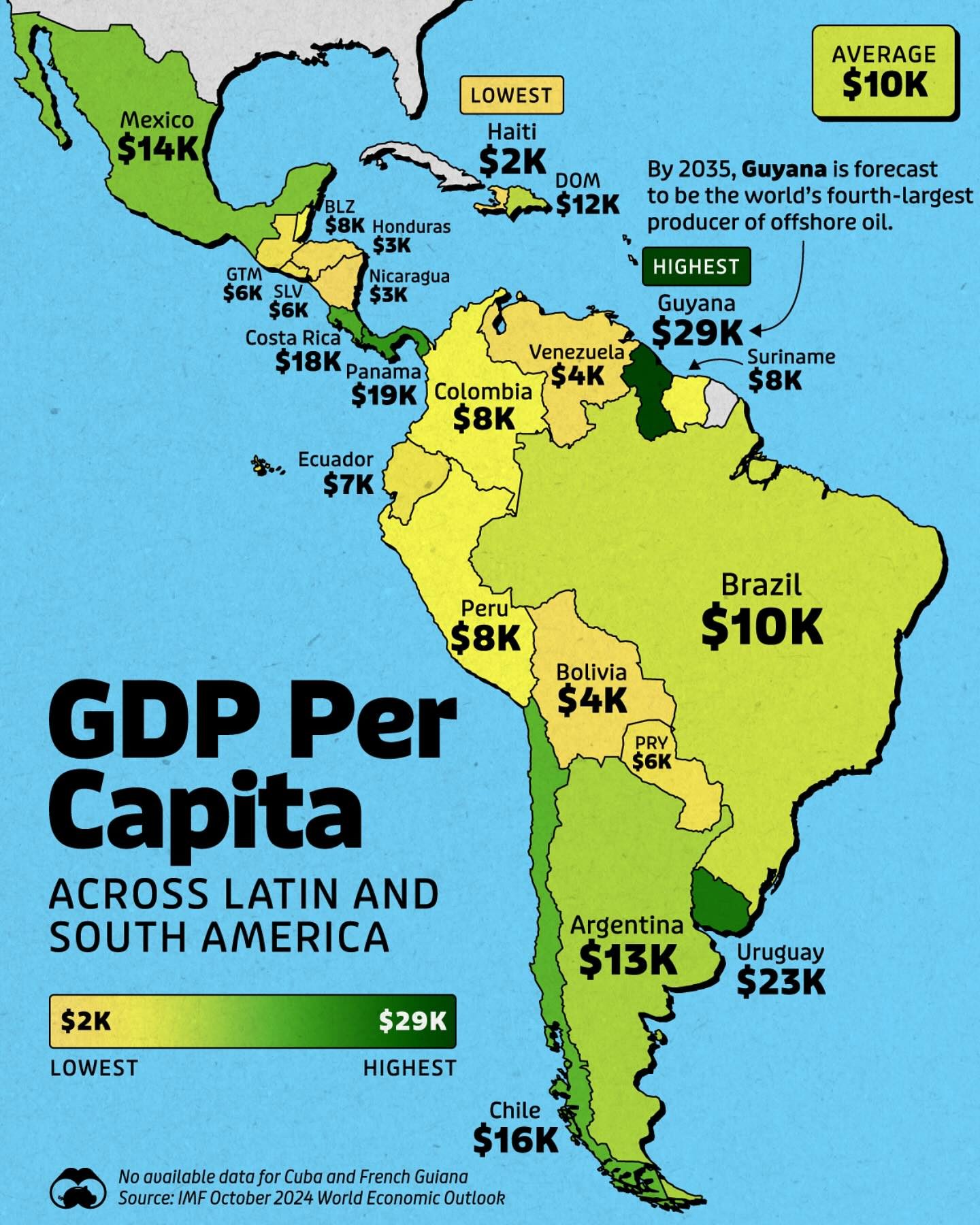
Gross Domestic Product (GDP) per capita is a critical metric for understanding the economic health and living standards of a country. In Latin and South America, the economic landscape is diverse, with significant disparities between nations. Guyana stands out with the highest GDP per capita in South America, reaching $28,920, largely due to its thriving oil industry. Conversely, Haiti, Nicaragua, and Honduras struggle at the other end of the spectrum with some of the lowest GDP per capita figures in the region. This variation in economic performance highlights the broader economic dynamics at play in the region.
Why This Matters
Understanding the economic disparities in Latin and South America is crucial for several reasons. Firstly, it provides insights into the living standards and economic opportunities available to residents in different countries. Secondly, it sheds light on the factors driving economic growth, such as natural resource exploitation and industrial development. Finally, it helps inform policy decisions aimed at promoting economic development and reducing poverty.
Economic Landscape of Latin and South America
Guyana's Rise to Prominence
Guyana's remarkable economic growth is largely attributable to its burgeoning oil industry. The country is forecast to become the world’s fourth-largest producer of offshore oil by 2035. This prediction underscores the transformative impact that the oil sector can have on a nation's economic trajectory. The oil industry has already boosted Guyana’s GDP per capita to $28,920, making it a standout performer in the region.
Venezuela: A Mixed Picture
Venezuela, once a leader in the region, has the highest GDP per capita at $29,000. However, the country faces significant economic instability and political turmoil. The high GDP per capita figure masks deep-seated economic issues, including inflation and economic mismanagement, which have led to widespread poverty and social unrest. Venezuela’s situation serves as a cautionary tale about the need for sustainable economic development beyond resource extraction.
The Struggle at the Bottom
On the opposite end, Haiti, Nicaragua, and Honduras grapple with the lowest GDP per capita figures in Latin America. Haiti's GDP per capita stands at a mere $2,000, reflecting the country's long-term struggles with political instability, natural disasters, and economic stagnation. Nicaragua and Honduras are not far behind, with GDP per capita figures of $6,000 and $3,000, respectively. These countries face significant challenges, including poverty, limited access to education and healthcare, and economic dependence on a few key sectors.
Key Factors Influencing GDP per Capita
Natural Resources and Industrial Development
Natural resources play a pivotal role in the economic performance of many Latin and South American countries. Venezuela and Guyana, for example, have benefited significantly from their oil industries. Guatemala, Ecuador, Peru, Colombia, Suriname, and Bolivia rely heavily on oil, gas, and mining. However, countries like Chile, which has diversified its economy through industrial development and innovation in industries like copper, lithium, and agriculture, have shown more stable economic growth.
Economic Policies and Governance
The effectiveness of economic policies and governance structures also significantly impacts a country’s GDP per capita. Countries with strong institutions, low corruption, and effective economic policies tend to perform better economically. For instance, Uruguay and Chile have implemented robust economic policies and governance structures, leading to higher GDP per capita figures compared to their regional peers.
Social and Political Stability
Social and political stability is critical for economic growth. Countries experiencing political unrest, social unrest, and civil conflicts often face economic stagnation. Venezuela and Haiti serve as prime examples of how political instability can derail economic progress, regardless of the natural resource wealth.
Foreign Investment and Trade
Foreign investment and trade are essential drivers of economic growth. Countries that attract significant foreign investment and engage in robust trade activities tend to have higher GDP per capita. Panama, with a GDP per capita of $18,000, benefits from its strategic location and role as a global trade and logistics hub. Bolivia, on the other hand, faces challenges in attracting foreign investment due to factors like political instability and economic policies.
Practical Tips for Economic Growth
Diversifying the Economy
A diverse economy is more resilient to external shocks and better equipped to sustain long-term growth. Countries like Chile and Costa Rica have successfully diversified their economies, reducing their reliance on a single sector and fostering innovation and sustainable growth. This approach helps mitigate the risks associated with natural resource dependence.
Promoting Education and Skills Development
Investment in education and skills development is crucial for economic growth and sustainability. A well-educated and skilled workforce can drive innovation, productivity, and competitiveness. Countries should prioritize education and training programs that align with the demands of the modern economy.
Enhancing Physical Infrastructure
Developing robust infrastructure, including transportation, energy, and digital infrastructure, is essential for economic growth. Infrastructure enhances productivity, facilitates trade, and attracts investment. Countries should focus on infrastructure development projects that support economic activities and improve the quality of life for their citizens.
Strengthening Governance and Institutions
Effective governance and institutions are vital for economic growth. Countries should work to strengthen their judicial systems, reduce corruption, and promote transparency and accountability. Strong institutions create a stable and predictable environment conducive to economic activity and investment.
Important Takeaways
Economic disparities in Latin and South America are significant, with some countries thriving while others struggle. Guyana’s success in the oil industry highlights the potential benefits of natural resource exploitation, while Venezuela's situation underscores the risks associated with relying heavily on a single sector. Haiti, Nicaragua, and Honduras face significant challenges, reflecting the broader economic issues in the region. Effective economic policies, governance, and investment in key sectors like education, infrastructure, and innovation are crucial for sustainable growth.
Conclusion
The economic landscape of Latin and South America is diverse and complex, reflecting a range of factors including natural resources, economic policies, governance, and social stability. Understanding these dynamics provides valuable insights into the economic challenges and opportunities in the region. By focusing on sustainable development, diversification, and effective governance, countries can work towards achieving long-term economic growth and improving the living standards of their populations.
Watch the Reel
Questions readers ask
What is the primary driver of Guyana's high GDP per capita in Latin America?
Guyana's high GDP per capita is primarily driven by its booming oil industry, which has significantly contributed to the country's economic growth, making it a standout performer in South America.
Which countries in Latin America have the lowest GDP per capita figures?
As of recent data, Haiti, Nicaragua, and Honduras have some of the lowest GDP per capita figures in Latin America, indicating significant economic challenges and lower standards of living compared to other countries in the region.
Why is it important to compare GDP per capita across different countries in Latin America?
Comparing GDP per capita across Latin America provides insights into the living standards and economic opportunities available to residents. This metric helps in understanding the economic disparities, identifying regions that may need support, and informing policy decisions to address these imbalances.
How does Guyana's GDP per capita compare to the rest of South America?
Guyana's GDP per capita is the highest in South America, reaching $28,920, largely due to its thriving oil industry. This places Guyana in a unique economic position compared to its neighbors, although it is still lower than some of the wealthiest countries in the entire Latin America region.
What factors contribute to the economic disparities in Latin America?
Economic disparities in Latin America are influenced by a variety of factors, including natural resource endowments, industry development, and economic policies. Guyana's recent economic success is tied to the growth of its oil industry, while countries like Haiti and Nicaragua face economic challenges stemming from political instability and lack of industrial development.
Where can I find the latest GDP per capita data for Latin America?
The most recent and reliable GDP per capita data for Latin America can be found through the International Monetary Fund (IMF) and other reputable sources. These organizations provide comprehensive data and analysis on economic indicators, including GDP per capita, for countries in the region.
Related deep dives
Similar reads based on topic and creator.

Recent articles
Fresh deep dives from the latest Reels we unpacked.




Comments
Be the first to comment.