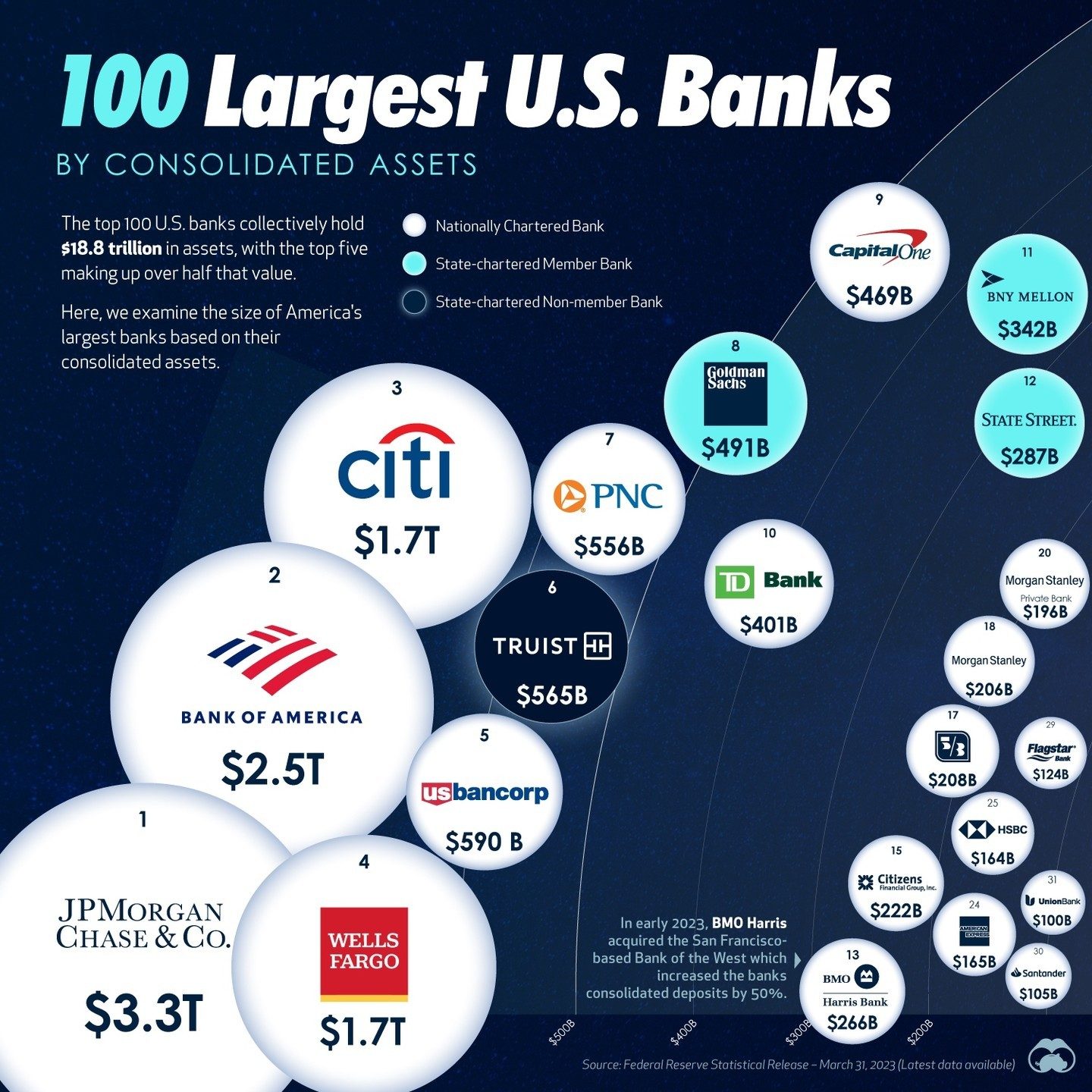
The Top 100 U.S. Banks by Consolidated Assets
The top 100 banks in the United States hold an astounding $18.8 trillion in consolidated assets. This massive figure underscores the significant role these financial institutions play in the nation's economy. Recent events, such as the collapses of medium-sized banks like Silicon Valley Bank and First Republic, have highlighted the importance of understanding the landscape of the banking industry. This visual ranking, sourced from data provided by the Federal Reserve, offers a clear view of the largest U.S. banks by their asset holdings.
Why This Matters
The financial stability and performance of the largest banks in the U.S. are crucial for the broader economy. These institutions are not only significant in terms of asset size but also in their influence on financial markets, lending practices, and economic policymaking. Understanding the distribution of assets among the top banks can provide insights into market concentration, risk management, and the potential impacts of financial shocks.
The Largest U.S. Banks
The Top Five
-
JPMorgan Chase & Co.
- Assets: $3.3 trillion
- Overview: As the largest bank in the U.S., JPMorgan Chase & Co. holds a substantial portion of the total assets. The bank's vast asset base reflects its extensive range of financial services, including investment banking, commercial banking, asset management, and more.
-
Bank of America
- Assets: $2.5 trillion
- Overview: Bank of America, with its diverse range of financial offerings, holds the second-largest asset base among U.S. banks. The bank's extensive branch network and broad customer base contribute to its significant asset holdings.
-
Citi
- Assets: $1.7 trillion
- Overview: Citi, known for its global presence, manages a substantial asset base. The bank's strength lies in its international operations and comprehensive range of financial services, including corporate and investment banking.
-
Wells Fargo
- Assets: $1.7 trillion
- Overview: Wells Fargo, with a significant focus on retail and commercial banking, holds a large asset base. The bank's extensive retail banking services and diversified customer base contribute to its financial strength.
-
US Bancorp
- Assets: $558.9 billion
- Overview: US Bancorp, known for its strong regional presence, holds a notable asset base. The bank's focus on community banking and customer service has contributed to its robust financial position.
The Next Tier
Following the top five, the next tier of banks includes financial giants such as Regions, Ally, and Truist. These banks, with asset holdings ranging from $200 billion to $1 trillion, play a pivotal role in the U.S. banking landscape. Key players in this category include:
- Regions: With a diverse range of financial services, Regions maintains a strong asset base. The bank's focus on customer service and community involvement has contributed to its financial stability.
- Ally: Known for its digital banking services, Ally has a significant online presence and a growing asset base. The bank’s innovative approach to financial services has attracted a large customer base.
- Truist: Formed from the merger of BB&T and SunTrust, Truist has a strong regional footprint and a robust asset base. The bank's comprehensive range of financial services benefits both individual and corporate clients.
Notable Mentions
The list of the top 100 banks includes many institutions that are well-known for their specific strengths and market niches:
- Goldman Sachs: With a focus on investment banking and asset management, Goldman Sachs holds a substantial asset base.
- Morgan Stanley: Similar to Goldman Sachs, Morgan Stanley specializes in investment banking and wealth management, contributing to its significant asset holdings.
- BNY Mellon: Known for its asset management and wealth management services, BNY Mellon has a strong asset base.
Practical Tips
Monitoring Financial Health
Understanding the financial health of the largest banks can be crucial for investors and consumers alike. Key metrics to monitor include:
- Asset Growth: Consistent asset growth can indicate a bank's financial stability and its ability to manage risks effectively.
- Liquidity Ratios: High liquidity ratios are a sign of a bank's ability to meet short-term obligations without relying on external funding.
- Non-Performing Loans (NPLs): A lower percentage of NPLs indicates better asset quality and risk management practices.
- Capital Adequacy Ratios: These ratios measure a bank's capital relative to its risk-weighted assets, providing insights into its financial stability and resilience.
Staying Informed
Keeping abreast of the latest developments in the banking sector can help individuals make informed decisions. Regularly reviewing financial news, regulatory updates, and industry reports can provide valuable insights into the performance and outlook of the largest U.S. banks.
Evaluating Bank Services
When choosing a bank, it's important to evaluate the range of services offered and the bank's reputation. Key factors to consider include:
- Service Offerings: Ensure the bank offers the financial services you need, such as checking and savings accounts, loans, and investment options.
- Customer Service: Assess the bank's customer service quality, including accessibility, responsiveness, and problem-resolution capabilities.
- Fees and Interest Rates: Compare fees and interest rates across different banks to find the best value for your financial needs.
- Digital Banking: Evaluate the bank's digital banking services, including online banking, mobile apps, and customer support.
Important Takeaways
- Market Dominance: The top five banks hold a significant portion of the total assets, underscoring their market dominance and influence.
- Diversity in Services: Banks vary in their service offerings, from traditional retail banking to specialized investment and corporate banking.
- Financial Stability: Monitoring key financial metrics can provide insights into a bank's stability and risk management practices.
- Regional vs. National: Some banks have a strong regional presence, while others operate on a national or global scale.
Conclusion
The ranking of the top 100 U.S. banks by consolidated assets provides a comprehensive view of the banking landscape in the United States. Understanding the distribution of assets, the performance of individual banks, and the broader context of the banking industry can offer valuable insights for investors, consumers, and policymakers. Whether you're evaluating a bank's financial health, choosing a financial institution, or staying informed about industry developments, this ranking serves as a crucial resource.
Watch the Reel
Questions readers ask
Why is it important to track the top 100 U.S. banks by assets?
Tracking the top 100 U.S. banks by assets is crucial because it provides insights into market concentration and financial stability. The consolidation of assets among the largest banks can significantly impact the broader economy, making it essential to monitor their financial health and performance.
Which bank currently holds the largest assets in the U.S.?
As of recent data, JPMorgan Chase holds the largest assets among U.S. banks. It is important to note that rankings can change based on acquisitions, mergers, and market fluctuations, so checking the most recent data from the Federal Reserve is advised.
How does the distribution of assets among the top 100 banks affect the economy?
The distribution of assets among the top 100 banks affects the economy by influencing market concentration. A high level of concentration can impact competition, risk management, and the overall stability of the financial system, making it a key factor to consider in economic analysis.
What role does the Federal Reserve play in providing data on U.S. bank assets?
The Federal Reserve is a primary source for data on U.S. bank assets. It compiles comprehensive information on the asset holdings of the top 100 banks, which is vital for understanding the financial landscape and making informed decisions about market trends and regulations.
How has the collapse of medium-sized banks like Silicon Valley Bank impacted the banking industry?
The collapse of medium-sized banks like Silicon Valley Bank has highlighted the importance of understanding the landscape of the banking industry, particularly the distribution of assets among larger institutions. It has sparked discussions about risk management, regulatory oversight, and the need for greater transparency in the banking sector.
What can I learn from the top 100 U.S. banks ranking provided by the Federal Reserve?
The ranking provides a clear view of the largest U.S. banks by their asset holdings, offering insights into market concentration and the financial health of these institutions. This information can help you understand the distribution of assets, identify trends, and assess the potential impact on the broader economy.
How often is the top 100 U.S. banks ranking updated?
The ranking of the top 100 U.S. banks by assets is typically updated on a quarterly basis by the Federal Reserve. This ensures that the data remains current and reflects the latest changes in the financial landscape, including shifts in asset holdings and market dynamics.
Recent articles
Fresh deep dives from the latest Reels we unpacked.




Comments
Be the first to comment.