Job Losses in 2025
The United States has seen a significant rise in job cuts through October 2025, with employers announcing a total of 1.1 million layoffs. This number marks a 65% increase from the previous year and is the highest since 2020. The reasons behind these job losses are multifaceted, influenced by a variety of economic factors and government initiatives. Let's delve into the key drivers behind these layoffs and understand the broader context.
Context / Why this Matters
Understanding the job losses in 2025 is crucial for grasping the current state of the U.S. economy and the potential impacts on the labor market. The Department of Government Efficiency (DOGE) and broader economic pressures have contributed significantly to these layoffs, with AI-related cuts playing a smaller but notable role. This analysis aims to provide a comprehensive overview of the situation, drawing on data from Challenger, Gray & Christmas, a leading authority on job cuts and economic trends.
Main Discussion
The Role of DOGE Actions
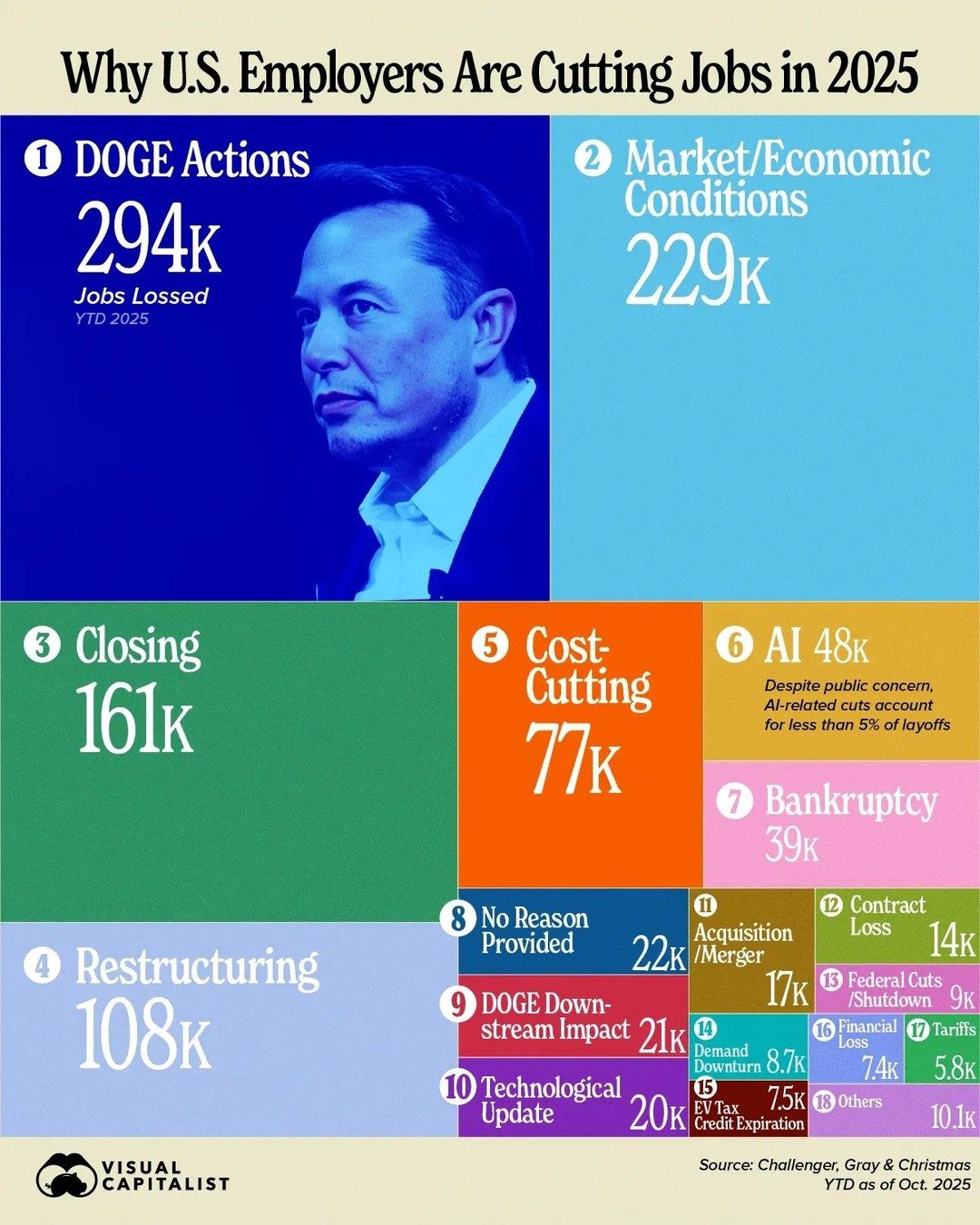
The Department of Government Efficiency (DOGE) has been a major factor in the job cuts, accounting for 294,000 layoffs. These actions are part of broader government initiatives aimed at streamlining operations and reducing costs. The Department of Government Efficiency (DOGE) has been actively involved in restructuring various government agencies and departments, resulting in significant job losses. These actions have far-reaching implications for the public sector and the broader economy, as many of these jobs are critical for maintaining essential services.
Economic Pressures and Market Conditions
Market and economic conditions have also played a significant role, with 229,000 job losses attributed to this category. Economic volatility and market fluctuations have forced many companies to downsize, leading to layoffs. The economic downturn has affected various sectors, including manufacturing, retail, and services, leading to widespread job losses. Additionally, the DOGE downturn has contributed to 21,000 job losses, further exacerbating the economic challenges.
Bankruptcy and Company Closures
Bankruptcy and company closures have contributed to 14,000 and 161,000 job losses, respectively. The financial distress faced by many businesses has forced them to shut down, resulting in significant job losses. Bankruptcy filings have increased, impacting sectors such as healthcare, retail, and hospitality. Company closures have been driven by a combination of factors, including reduced consumer demand, increased operating costs, and financial mismanagement.
Cost-Cutting and Technological Updates
Cost-cutting measures have resulted in 77,000 job losses, as companies strive to reduce expenses and improve profitability. Technological updates have also contributed to job losses, with 20,000 jobs lost in this category. Advancements in technology, such as automation and AI, have led to the elimination of jobs that are now automated. Companies are increasingly adopting new technologies to enhance efficiency and reduce operational costs, resulting in job losses for those in traditional roles.
Restructuring and AI-Related Cuts
Restructuring efforts have accounted for 108,000 job losses, as companies reorganize to better align with market demands. AI-related job cuts represent less than 5% of the total layoffs, with 48,000 jobs lost in this category. Despite public concern, AI-related job losses have been relatively limited, indicating that the technology is still in its early stages of adoption and implementation. However, as AI continues to evolve, its impact on the job market is expected to grow.
Other Factors
Other factors, such as acquisitions and mergers, federal cuts, and shutdowns, have also contributed to job losses. Acquisition and merger activities have resulted in 17,000 job losses, as companies integrate and streamline operations. Federal cuts and shutdowns have led to 9,000 and 7,400 job losses, respectively, reflecting the financial pressures faced by the government.
Practical Tips
To navigate the current job market landscape, consider the following practical tips:
- Diversify Your Skills: Develop a diverse set of skills that can be applied across different industries. This will make you more adaptable and better equipped to handle job market changes.
- Stay Informed: Keep up with the latest economic trends and industry developments. This will help you anticipate changes and better prepare for potential job losses.
- Network: Build and maintain a strong professional network. Networking can provide valuable insights, job opportunities, and support during challenging times.
- Upskill in Technology: Given the increasing role of technology in job losses, consider upskilling in areas such as AI and automation. This will make you more competitive in the job market and better equipped to adapt to technological changes.
- Explore Government Initiatives: Stay informed about government initiatives and programs aimed at supporting job seekers and providing retraining opportunities. These programs can offer valuable resources and support during a job transition.
Important Takeaways
- DOGE Actions and AI Cuts: DOGE actions and AI-related cuts have played significant but different roles in job losses, with DOGE actions being more impactful.
- Market Conditions: Economic pressures and market conditions remain major drivers of job losses, affecting various sectors.
- Industry-Specific Factors: Factors such as bankruptcy, restructuring, and technological updates have contributed significantly to job losses in specific industries.
- Preparation: Individuals and organizations must adapt and prepare for potential job losses by diversifying skills, staying informed, and upskilling in technology.
Conclusion
The job losses in 2025 reflect a complex interplay of economic pressures, government initiatives, and technological advancements. Understanding these factors is essential for individuals and organizations to navigate the current job market and prepare for future changes. By staying informed, diversifying skills, and leveraging available resources, individuals can better navigate the challenges of job loss and the evolving job market. As the economy continues to evolve, it is crucial to remain adaptable and proactive in addressing the changing landscape.
Watch the Reel
Questions readers ask
What are the main reasons behind the 1.1 million job losses in 2025?
The primary reasons behind the 1.1 million job losses in 2025 include government restructuring initiatives, broader economic pressures, and the implementation of new economic initiatives. These factors combined have led to a significant increase in layoffs compared to previous years.
How do government initiatives contribute to job losses in 2025?
Government initiatives, such as those from the Department of Government Efficiency, have led to restructuring and efficiency measures that result in job cuts. These initiatives aim to streamline operations, which often involves reducing the workforce.
What is the impact of economic pressures on job market trends in 2025?
Economic pressures, including market fluctuations, inflation, and changes in consumer spending, have a direct impact on job market trends. These pressures can lead employers to reduce their workforce, contributing to the high number of layoffs in 2025.
Which sectors are most affected by the job losses in 2025?
The job losses in 2025 are widespread, but sectors heavily reliant on public services and those undergoing significant technological changes, such as AI implementation, are particularly affected. These sectors face both government restructuring and the need to adapt to new technologies.
How do the 2025 job losses compare to previous years?
The 1.1 million job losses in 2025 represent a 65% increase from the previous year, marking the highest number of layoffs since 2020. This trend highlights the significant impact of current economic and governmental factors on the labor market.
What are the broader economic pressures contributing to job losses in 2025?
The broader economic pressures include inflation, changing market conditions, and shifts in consumer behavior. These factors create an uncertain economic environment, prompting employers to reassess their workforce needs and leading to increased layoffs.
How do announced layoffs in 2025 affect job security for employees?
The announced layoffs in 2025 have created heightened uncertainty and reduced job security for many employees. The significant increase in layoffs indicates that even traditionally stable sectors are experiencing cutbacks, making employees more vulnerable to job loss.
Recent articles
Fresh deep dives from the latest Reels we unpacked.




Comments
Be the first to comment.