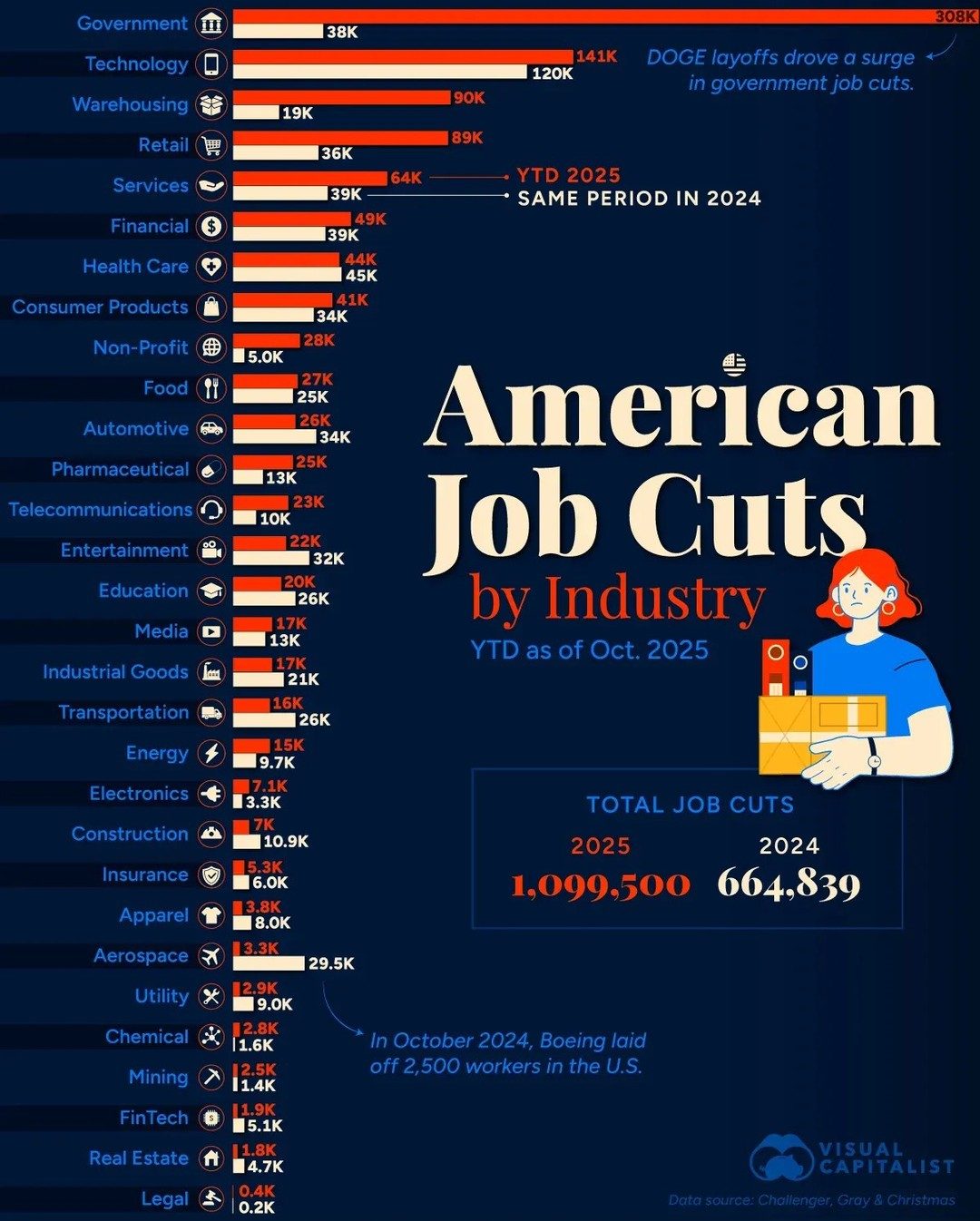
Job Cuts by Industry in 2025
In 2025, U.S. employers announced nearly 1.1 million job cuts through October, marking the highest total since 2020. This significant rise, a 65% increase from the previous year, was driven largely by reductions in government, tech, warehousing, and retail sectors. Meanwhile, industries such as aerospace, apparel, and transportation saw sharp declines in job cuts.
The rise in job cuts across various sectors is a reflection of broader economic shifts and sector-specific challenges. Government cuts, for instance, may be influenced by budget constraints and shifting policy priorities. The tech industry, known for its rapid growth and innovation, has seen significant layoffs, possibly due to market saturation, increased competition, or economic downturns. Retail, a sector highly sensitive to consumer spending, has also faced substantial job cuts, likely due to shifting consumer behavior and the rise of e-commerce.
Why This Matters
Understanding the landscape of job cuts by industry is crucial for several reasons. It provides insights into the health of different sectors, helps policymakers address economic challenges, and assists job seekers in making informed decisions. Industries with high layoffs might indicate sectors undergoing significant transitions, while those with fewer cuts could signal stability or growth. This information can guide investments, career choices, and policy interventions.
Main Discussion
Government
Government-sector job cuts have been substantial, likely driven by budget cuts, restructuring, or changes in policy. These cuts can impact public services, from healthcare to infrastructure, and have ripple effects across the economy. Workers in this sector often have specialized skills, and their displacement can lead to skill shortages in other areas.
Technology
The tech industry, often seen as a driver of economic growth and innovation, has also seen a significant number of layoffs. Factors contributing to this include market saturation, increased competition, and economic downturns. Companies may be downsizing to cut costs, reallocate resources, or adapt to changing market conditions.
Retail
The retail sector has seen a high number of job cuts, reflecting shifting consumer behavior and the rise of e-commerce. Traditional brick-and-mortar stores are facing increased competition from online retailers, leading to store closures and layoffs. This shift is also influenced by the changing preferences of consumers, who increasingly prefer the convenience and variety offered by online shopping.
Aerospace
The aerospace industry has experienced a decline in job cuts in 2025. This could be attributed to increased demand for aerospace products and services, driven by factors such as the growth of the aviation industry, defense spending, and space exploration. The sector's resilience and focus on innovation may have contributed to this positive trend.
Apparel
The apparel industry has also seen a decline in job cuts in 2025. This sector is known for its cyclical nature, with demand fluctuating based on fashion trends, economic conditions, and consumer spending. The decline in job cuts could indicate a period of stability or growth, possibly driven by new fashion trends, increased consumer spending, or successful business strategies.
Transportation
The transportation industry has experienced a decline in job cuts in 2025. This sector is vital for the movement of goods and people and is influenced by factors such as fuel prices, infrastructure development, and technological advancements. The decline in job cuts could be due to increased investment in infrastructure, innovations in logistics, or a stable demand for transportation services.
Practical Tips
For job seekers navigating this complex landscape, staying informed about industry trends is crucial. Consider the following tips to make informed career decisions:
Stay Informed
Regularly monitor industry reports and job market trends to stay updated on which sectors are experiencing growth or decline. This information can help in making informed decisions about career transitions or upskilling.
Upskill and Reskill
Invest in continuous learning and skill development. Acquiring new skills or enhancing existing ones can make you more competitive in the job market, especially in sectors undergoing significant changes.
Diversify Your Skill Set
Having a diverse skill set can make you more adaptable to changing job market conditions. Consider learning transferable skills that can be applied across different industries.
Network
Building a strong professional network can provide valuable insights and support when navigating job transitions. Attend industry conferences, join professional organizations, and leverage online networking platforms to expand your connections.
Seek Support
Government programs, industry-specific resources, and community support services can offer valuable assistance during times of unemployment or career transition. Explore available resources and seek support when needed.
Important Takeaways
Data from Challenger, Gray & Christmas reveals that job cuts are not evenly distributed across all sectors. Understanding the specific challenges faced by different industries can provide valuable insights for job seekers, policymakers, and businesses.
By staying informed about industry trends, continuously developing skills, and building a strong professional network, job seekers can navigate the complexities of the job market more effectively. Policymakers can use this information to formulate strategies aimed at mitigating the impact of job cuts and supporting affected workers, while businesses can adapt their strategies to remain competitive in a rapidly changing economic landscape.
Conclusion
The U.S. job market in 2025 is characterized by significant job cuts, with some sectors experiencing more layoffs than others. By understanding the landscape of these job cuts, individuals, businesses, and policymakers can make informed decisions to navigate these challenges. Staying informed, continuously developing skills, and seeking support can help job seekers thrive in a rapidly changing job market.
Watch the Reel
Questions readers ask
Which industries were most affected by job cuts in 2025?
The most affected industries in 2025 were government, tech, warehousing, and retail. These sectors experienced the most significant number of job cuts, with the tech industry in particular seeing substantial layoffs. Government job cuts are likely due to budget constraints. The rise in tech layoffs can be attributed to market saturation and increased competition, and the retail sector is likely suffering from shifts in consumer spending and online shopping trends. The warehousing sector is also affected by the slowdown in online retail.
How many job cuts were announced in the U.S. by October 2025?
Through October 2025, U.S. employers announced nearly 1.1 million job cuts. This number represents a 65% increase from the previous year, making it the highest total since 2020.
Why did job cuts surge in 2025?
The surge in job cuts in 2025 can be attributed to broader economic shifts and sector-specific challenges. These include budget constraints and policy changes in the government sector, market saturation and increased competition in the tech industry, changes in consumer behavior in retail, and a slowdown in online retail for the warehousing sector.
Which industries saw a decrease in job cuts in 2025?
Despite the overall increase in job cuts, some industries, such as aerospace, apparel, and transportation, saw sharp declines in job cuts. These changes may be attributed to sector-specific recovery, increased demand, or other positive shifts within these industries.
How do the 2025 job cuts compare to previous years?
The 2025 job cuts marked a 65% increase from the previous year, with nearly 1.1 million job cuts announced by October. This is the highest number of job cuts since 2020, highlighting a significant shift in the job market compared to recent years.
What insights can be gained from the 2025 job cut data?
The 2025 job cut data offers valuable insights into the health of different industries, guiding policy, investment, and career decisions. By analyzing which sectors are most affected, stakeholders can make informed choices about where to allocate resources, invest, or pursue career opportunities.
Recent articles
Fresh deep dives from the latest Reels we unpacked.




Comments
Be the first to comment.